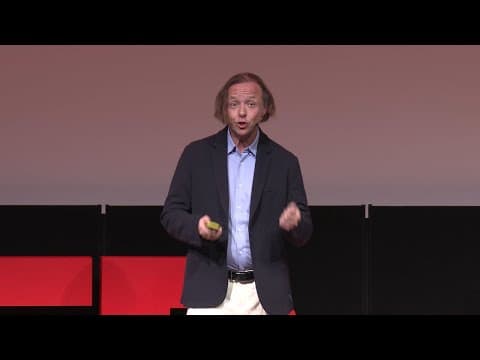
How we tackle the climate crisis | Chris Caldwell | TEDxLondonBusinessSchool
Audio Summary
AI Summary
The speaker shares a personal anecdote about realizing they were living the "wrong life" as an investment banker. During a demanding deal, their colleague Allison missed her daughter's important farewell dinner as she was immigrating to New Zealand. This event prompted the speaker to question their own priorities, realizing that work had consistently come before family, and promptly resigned.
This led to a re-evaluation of success metrics. The speaker uses a football analogy to illustrate how focusing on secondary measures like passes completed or distance run, while neglecting the primary goal of scoring, leads to a flawed system. They argue that modern civilization operates similarly, prioritizing growth, efficiency, and throughput above all else, leading to detrimental environmental consequences.
While acknowledging the benefits of this progress, such as increased life expectancy and poverty reduction, the speaker highlights the hidden costs, particularly the unfettered use of fossil fuels. They contend that climate change isn't a moral failing but a design flaw in a system that rewards cheap energy and fast growth without accounting for environmental damage. The speaker emphasizes that our current model of progress, driven by extraction and consumption, is unsustainable and effectively steals from future generations.
The speaker then shifts to their work in renewable energy, starting with establishing wind turbines in Northern Ireland. They faced significant systemic resistance but persevered, ultimately changing what counted as success for the region and leading to widespread renewable energy adoption. They recount a similar challenge in Barbados, where hurricanes threatened wind turbine projects. Instead of walking away, they redesigned the system to be resilient, developing foldable turbines and rapid reinstatement plans, proving that by changing what is valued, different solutions emerge.
The speaker draws a parallel to the phasing out of chlorofluorocarbons (CFCs) due to ozone depletion, demonstrating that global cooperation and regulatory changes can address environmental threats. They argue that a similar approach is needed for carbon emissions, advocating for a system that stops treating pollution as free, stops valuing fragility as efficiency, and rewards long-term cost reduction.
Clean energy, efficient buildings, and sustainable infrastructure are presented as solutions that reduce long-term costs and offer stability, unlike systems that collapse under pressure. The speaker concludes by asserting that systems respond to what is rewarded, not what is hoped for. They emphasize that we are the first generation to fully understand the implications of atmospheric chemistry, global capital, and energy systems, and the last with the opportunity to act. By changing the rules, investment and innovation will follow, leading to a future where people can truly thrive, built on clean energy, resilient systems, and lasting prosperity.