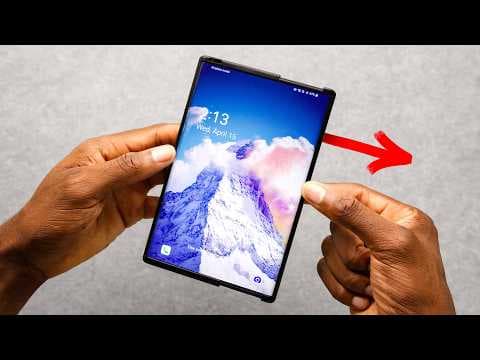
The Unreleased Rollable Smartphone!
Audio Summary
AI Summary
LG, known for its innovative yet commercially unsuccessful phones, was on the brink of collapse but had one last groundbreaking device in development: a rollable smartphone. This device, which never saw a public release, is now available for review, showcasing LG's most ambitious design.
Prior to their closure, LG released the LG Velvet and the LG Wing. The Wing was particularly notable for its unique design, featuring a main screen that swiveled horizontally to reveal a smaller, square display underneath, creating a T-shaped viewing experience. This required significant engineering and software innovation to ensure functionality and a seamless user experience. Before that, LG also produced the G8X, which aimed to offer a dual-screen experience similar to early folding phones but at a lower cost. It achieved this with a case that incorporated a second display, a 180-degree hinge, and magnetic charging adapters for convenience. Despite these inventive designs, LG failed to establish a consistent, profitable smartphone line, leading to the shutdown of its mobile division in 2021. This was around the same time rumors of a rollable smartphone from LG began circulating, two years after they debuted a rollable TV at CES.
Now, in 2026, the unreleased LG rollable phone has surfaced. When closed, it appears as a standard slab phone with a 6.7-inch display that curves over both edges, similar to older Samsung models. However, with a three-finger swipe gesture, the phone expands, rolling open to transform into a 7.4-inch mini-tablet with a slightly more square aspect ratio. This expansion and retraction motion is accompanied by a distinct sound effect, which LG likely intended to mask the internal motor noises.
The rollable concept offers a potential alternative to foldable phones, providing a larger screen without a visible crease. The "extra" screen material is cleverly hidden within the device. When the phone is in its compact state, the additional display segment is tucked behind a rail on the right side. Flipping the phone over reveals the display curving around the back, visible through a clear glass panel. This rear portion of the screen can be activated for various functions, such as displaying notifications or serving as a camera interface for taking selfies with the primary cameras. The phone features a 64-megapixel main camera and a 12-megapixel ultrawide lens. This design element somewhat resembles the Xiaomi Mi Mix Alpha, a concept phone that also featured an all-screen design wrapping around the device.
Due to the unique design and the space occupied by the rolling mechanism, the phone lacks traditional physical buttons on its sides. The volume controls are pressure-sensitive areas on the left side, while the power button, which doubles as a fingerprint reader, is located on the back, beneath the cameras. LG put considerable effort into the software experience, creating engaging animations for the lock screen and settings app that adapt to the phone's expanded or retracted state. For instance, the lock screen displays a blooming flower animation when expanding and retracts to a single petal when closing. The settings app also smoothly adds or removes a column of information as the screen size changes. These details suggest that LG was quite far along in the development process.
Several other notable observations include the surprising strength of the internal motors, capable of pushing a 16-inch MacBook Pro across a table, yet also designed to automatically close if squeezed too hard to prevent damage. While the device can pinch small items like microfiber cloths, fingers are generally too large to get caught. However, the open design, with visible gear teeth and air gaps, suggests that the phone would likely not have been water or dust resistant. The flexible display, constantly exposed, would also raise durability concerns compared to modern folding phones that protect their screens when closed.
Users can customize the sound effects that play during the unrolling process, or even turn them off completely, revealing the underlying motor sounds. Although the rollable design aims to minimize creases, a slight "wavering" or subtle curve is still visible on the display, especially when the screen is off, due to the larger rolling radius compared to a tight fold. Internal specifications include a 4500 mAh battery and 12 GB of RAM. The internal engineering, as demonstrated in tear-down videos, reveals a complex system involving two motors and three spring-loaded arms working in tandem to facilitate the rolling action.
Despite its advanced stage of development and functional hardware and software, the LG rollable phone never made it to market due to the company's mobile division closure. While LG was seemingly the only company pushing such a design, there are still rumors that Samsung might be exploring a similar rollable smartphone concept in the future.