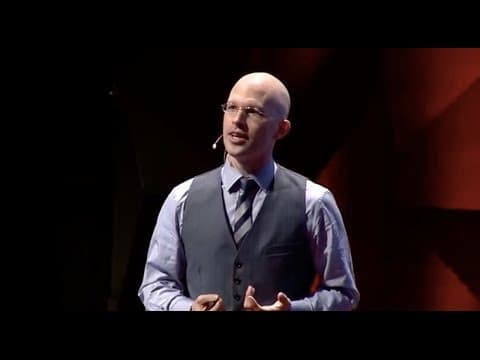
The first 20 hours -- how to learn anything | Josh Kaufman | TEDxCSU
Audio Summary
AI Summary
Two years ago, the speaker's life changed with the birth of his daughter, Lela. Becoming a parent is an amazing, life-altering experience that shifts priorities overnight. Alongside the joys, there's a tremendous amount to learn, even simple things like dressing a child, which the speaker humorously admits he struggled with initially. Both he and his wife, Kelsey, are entrepreneurs who work from home, running their own businesses. Kelsey creates online courses for yoga teachers, while the speaker is an author. With an infant and two demanding careers, life became incredibly busy. Around eight weeks postpartum, sleep deprivation fully kicked in, leading to a common parental thought: "I am never going to have free time ever again."
This thought was particularly concerning for the speaker, as he deeply enjoys learning new things, delving into subjects, and mastering them through trial and error. The perceived lack of free time threatened this passion. As a self-proclaimed "geek," he decided to research how people learn, and more specifically, how to learn quickly. He consulted library books and websites, seeking to answer the question: "How long does it take to acquire a new skill?"
His research repeatedly pointed to "10,000 hours." This figure, which many people have heard, suggests that becoming proficient at something requires a full-time job's worth of effort for five years. This realization was disheartening, as he felt he didn't have that kind of time. However, he quickly realized this couldn't be entirely true, as people frequently learn new things in far less time.
The discrepancy, he discovered, lies in the origin of the 10,000-hour rule. It stems from studies of expert-level performance conducted by Professor K. Anders Ericsson at Florida State University. Ericsson studied professional athletes, world-class musicians, and chess grandmasters – individuals in ultra-competitive, high-performing fields – to determine the time required to reach the pinnacle of those domains. He found that those at the very top accumulated around 10,000 hours of deliberate practice.
The speaker explains that the 10,000-hour rule became widely popularized through Malcolm Gladwell's 2007 book, "Outliers: The Story of Success." Gladwell's interpretation, while accurate for elite performance, was then misinterpreted through a "society-wide game of telephone." The original message—that it takes 10,000 hours to reach the top of an ultra-competitive, narrow field—was gradually distorted. It became "10,000 hours to become an expert," then "10,000 hours to become good at something," and finally, "10,000 hours to learn something." The speaker emphasizes that this last statement is definitively untrue.
Drawing from his research in cognitive psychology, the speaker presents the actual learning curve. Researchers studying skill acquisition, whether motor or mental, often time participants performing new tasks. Initially, participants are slow and unskilled. With a little practice, their performance improves rapidly. This early stage of practice is highly efficient. When performance time is re-labeled as "how good you are," the graph shows a steep initial improvement, followed by a plateau where subsequent gains become much harder and take more time.
The speaker's core question was: how long does it take to go from being "grossly incompetent" to "reasonably good" in the shortest possible time? His research revealed a surprising answer: 20 hours. He asserts that by dedicating 20 hours of focused, deliberate practice to any skill—be it learning a language, drawing, or juggling flaming chainsaws—one can achieve astounding proficiency. Twenty hours is a manageable commitment, roughly 45 minutes a day for about a month.
To achieve these results, the speaker outlines a four-step method for intelligent and efficient practice:
1. **Deconstruct the skill:** Identify exactly what you want to be able to do and break the skill into smaller, manageable components. Focus on practicing the most important parts first to maximize improvement.
2. **Learn enough to self-correct:** Gather three to five resources (books, DVDs, courses) but use them to gain just enough knowledge to begin practicing and identify/correct your own mistakes. Avoid using learning as a form of procrastination.
3. **Remove barriers to practice:** Eliminate distractions like television and the internet. Use willpower to create an environment conducive to focused practice.
4. **Practice for at least 20 hours:** Most skills have a "frustration barrier" where initial incompetence feels discouraging. By pre-committing to 20 hours, you push past this barrier and stick with it long enough to see significant rewards.
The speaker demonstrates this method by sharing his personal journey of learning to play the ukulele. He had long wanted to play after being inspired by Jake Shimabukuro's TEDTalk. To test his theory, he committed 20 hours to ukulele practice. He acquired an electric ukulele, learned how to string and tune it, and then began deconstructing the skill of playing songs. He realized that while chord books contain hundreds of chords, most pop songs utilize a small, repetitive set of chords. He learned about the "Axis of Awesome" and their claim that four chords (G, D, Em, C) can be used to play almost any pop song from the past five decades.
He then performed a medley of popular songs using these four chords, showcasing his progress. After the performance, he revealed that this particular demonstration marked his 20th hour of practicing the ukulele.
The speaker concludes by emphasizing that the biggest barrier to learning something new is not intellectual, but emotional. The discomfort of feeling "stupid" at the beginning of any new endeavor often prevents people from starting or continuing. However, by investing just 20 hours into anything that sparks your interest, you can overcome this emotional hurdle and achieve significant skill. He encourages everyone to identify what lights them up and go out and learn it, as it only takes 20 hours.