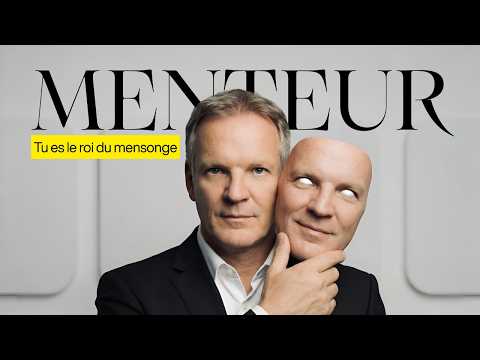
Pourquoi Vous Vous Mentez Tous Les Jours (La Vérité Neuroscientifique)
AI Summary
The human brain is a master of deception, not just toward others, but toward itself. This phenomenon is central to our survival and psychological comfort, as explored through various scientific and psychological lenses. The journey into self-illusion begins with a striking medical case from 1997. Neurosurgeon Ramachandran treated a patient who, following a stroke, was completely paralyzed on her left side. Despite her inability to move, she insisted she could. Her brain, unable to accept the reality of paralysis, automatically generated "lies"—not out of malice, but as a defense mechanism called anosognosia. This medical extreme reflects a universal truth: we all lie to ourselves daily to protect our egos from unbearable truths.
To understand why we do this, we must look at the theory of cognitive dissonance, introduced by Leon Festinger in 1957. When our actions contradict our values or when we hold two conflicting beliefs, our brain experiences literal pain. Brain imaging shows that cognitive dissonance activates the anterior cingulate cortex, the same area responsible for physical pain. To escape this discomfort, the brain "rewrites the story." Festinger famously studied a cult that predicted the world would end in 1954. When the prophecy failed, instead of admitting they were wrong, the members became even more fervent, claiming their faith had saved the planet. We do the same today: we stay in miserable jobs by telling ourselves they offer "stability," or remain in failing relationships because we’ve "built something together." These aren't rational analyses; they are psychological painkillers.
Biologically, self-deception offers a competitive edge. Biologist Robert Trivers suggests we lie to ourselves so that we can lie more effectively to others. If you truly believe your own lie, your body won’t betray you through micro-expressions or nervous tics, making you more convincing. This often manifests as excessive confidence. Studies show that people who overestimate their skills often gain higher social status and success in negotiations or job interviews because confidence is contagious. Figures like Steve Jobs and Elon Musk projected total self-assurance to revolutionize industries. However, this is a double-edged sword; when confidence has no basis in reality, it leads to disaster, as seen in the case of Elizabeth Holmes.
Psychiatrist Carl Jung provided another layer to this through his concept of "The Shadow." The shadow consists of the parts of ourselves we refuse to acknowledge—our jealousy, cruelty, or cowardice. Jung argued that what irritates us most in others is often a projection of what we suppress in ourselves. Modern neuroscience supports this; when confronted with information that contradicts our self-image, the medial prefrontal cortex—the area managing personal identity—reacts as if under physical attack. This is why negative feedback often triggers anger rather than reflection. According to psychotherapist Nathaniel Branden, the primary cause of psychological suffering is not what happens to us, but what we refuse to see about ourselves.
The transcript identifies five specific lies we tell ourselves constantly:
1. **"I am objective."** In reality, the "blind spot bias" makes us see biases in others while remaining convinced of our own neutrality.
2. **"I control my decisions."** Research shows brain activity precedes conscious decision-making by 350 milliseconds to seven seconds. The brain decides first, then creates the illusion of choice.
3. **"I remember exactly what happened."** Memories are not recordings; they are reconstructions that we rewrite every time we recall them.
4. **"I am a good person."** Most people believe they are above average in morality and intelligence, a phenomenon known as the "better-than-average effect."
5. **"I’ll change when I’m ready."** Procrastination is actually a failure of emotional regulation, not time management. We delay because the task triggers emotions like fear of failure or judgment that we aren't ready to face.
While self-deception is a survival mechanism, remaining unaware of it is dangerous. To combat this, four practical tools are suggested. First is the **Reaction Journal**, where one records strong emotional reactions to understand what they reveal about oneself. Second is **Mirroring**, asking if a disliked trait in another person is actually a suppressed part of one's own shadow. Third is **Voluntary Disavowal**, which involves actively looking for evidence that contradicts your positive self-beliefs to foster honesty. Finally, the **Brutal Friend**—finding someone who practices radical transparency and tells you the painful truths you ignore. As Jung said, enlightenment comes not from imagining figures of light, but by making the darkness conscious. The most dangerous person in your life is you, when you refuse to see the truth. Awareness is the first step to breaking the cycle.