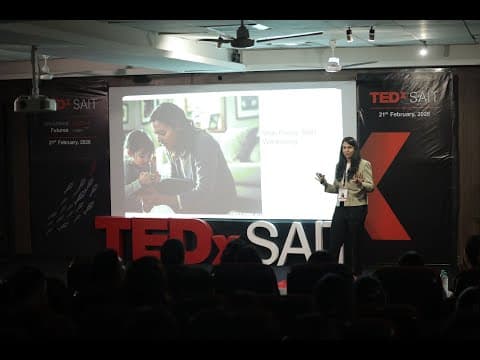
The World Needs Fewer Stronger Children | Rahela Tayyebi | TEDxSAIT
Audio Summary
AI Summary
The speaker begins by questioning the common parenting goal of making children "stronger," suggesting that this approach might actually be breaking them. The impetus for this thought came from a PTM meeting where a teacher suggested their six-year-old son needed to be "stronger" because he cried when he couldn't complete a worksheet or when a friend took something. The speaker reflects that at six years old, crying out of frustration is a normal emotion, and perhaps the issue isn't the child's lack of strength, but adults expecting children to handle situations they are not yet equipped for.
The speaker observes a common parental instinct to parent differently than they were raised, often by saying "yes" to everything and removing perceived harsh boundaries. This can lead to a fear when a child cries after being told "no," making parents feel they've made a mistake and that their child isn't strong enough. This fear can then lead parents to revert to the suppression tactics they experienced in their own upbringing. The speaker likens this adult suppression to situations where one might suppress feelings with a boss, spouse, or mother-in-law, thinking "I'm strong." However, this suppressed emotion is carried throughout the day, leading to explosions at home.
Neuroscience, the speaker explains, indicates that a nervous system under threat builds defense, not resilience. A "defended" child constantly scans their environment to see if it's safe to express emotions, fearing they might be "too much" or cause trouble. Conversely, a "resilient" child understands that all their emotions are safe and they are not alone. A defended child performs for strength, while a resilient child knows they possess it intrinsically.
To foster genuine resilience, the speaker offers three key strategies for parents.
Firstly, "stop fixing and start witnessing." When a child expresses distress, the immediate adult reaction is often to problem-solve or offer solutions. For instance, if a child is upset because a friend didn't save them a seat on the bus, an adult might suggest telling the teacher or not relying on one friend. While well-intentioned, this approach can make children feel like their feelings are problems to be fixed. The speaker draws a parallel to adult friendships, where receiving immediate advice can lead to shame rather than relief. Instead of fixing, parents should simply name the feeling. For the bus seat incident, a simple acknowledgment like "That's not fair" is sufficient. This validates the child's emotions and encourages them to share more, knowing their parent is there for them without judgment.
Secondly, "let them watch us struggle sometimes." The speaker advocates for allowing children to see parents as human beings with emotions. This doesn't mean sharing deep personal woes, but rather demonstrating that it's okay to be overwhelmed or tired. The speaker recounts an instance where, instead of pushing through to prepare dinner and help with homework, she told her son she was overwhelmed and needed to lie down. By modeling emotional regulation and admitting vulnerability, parents teach valuable lessons. When parents apologize for yelling, they teach accountability. When they ask for help, they teach that it's not a sign of weakness. Children learn more from observing how parents live and manage their emotions than from mere words.
Thirdly, "let them feel bad sometimes." In a desire to create perfect lives for their children, parents often remove all obstacles, inadvertently teaching them that discomfort is inherently wrong. This can lead to a child feeling ill-equipped to handle things alone when they realize their parents cannot protect them from everything. The speaker suggests that allowing children to struggle and experience uncomfortable feelings like sadness is crucial. It teaches them that these emotions are survivable. The speaker uses the analogy of an anchor, which steadies a ship without pushing it, to describe the parent's role.
The speaker concludes by reflecting on the future being built for children. The question is whether we are creating a generation that can handle everything alone, or one terrified to need anyone. The speaker reiterates the desire for her son not to be so strong that he hides his emotions, or so resilient that he can't understand his own pain. Instead, she wants him to be strong enough to be soft, to cry when frustrated, and to be able to show all his feelings without suppression. The world, she argues, may need fewer sensitive children and more adults who haven't forgotten how to feel. When asked to make a child "stronger," the speaker suggests questioning "stronger than what?" Is it stronger than their need for connection, safety, or love? True strength, she posits, is not about suppressing emotions but about being able to feel them and be loved through them, a state she describes not as strength, but as "loneliness with better PR."