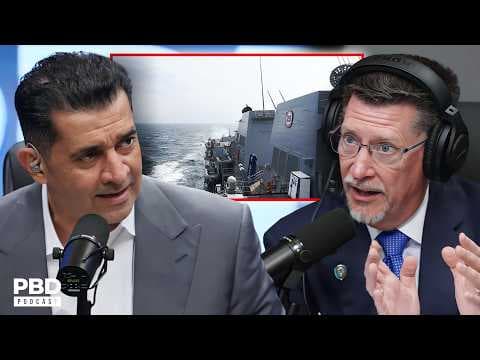
“Blown To HELL!” - Trump’s Hormuz Blockade PUNISHES Iran After Peace Talks Collapse
Audio Summary
AI Summary
Following the collapse of nuclear talks with Iran, President Trump has announced an immediate blockade of the Strait of Hormuz. He stated that while most points of negotiation were agreed upon, the crucial nuclear issue remained unresolved. Effective immediately, the U.S. Navy will commence blockading all vessels attempting to enter or leave the Strait of Hormuz. The ultimate goal is to establish an "all being allowed to go in, all being allowed to go out" basis, but this has been hindered by Iran's claims of potential mines in the area, which the President characterized as "world extortion."
President Trump has also instructed the Navy to interdict any vessel in international waters that has paid a toll to Iran, asserting that no one paying an illegal toll will have safe passage. Furthermore, the U.S. will begin destroying mines laid by Iran in the straits, with a stern warning that any Iranian firing at U.S. or peaceful vessels will face severe retaliation. The President implied that Iran is well aware of how to de-escalate the situation, highlighting the devastated state of their military – navy, air force, and anti-aircraft/radar systems – all attributed to their nuclear ambitions. He also suggested that Iranian leaders are deceased due to these ambitions.
The blockade is set to begin shortly, with other countries expected to participate. Iran will be prevented from profiting from what is described as an illegal act of extortion. The President indicated that Iran's demands for more money and nuclear capabilities will not be met, and at an opportune moment, the U.S. military will be fully prepared to "finish up the little that is left of Iran."
Following this announcement, oil prices saw a significant increase. As of the time of the transcript, oil prices were at $103.39, having risen from $105 earlier in the morning and peaking at $119. Projections suggest that if the situation continues for another week or two, prices could reach $140, and potentially $200 if it persists longer.
The transcript then references efforts by JD Vance to negotiate with Iran, noting that these negotiations lasted 21 hours but ultimately failed to reach an agreement. JD Vance is quoted as stating that the outcome was "bad for Iran much more than it's bad news for the United States of America." He explained that the U.S. had clearly communicated its red lines and areas of accommodation, but Iran chose not to accept their terms.
A visual aid was used to illustrate the Strait of Hormuz, showing the shipping lanes. The dark blue water represents Oman, and the older shipping lanes, pre-war, are depicted with two miles of separation for navigational safety. Iran has declared a red, gridded area as hazardous, claiming to have placed mines but being unable to recall their exact locations. The speaker believes this is a tactic to force shipping lanes to reroute through areas controlled by Iran, where they intend to impose tolls. The President's blockade is framed as a direct response to this, aiming to clear mines from the original lanes and restore order.
The discussion then shifts to whether President Trump is betraying his base or simply following through on his long-standing promises regarding Iran. His past actions are cited, including his 2015 campaign speech where he criticized Iran, his withdrawal from the JCPOA (Iran nuclear agreement), his past threats to bomb Iran, the assassination of Soleimani, actions against ISIS, and the 12-day war involving bombing nuclear facilities, as well as the Muslim ban. The argument is made that Trump is not starting a new war but rather ending a 47-year conflict with Iran.
The Strait of Hormuz is presented as Iran's last remaining leverage, with their military, navy, and air force significantly degraded. Their actions have made them enemies of neighboring countries and social pariahs, leaving the Strait of Hormuz as their primary economic weapon through oil. The situation is compared to a poker game where Iran, holding the Strait of Hormuz, is met with Trump's "royal flush" – the blockade of their blockade. Trump is portrayed as holding all the cards and leverage, forcing Iran to react.
A clip of JD Vance discussing the 21-hour negotiations highlights the lack of agreement and reiterates that the outcome was unfavorable for Iran. President Trump is then quoted as predicting that Iran will return and "give us everything we want," emphasizing his demand for 100% of their compliance, not a partial agreement.
The strategic decision to send JD Vance to negotiate is analyzed. It is suggested that sending Vance, perceived as less interventionist or more isolationist, signals that Trump is not seeking a new war. This move is seen as unifying Rubio, Vance, and Trump on the issue of Iran, regardless of individual political stances. The speaker contrasts this with sending Rubio, who might be labeled an interventionist. The pressure is placed on Vance to "close the deal," with criticism noted online suggesting he lacks the "cloud" or ability to achieve favorable outcomes. His political standing and past negotiations are mentioned, implying this is an opportunity for him to prove his diplomatic capabilities.
The strategy behind sending Vance is further elaborated: by sending someone perceived as less inclined towards war, Trump can establish a moral high ground. If negotiations fail, any subsequent military action can be framed as inevitable, not aggressive, drawing parallels to Sun Tzu's "Art of War," where warfare is based on deception. This move is described as a "gangster move" that will also serve to bind Vance to Trump's policies by 2028, as he will have been present during the failed negotiations with Iran.
The transcript concludes with a brief, unrelated segment about the creation of a shoe brand, emphasizing craftsmanship and quality, followed by prompts to watch more videos or the entire podcast.