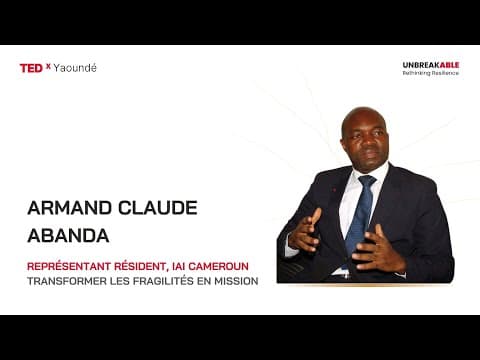
Transformer les fragilités en mission | Armand Claude ABANDA | TEDxYaounde
Audio Summary
AI Summary
Armand Claude Avanda, Resident Representative of the African Institute of Informatics (IAI) and holder of the UNESCO Chair for Central Africa, shares insights on how young people can leverage challenges and frustrations to achieve success. He recounts his own journey, starting a seemingly "crazy" project in his thirties that no one initially believed in. Today, IAI boasts 40 centers, has trained over 10,000 highly skilled IT professionals working globally, and has empowered 103,500 women through the "100,000 Women" initiative and 9,300 young people and women through "MEF 2035," fostering their autonomy.
Avanda emphasizes perseverance, urging individuals not to give up despite difficulties. Frustration, he argues, can be a source of strength and creativity. He uses the example of an orphan mocked by peers, suggesting this shock can be transformed into a drive for excellence. Key to success is a social attitude, rooted in humility, which he considers the mother of all human values. Humility fosters gratitude, loyalty, and forgiveness. A lack of humility, conversely, can lead to others undermining your efforts.
To succeed, one must cultivate a supportive environment. Avanda credits Dr. Brahim Adamafa, former IAI director, for giving him a chance early in his career. He stresses that competence alone is insufficient; good behavior and a positive attitude are crucial. Combining "aptitudes" (skills) with "attitudes" (mindset) consistently over time is essential for optimal achievement.
Innovation and creativity are also paramount. Rather than merely creating, the focus should be on innovating—developing something new and distinct that addresses an existing gap or significantly improves upon what's available. He cites WhatsApp as an example of an innovation born from identifying a need. The IAI slogan, "One student, one project, one enterprise," reflects their mission to train job creators, not just job seekers, instilling an entrepreneurial mindset from the outset.
Avanda shares his personal struggle when first arriving in Cameroon with only 3,500 CFA francs and no computer, tasked with establishing an IT school. Faced with this "fracture" and financial deficit, he sought public recognition. He courageously contacted Minister Roger Milingi, who, despite his busy schedule, agreed to visit the modest IAI office. This official acknowledgment, though brief, legitimized the institution.
He then embarked on an extensive communication campaign without funds, walking to various media outlets. He convinced the director of Cameroon Tribune to publish the competition notice for free and secured free airtime on radio stations. This communication blitz resulted in 400 applicants for 120 spots in the first year, escalating to 5,000 applicants the following year, establishing IAI as a leading IT school.
Avanda also addresses adversity, jealousy, and attempts to undermine his position. His mother's words, "You started, you must finish. Never doubt yourself," became his guiding principle. He highlights how he overcame a lack of institutional support for the "100,000 Women" operation by devising a self-financing strategy. By organizing training sessions in various towns and inviting political figures and elites to sponsor women's training for a small fee, he created a network of supporters. This approach not only funded the initiative but also garnered respect and influence.
His success in Cameroon led to the creation of IAI branches in Niger and Togo, demonstrating the continental impact of his actions. He concludes by reiterating the importance of resilience, self-belief, and the "spirit of impact" for young people.