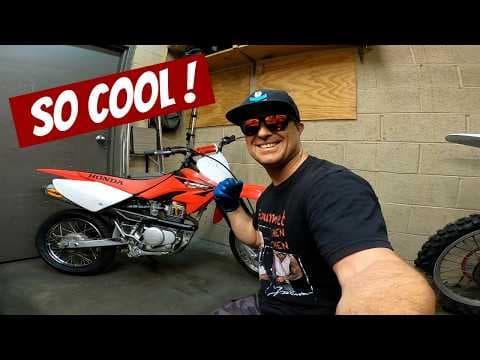
Trop content de mes new carénages
Audio Summary
AI Summary
The video details a series of modifications and repairs being made to a motorcycle. The process begins with draining the old, foul-smelling gasoline from the fuel tank. This is followed by the installation of a new fuel tank, and then the FMF exhaust system, described as magnificent and racing-oriented, originating from Southern California and known for its noise.
The presenter notes that the used motorcycle he purchased has had some custom work done, specifically the welding of adaptable tabs to accommodate a heat shield. He describes this modification as a "slipper" – appearing original but not being so. However, he criticizes the welding quality, comparing it to "popcorn" and finding it "disgusting" and "contaminated." Despite this, he thanks the previous owner for the modification.
Next, the presenter plans to reinstall the engine protection plate, or "skid plate," which he humorously refers to as protection for his "balls" to allow him to "glide like a ski." He also mentions the installation of a small rubber button designed to dampen vibrations, expressing satisfaction with it.
After reinstalling the exhaust pipe and a turntable, the presenter confirms the installation of an anti-theft shield and the new fuel tank, noting that the gasoline has been drained, with a small amount left for potential use later. He points out a cracked and broken rubber strap used to hold the tank, while the side screws are reported to be fine.
The engine oil has been changed, with 0.78 liters of K&N 10W-40 full synthetic oil added, as specified in the manual. The presenter then moves to the saddle, indicating he will clean it. He reminisces about "maxi scoot" on Franco-German circuits. He describes the previous state of the motorcycle's equipment as "disgusting," dusty, and dirty, reminiscent of vacant lots and the Californian desert.
A peculiar aspect of the saddle installation is highlighted: the rear screws are actually meant for holding the mudguard. The saddle itself is secured by the rear fender. Without the rear fender, the saddle would be unstable, and the presenter humorously warns that a "size 92" (referring to a large rear end) could cause it to detach. He concludes the saddle installation as quick and efficient.
The next items on the agenda are the mudguards and the front license plate. The presenter contemplates starting the engine, despite the overcast weather, and decides to try their luck with a small amount of gasoline and oil in the tank. He nervously attempts to start the engine, using the choke. The engine starts, but he expresses concern about a potential issue, mentioning that he doesn't know what to do with the rocker arm seals and interprets this as a "bad sign." However, he then reassures himself that it's not necessarily bad, especially with a new piston.
The presenter then discusses the front mudguard, noting that the original was wrecked and scratched. He considered buying a full fairing kit but found it too expensive. He opted for a complete fairing kit for a smaller model, the Honda CRF 70cc, purchased on eBay for $50, which was supposed to fit.
However, he encounters several issues with this kit. The front fender, while protected, is a much darker shade of red than the original. More significantly, the rear fender and mudguard are incompatible with the CRF 80. The mounting points are completely different, requiring cutting and adaptation. He describes the situation as a "mess" and that one needs to be a "MacGyver" to make it work. He also notes that the plastic appears to be a different, darker red ("Ruby red") compared to the original reddish-orange.
Dissatisfied with adapting the cheap kit, the presenter decides to order an original XR80 front fender in the correct color and size, acknowledging it's more expensive. He also procures a "real" rear fender, though slightly thinner. He then considers salvaging parts from the cheap kit, specifically the side panels, which are a darker red. He notes that while they don't match the original red perfectly, they are functional and fit the CRF 80. He also mentions that the white parts from the kit seem to fit and match well, as the original bike has white accents.
He then details the installation of the front fender, explaining how the rear fender attaches to the seat and then to the frame. He attempts to fit the adaptable CRF 70 front fender onto the CRF 80, noting that the mounting points and the small protruding part seem to match. However, he discovers that the "glans" (referring to a specific part of the fender) is missing at the front, and the acorn nuts and rubber washers are also absent.
Further attempts to fit the front fender reveal that it touches the saddle. He realizes it's not the correct part and that the mounting tabs are different, causing it to hit the frame. He decides to recycle the original side panels, carefully removing them by detaching a plastic rivet. He then proceeds to install these original side panels, highlighting how the small nipple fits into a clip and then securing them with screws.
He expresses satisfaction with a stop he welded, which prevents the tank from hitting the frame. He criticizes the original bracket as "completely irrelevant" and not original. The installation of the side panels is described as smooth, though a bit of a strain, requiring some bending to align. He notes that the cable routing for the clutch is tight but manageable.
The presenter concludes by stating he didn't expect to finish the work today and plans to add stickers later. He expresses his happiness with the progress, comparing the aesthetic to something from the future or space. He thanks the viewers for following and signs off.