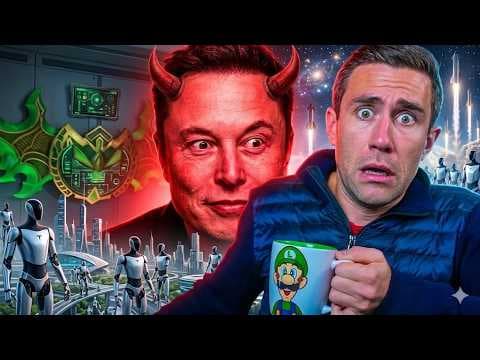
Elon Musk's EVIL Plan: SpaceX & Tesla Stock.
Audio Summary
AI Summary
This video analyzes Elon Musk's potential Machiavellian takeover of Tesla and its implications for both Tesla and SpaceX, incorporating recent Tesla earnings. The premise is that Musk is leveraging the current momentum-driven stock market, rather than fundamental value, to achieve complete control of Tesla.
A key element of this strategy is the anticipated SpaceX IPO. The NASDAQ recently changed its rules to allow stocks with less than a 10% outstanding float to be included in its indices, a move that is seen as specifically benefiting SpaceX. Elon Musk is expected to float only 6-7% of SpaceX, a very small portion. This low float, combined with intense promotion, is designed to create a "meme stock" effect, driving SpaceX's valuation significantly higher than its fundamentals might suggest, similar to the VCX Fundrise example, which saw an extreme surge before collapsing.
In contrast to Tesla, where Musk's ownership is around 13-20% and he desires more voting control, he already holds 42% monetary equity and 79% voting control in SpaceX. This control allows him to make significant decisions, such as directing SpaceX's operating profits towards XAI, and potentially acquiring Cursor AI for $60 billion, which is seen as a way to secure a customer for the data centers Elon built, thereby reducing XAI's losses and boosting SpaceX's appeal ahead of its IPO.
The strategy involves "sandbagging" Tesla stock, meaning intentionally depressing its market cap or keeping it stable, while simultaneously hyping SpaceX. This could lead to a scenario where investors sell Tesla shares to buy SpaceX, drawn by the excitement around Musk's new venture and its potential for rapid growth due to the low float.
Tesla's recent earnings call revealed several issues that align with this "sandbagging" theory. Elon Musk admitted that Hardware 3 is incapable of achieving unsupervised Full Self-Driving (FSD), necessitating expensive retrofits or trade-in credits for existing vehicles. He suggested building "mini-factories" in cities to handle these upgrades, which would be a significant liability and cost for Tesla. This aligns with the idea of increasing Tesla's costs while its sales growth is slowing.
Despite these liabilities, Tesla reported a $230 million one-time benefit from warranty true-downs, suggesting less warranty work was done than expected. This is interpreted as Musk strategically downplaying costs to create a misleading picture.
Furthermore, Tesla announced plans to acquire an unnamed hardware company for up to $2 billion and increase capital expenditures from $20 billion to $25 billion. They also intend to build a $3 billion research fab in Austin for chip research (Dojo 3), after the initial Dojo project was largely abandoned. These massive capital expenditures, at a time when sales are declining and the stock's valuation (PEG ratio over 5) is considered high, are seen as deliberate moves to make Tesla stock less attractive in the short term.
The financial projections for Tesla are concerning, with an expected EPS of $1.63, leading to a forward PE ratio of approximately 240. The stock's fair value based on fundamentals is estimated around $117, representing a potential downside of 69%. This potential drop to $440 billion in market cap would make Tesla an attractive target for a leveraged buyout (LBO) by SpaceX, using the capital raised from its highly successful IPO. With SpaceX's super-voting shares and Musk's 79% control, he could use SpaceX to acquire a controlling interest in Tesla, potentially pushing his ownership past 50%.
Other concerns for Tesla include the slow expansion of RoboTaxi services, attributed to numerous "edge cases" in AI training that are difficult to resolve for real-world driving. There are also reports of Musk seeking sites for large-scale solar cell manufacturing, a capital-intensive and low-margin business dominated by China, which is seen as another potential drain on Tesla's resources. The video highlights personal frustrations with Tesla Solar's lack of communication and delays in installations, suggesting a deliberate slowdown possibly to align with Tesla's own panel manufacturing plans.
Tesla's energy margins remain decent at 39.5% but are stalling. While the company blames "lumpy Megapack sales" and the loss of tax credits, the analysis suggests intentional sandbagging to depress numbers. Regulatory credits still represent a significant portion of Tesla's net income.
The CFO's statement that negative free cash flow is expected for the rest of the year due to planned expenditures on the semiconductor fab, solar manufacturing equipment, and other ventures further supports the idea of intentional short-term financial strain. These expenditures, combined with plans for scaling Optimus and RoboTaxi, paint a picture of massive spending without immediate returns.
In summary, the narrative posits that Elon Musk is orchestrating a complex strategy to depress Tesla's stock through increased liabilities, high capital expenditures, and slowing growth, while simultaneously inflating SpaceX's valuation through a low-float IPO and aggressive promotion. This would create an opportunity for SpaceX, under Musk's control, to acquire a controlling stake in Tesla at a significantly lower valuation, thereby consolidating Musk's power across his ventures. While this is speculative, the various pieces of information from Tesla's earnings and Musk's actions are presented as aligning with this theory.