Les Marchés en 2026 : une Économie que personne n'a vu venir ?
Audio Summary
AI Summary
The podcast begins with a reminder about a contest to win an iPad, requiring a KX account and a minimum 1€ crypto deposit. Additionally, OKX is offering 30€ for the first 10,000 users who open a derivatives account, with double votes in the draw for those who participate.
The host announces it's April 17, 2026, and shares a personal anecdote about cutting his hair, which had been a running gag with his community due to his "original" hairstyles. He explains that his previous hair was difficult to manage and often led to him getting lost in "artistic propositions." He humorously declares this a significant event for the internet.
The main podcast topics are finance, current events, personal development, and science.
**Financial Topic: The Return of Stagflation**
The host introduces the concept of stagflation, defined as a simultaneous rise in inflation and a slowdown in economic growth. He notes this is a scenario most investors haven't experienced, with the last significant occurrence being in the 1970s. He explains that central banks, like the US Federal Reserve, typically use interest rates to manage inflation and growth, but stagflation presents a dilemma: raising rates to combat inflation can further harm growth, and vice versa.
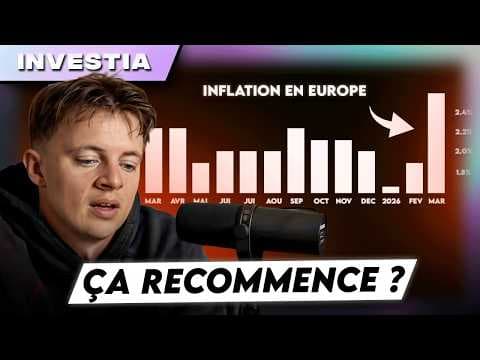
The resurgence of stagflation in 2026 is linked to events in the Strait of Hormuz. Following Israeli-American strikes on Iran, a partial blockade of the Strait, which handles approximately 20% of global oil transit, has occurred. This has led to reduced oil production by Gulf countries and a significant surge in oil and gas prices (gas increased by 65% in a week). Inflation in the Eurozone rose from 1.9% to 2.5% in a month, largely driven by energy costs. Concurrently, the OECD has lowered its US growth forecasts for 2026 and 2025, indicating slowing growth.
A parallel is drawn to the 1970s, specifically the 1973 oil embargo, which led to a decade of high inflation (14%) and unemployment (9%). While acknowledging the current situation is not yet as severe, the host points out differences in the economy, such as hyper-monetary printing and debt-driven growth, which were less prevalent in the 1970s. He notes differing opinions on whether the current energy disruption is historically unprecedented or if the economy is more diversified and less reliant on oil. His assessment is that the current situation resembles stagflation but in a "mitigated version, for now."
For investments during stagflation, classic assets tend to suffer. Bonds are negatively impacted by inflation eroding real returns, and growth stocks are hit by slowing growth and sustained high interest rates. Commodities like energy, gold, and metals, along with real assets and potentially real estate, tend to perform better. He questions the viability of 100% stock or global ETF portfolios in such an environment.
The host anticipates 2026 will be a "sluggish, very uncertain year" where terms like stagflation and bear market will be more frequently discussed. He notes that investors who have only experienced the post-2010 decade will need to adapt to unprecedented market conditions, characterized by amplified volatility and leverage due to past monetary policies (2008 crisis, COVID-19 pandemic's 40-50% monetary mass increase) and high interest rates.
Despite the fear, he emphasizes two realities: the debt-driven economy necessitates monetary printing, suggesting long-term hyper-monetary printing. In this context, gold and Bitcoin are presented as logical assets. He also addresses the psychological aspect of market downturns, cautioning against projecting current fears onto historical extreme recessions like the 1930s. He argues that markets move faster now due to increased global liquidity and agility of central bank levers. Stagflation or bear markets might be shorter than anticipated. He concludes that over a minimum 10-year horizon, financial markets tend to rise.
**Current Events: The Tortoise Jonathan and a Crypto Scam**
The podcast shifts to a lighter topic: Jonathan, a 193-year-old tortoise. An April Fool's Day hoax, spread via a fake vet's X account and amplified by the BBC, announced Jonathan's death. This was revealed to be a crypto scam, where an individual created a fake account to solicit crypto donations by exploiting public emotion. The actual vet, Joe Hollins, debunked the news the following day. Jonathan, a giant tortoise from Seychelles, has lived on Saint Helena since 1882 and is believed to have been born around 1832, predating Napoleon's death on the same island by only a few years. He has witnessed two World Wars, the invention of electricity, the telephone, the airplane, and the internet, and has seen 40 US presidents. Despite being blind and deaf, he is still alive and well, having also survived a crypto scam.
**Personal Development: The Importance of Learning, Unlearning, and Relearning**
The host quotes Alvin Toffler: "The illiterate of the 21st century will not be those who cannot read and write. They will be those who cannot learn, unlearn, and relearn." He applies this to the current era of abundant, accessible information, arguing that the real challenge is not learning but unlearning. The brain is wired for efficiency, creating strong neural connections and habits that are difficult to break. This neuroplasticity, while beneficial for reinforcing existing pathways, makes it hard to discard outdated beliefs or methods.
The danger lies not in ignorance but in "obsolete certainty"—beliefs that were once true but are no longer valid. He uses the example of investors who built wealth through specific methods (e.g., real estate) and become rigid in their approach, dismissing other asset classes as scams. Unlearning, he clarifies, isn't erasure but building new, stronger neural pathways that eventually supersede the old ones. This requires identifying deeply held convictions and questioning the context in which they were acquired. He suggests dedicating time to critically examine daily routines and ingrained beliefs, acknowledging that this process can be uncomfortable but fosters mental agility. He also touches upon inherited beliefs from parents and previous generations, which may no longer be relevant in the current world.
**Personal Experience: Neuroplastic Pain and Knee Issues**
The host shares a personal struggle with knee pain over the past six months. After an intense period of physical activity, including a Spartan race and multiple tennis matches, he developed persistent knee pain. Despite trying various solutions like changing shoes, resting, physical therapy, and strengthening exercises, the pain remained, characterized by unpleasant tingling. The pain intensified during stressful work situations, leading him to consider a psychosomatic origin.
He discovered the concept of neuroplastic or psychosomatic pain, where the brain creates real physical pain signals originating from emotional stress rather than a purely mechanical issue. He found a book by Dr. Sarno and began working on this aspect, linking his knee pain to personal stress and burdens he was carrying. He describes how understanding the emotional source of the pain allows the brain to stop sending pain signals to the knee. He reports significant improvement and is now able to resume running. He encourages those with chronic pain to explore this approach, noting that simply understanding the existence of neuroplastic pain can be helpful.
**Historical Event: Vasili Arkhipov and the Cuban Missile Crisis**
The podcast recounts the story of Vasili Arkhipov, a Soviet submarine officer who played a crucial role in averting nuclear war during the Cuban Missile Crisis on October 27, 1962. The Soviet submarine B-59 was cornered by US naval forces, which dropped depth charges to force it to surface. The submarine's crew, unaware of the US intentions and suffering from extreme heat, high CO2 levels, and a loss of radio contact, believed war had begun. The submarine carried a nuclear torpedo, and its launch required three signatures: the captain, the political officer, and Arkhipov. The captain and political officer signed, but Arkhipov, despite immense pressure and the belief that war was imminent, refused to sign. He argued and convinced the captain to surface, where they discovered there was no war. Arkhipov had previously helped manage a nuclear reactor leak on another submarine in 1961, exposing himself to radiation. His heroic actions were not recognized during his lifetime, and the full story only emerged in 2002.
**Science Topic: New Discoveries About Mars**
The final segment focuses on recent discoveries about Mars in early 2026, challenging the perception of it as a dead planet.
1. **Northern Hemisphere Ocean:** A Swiss study published in January 2026 suggests that approximately 3 billion years ago, an ocean covered the entire northern hemisphere of Mars, comparable in size to Earth's Arctic Ocean. This indicates Mars was once a "blue planet."
2. **Water in Meteorites:** In February 2026, Danish researchers analyzed the Black Beauty meteorite (a Martian rock that fell to Earth) using neutron scanning. They found significantly more ancient water trapped within it than previously thought, dating back to about 4.45 billion years ago—almost the beginning of the solar system.
3. **Conditions for Life:** The presence of oceans, rivers, a thicker atmosphere, and a milder climate for hundreds of millions of years raises the question of whether life existed on Mars. While not confirmed, the Perseverance rover has found mineralogical evidence in the Jezero Crater (an ancient lakebed) that forms in water and resembles micro-organism traces on Earth. However, the mission to return these samples to Earth for definitive analysis faces budget and complexity issues.
The podcast concludes with a call to action for likes, comments, subscriptions, and participation in the OKX contest, highlighting that this is a new form of monetization for the podcast after two years.