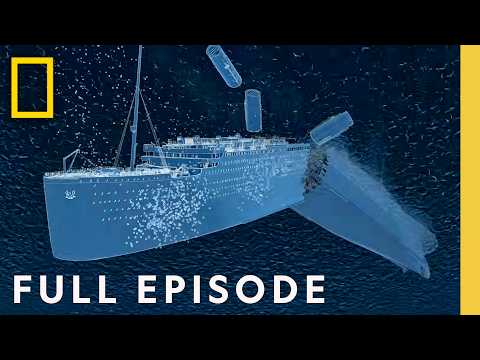
Titanic: The Digital Resurrection (Full Episode) | DOCUMENTARY SPECIAL | National Geographic
Audio Summary
AI Summary
In a remote part of the Atlantic Ocean, nearly 400 miles from Newfoundland, a remarkable expedition is underway to create a full-sized digital replica of the Titanic. This virtual twin, created from over 700,000 scanned images and 16 terabytes of data, offers unprecedented detail into the wreck, providing new insights into its sinking and the final moments of those on board.
The Titanic, hailed as the most luxurious and unsinkable ship of its time, began its maiden voyage from Southampton to New York on April 10, 1912. It was the golden age of ocean liners, with White Star Line prioritizing luxury over Cunard's speed. On board were aristocrats, business magnates, and immigrants seeking new lives. However, just seven days later, the ship would be at the bottom of the Atlantic, with almost 1,500 people dead. For decades, the wreck's location remained a mystery until Bob Ballard found it in 1985. The immense pressure and pitch-black conditions at 2.5 miles down made it difficult to view the entire ship until now.
Two unmanned submersibles, Romeo and Juliet, were deployed for the scanning project. Romeo filmed high-resolution footage, while Juliet, equipped with lasers, captured millions of measurements of every inch of the wreck. After three weeks of continuous scanning, the expedition team completed their work. The enormous amount of data gathered took over a year to research and process, culminating in the creation of the digital twin.
World-renowned expert Parks Stephenson, who has been on multiple dives to the Titanic, assembled a team to examine the digital twin. Master Mariner Captain Chris Hearn hoped to understand the crew's experience during the sinking, while metallurgist Dr. Jennifer Hooper, who had previously studied small fragments of the wreck, was eager to see the full-scale site. After nearly two years of research and processing, the 700,000 scan images were meticulously pieced together and projected on colossal LED panels, bringing the investigators face-to-face with the severed wreckage.
The digital twin revealed the immense scale of the destruction. The ship lies in two parts, with the stern a third of a mile from the bow. The level of damage was catastrophic, appearing as if the ship had been struck by an enormous missile. The twin also allowed experts to study previously inaccessible parts of the ship, revealing details like Titanic's hull number, 401, on a propeller, which was in pristine condition.
The disaster occurred on a cold, clear, starry night on April 14, 1912, four days into the voyage. Wireless operator Jack Phillips received a warning about pack ice and icebergs. At 11:39 p.m., three bells signaled an obstacle ahead. First Officer Murdoch ordered the engines to stop and the ship to turn hard starboard. Seconds later, the Titanic hit the iceberg. Many on board felt little, believing it was a close shave. Yet, this glancing blow sank a ship thought to be unsinkable.
The scan provided the first visible evidence of ice damage, showing a smashed porthole that Margaret Swift, a first-class passenger, saw ice come through. This indicated the iceberg was at least 30 feet above the waterline, providing crucial information about the collision. However, Titanic's fatal wound remained hidden, as the bow was buried in 20-25 feet of mud on the seabed.
To understand the full extent of the damage, the investigation turned to Titanic's birthplace, Harland & Wolff in Belfast. Original blueprints showed the ship was divided into 16 watertight compartments and designed to stay afloat even if four flooded, cementing its reputation as unsinkable. After the tragedy, naval architect Edward Wilding concluded that more than four compartments must have been damaged, causing the ship to sink. He estimated a series of puncture holes totaling about 12 square feet.
At University College London, Professor Jeom-Kee Paik, Dr. Simon Benson, and Dr. Stephen Payne used computer simulations to test Wilding's hypothesis. Simulating the iceberg strike at an estimated speed of 22 knots, they found the glancing blow lasted 6.3 seconds. The simulation revealed a thin line of gash, with ruptures spreading across six compartments along the starboard side, extending from the front to boiler room number five, and a small section in the forepeak. The total area of the holes was approximately 18 square feet, slightly higher than Wilding's estimate but confirming his overall assessment that the damage was minimal in scale but spread over too many compartments. The ship was designed to withstand only four flooded compartments, but six were compromised.
The irony, Parks Stephenson noted, was that by turning to avoid the iceberg, the crew inadvertently created a lengthy area of damage that opened up too many compartments. Wilding had predicted that if the ship had hit the iceberg head-on, it would have stayed afloat. The simulation confirmed this, showing that a head-on collision would have only damaged the peak tank and cargo tanks, totaling four compartments, allowing the ship to remain afloat. However, Captain Chris Hearn pointed out that no officer would deliberately steer directly into an iceberg, as it would likely kill those in the forward bunks. Murdoch's maneuver, while attempting to save lives, sealed the Titanic's fate.
Within 20 minutes of impact, Captain Smith received reports of flooding in the boiler rooms. Fireman Fred Barrett witnessed a large volume of water entering boiler room six. Chief Engineer Joseph Bell, in charge of 200 men, faced a dire situation. Boiler room six was lost, and boiler room five had a paper-sized breach. Wilding estimated 16,000 tons of water had entered the ship. Water burst into boiler room five, leading Bell to exclaim, "My God, we are lost." Bell and his men were forced to boiler room two, the last one capable of providing power.
Recognizing the ship was doomed, Bell shifted focus to saving lives. Maintaining power was crucial for lights and the wireless room to alert nearby ships and guide people to lifeboats. The digital twin allowed experts to examine boiler room two, the last place where fires were kept going. The conditions were brutally hot and steamy, a true test of leadership.
The digital twin also offered new evidence of how Bell kept the power on. A steam valve, found nearly 2,300 feet away on the stern, was seen in the open position. This valve connected boiler room two to the emergency dynamos, which were 40 feet higher than the main generator and would take longer to flood. The open valve indicated continuous steam flow, meaning Bell manually ensured power to the emergency dynamos, which provided light, heat, and ran the pumps. Survivors testified that the ship's lights remained on for over two hours after the collision, corroborating this. The steam valve, frozen in its final act, stands as proof of the engineers' bravery. All 35 engineers, including Bell, went down with the ship, their bodies never found.
Above deck, panic spread as passengers rushed to the boat deck. Due to laws in 1912, Titanic only had enough lifeboats for half of those on board, and many were not launched full. Amidst the chaos, stories of heroism and heartbreak emerged, such as Ida Strauss refusing to leave her husband and Rhoda Abbott staying with her sons who were deemed too old for a lifeboat. First-class passenger Jack Thayer witnessed Bruce Ismay, chairman of the White Star Line, pushing his way into a lifeboat, a decision that tarnished his reputation.
First Officer William Murdoch, in charge of lifeboats on the starboard side, was later accused of suicide. However, Second Officer Lightoller, the most senior surviving officer, refuted this, stating he saw Murdoch swept overboard. The digital twin offers clues supporting Lightoller's account. The forward davit at Murdoch's station was found in the upright or retracted position, indicating the crew was preparing to launch a lifeboat. Lightoller witnessed Murdoch trying to launch one final boat at 2:15 a.m., minutes before the ship went down. The ship dipped, washing the lifeboat overboard and sweeping Murdoch away. The davit's position supports Lightoller's version, suggesting Murdoch was struggling to save lives until the very end, never abandoning his duty.
Around 2:00 a.m., Captain Smith released wireless operators Jack Phillips and Harold Bride from their posts. Bride left, but Phillips continued sending messages, his selfless conduct recalled by Bride. The messages abruptly stopped shortly after 2:00 a.m.
After the sinking, inquiries concluded the ship gently slipped below the waves, but many survivors testified it broke apart. The wreck's discovery in 1985 confirmed this. The digital twin shows the pieces resting a third of a mile apart. Parks Stephenson, who has investigated the breakup for decades, believes the debris field around the wreck holds the answers. Covering 15 square miles, countless fragments of Titanic are scattered across the ocean floor. By piecing together these shattered sections of the hull, experts discovered that the ship did not snap cleanly in two; a huge section was completely destroyed. It was a "giant catastrophic fracture," a "domino effect" where the ship's strength, compromised by the shell, led to the obliteration of its exposed interior.
This cataclysmic moment, where 70-80 feet of the ship broke simultaneously, sealed the fate of those in that section. The twin offers a glimpse into their final moments, including America's richest men, Benjamin Guggenheim and J.J. Astor. Guggenheim's suite was at the epicenter of the breakup. While the romantic image of noblemen dying peacefully was prevalent, the twin makes clear the violence experienced. Astor's premium suites were blown apart, and his body was recovered a week later. The twin shows that death did not discriminate based on status.
Over 60 feet below Astor's suite, Joseph Bell and his engineers remained in boiler room two. The boiler's concaved inward shadow indicates an implosive event, meaning the boilers were still operating when the ship broke and the bow went under. This location serves as a memorial to the bravery and dedication of the 35 engineers who gave their lives to give others a chance.
Two hours and 40 minutes after the iceberg strike, about 700 people were in lifeboats, while the rest fought for their lives or were dead. The digital twin continues to shed light on the lives lost. After the ship broke up, the bow quickly disappeared, but the stern stayed afloat for a few more minutes. Assistant Purser Frank Prentice, on the poop deck, witnessed the stern rising, hearing everything crashing through the ship before he dropped 100 feet into the water.
The bow sank first, shedding its contents and hitting the mud with force, jackknifing. The stern followed, flattening into a spiral, its freight and furnishings strewn across the ocean floor. Thousands of items are buried in the mud, some seen for the first time in over 100 years. The debris field has yielded answers about the ship and insights into life on board. An ornate bench, 715 feet from the stern, once adorned an upper deck. The centerpiece of a glass ceiling dome, from a grand staircase, lies 416 feet away. Footage from the scan, combined with records and insurance claims, helped identify owners of glimpsed items, such as Charlotte Cardeza's suitcase and Henry B. Harris's shoes and opera glasses. An intriguing pig's tusk bangle and shark's tooth, nearly 500 feet from the stern, belonged to Scottish businessman Colonel John Weir, revealing a family secret about his Australian family.
These findings bring humanity to the desolate wreck site. Countless items remain, their owners unknown, like a pair of men's shoes marking a third-class passenger's final resting place, or an ornate doll's head, potentially belonging to one of the 60 children who perished. For Parks Stephenson, the digital twin enables investigation and study without disturbing the wreck. The twin has opened up new thought processes, marking the most impactful development since the wreck's discovery in 1985. The "rusticles," a by-product of bacteria eating the iron, show that the ship is slowly degrading. The digital twin has frozen this evidence in time, allowing research to continue long after the wreck's inevitable decay, ensuring the search for answers endures.