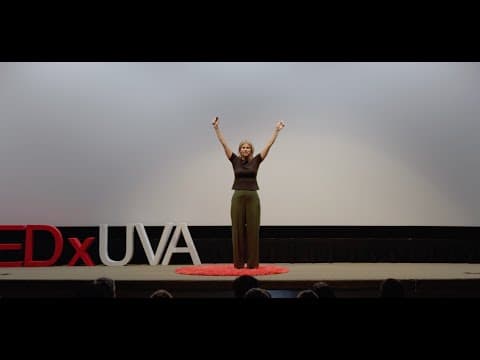
A Neuroscientist’s Guide to the Void | Erin Clabough | TEDxUVA
Audio Summary
AI Summary
Many people find it uncomfortable to sit in silence, often due to a fear of self-reflection, a phenomenon some call "the void." A University of Virginia study found that two-thirds of men preferred electric shocks to 15 minutes of silence, while women were significantly more comfortable with quiet. This highlights a societal discomfort with stillness.
The speaker, a neuroscience professor, initially studied dying neurons but realized she was studying the wrong kind of "dying." Despite outward success – a perfect job, four children, awards – she was exhausted, crying in her car, and even sleeping in her office due to an overwhelming schedule. She was "shiny and never still."
She began quitting things, starting with social media, realizing her inability to be still was the core issue. She learned that silence isn't the same as stillness and that true stillness required a body-first approach, incorporating nature, movement, sound, and breath. A friend introduced her to Kundalini yoga, a practice she initially found absurd but which helped settle her mind. She discovered that "the void is our truest existence" and she had never learned to tolerate or cherish it.
This personal transformation led her to re-evaluate her teaching. She started asking students about their educational experiences and uncovered widespread "quiet, polite, high-functioning trauma." Students were either disengaging, gaming the system, or experiencing panic attacks, all having lost their childhood wonder for learning. She noted that one in six students had formal diagnoses requiring accommodations, and screening surveys revealed one in three students reported moderate to severe anxiety and depression. She concluded that if plants aren't growing, it's a soil problem, not a plant problem; students aren't broken, but the conditions aren't working for them.
The speaker challenged Maslow's hierarchy of needs, where self-actualization is at the top, arguing it's at the core, woven through all other needs. She developed a new framework and created courses focused on self-actualization, using practices like meditation, breathwork, and nature immersion. Students reported becoming "friends with myself" and learning to regulate emotions without distractions.
She extended these practices to elementary and middle school students, who demonstrated a natural inclination towards stillness and self-awareness. One practice, Kirtan Kriya, a chanting technique, was found to protect against cognitive decline in Alzheimer's research, surprising her as a neuroscientist. This underscored the profound hunger for rest and self-knowledge.
The speaker emphasized that knowing oneself is the most important project, as it shapes one's perception of everything. She urged teachers to trust their intuition about what isn't working, parents to model self-care, and students to trust their innate completeness and embrace stillness. The "void" is simply stillness, where roots of self-knowledge can grow.