Thailand News: No Alcohol for Songkran? 57M Litres Missing and Petrol Curbs Hit
Audio Summary
AI Summary
Here's a summary of the provided YouTube transcript:
This news update from Thailand on Wednesday, April 8th, covers several key developments including new alcohol-free rules for Songkran water zones, a significant fuel discrepancy in Suratthani, potential overnight fuel station closures, and international news from Vietnam and a Thai royal initiative.
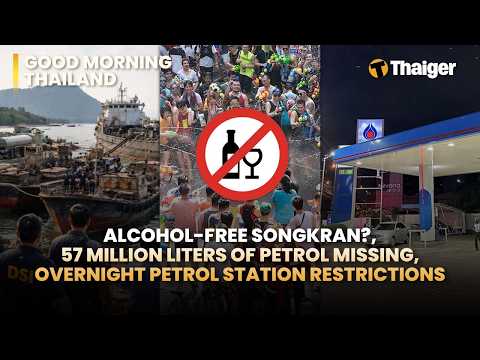
**Songkran Alcohol Restrictions:** Bangkok authorities have announced that officially designated Songkran water splashing events in the city will be alcohol-free and must conclude by 10 p.m. each night. These measures will be in effect from April 11th to April 15th. Major celebration areas like Lan Luang, Silom Road, and Khao San Road will be subject to these rules. Organizers are also instructed to avoid oversized water cannons, indecent behavior, and powdered chalk. Some festival areas will have restricted activities to manage traffic flow and emergency services. Police anticipate larger crowds in Bangkok this year, partly because higher fuel prices may discourage travel to home provinces. The presenter expresses skepticism about the enforceability and impact of these rules, noting the short notice and potential conflict with established celebratory culture and existing sponsorship deals.
**Airline Route Suspensions Due to Fuel Costs:** Thai airlines are facing significant disruptions due to rising jet fuel costs, exacerbated by tensions in the Middle East. Several airlines have announced route suspensions and cancellations. Thai Smile has paused its Don Mueang-Seoul service from May 9th to September 30th, while Nok Air has dropped its Chiang Mai-Udon Thani route for April. Thai AirAsia and Thai AirAsia X have suspended various domestic and international services, including routes to Narathiwat, Chiang Rai, Okinawa, Chennai, Chongqing, Shanghai, and Riyadh. Airlines cite increasing operating costs as the reason for these adjustments, with some also introducing fare increases. In parallel, authorities have promoted discounted domestic fares for Songkran to help travelers return home. The presenter highlights this as a long-term impact of rising fuel costs, affecting both domestic and international travel to Thailand, which is a tourism-dependent economy. The ongoing instability in the Middle East is seen as a factor with no immediate end in sight, potentially impacting travel to and from Europe, a significant demographic for Thai tourism.
**Massive Fuel Discrepancy in Suratthani:** Investigators are probing a substantial fuel discrepancy in Suratthani, where 57 million liters of fuel are unaccounted for during tanker deliveries. The Ministry of Justice has initiated an investigation after reports indicated that 217 million liters were shipped to six depots, but only 160 million liters were recorded upon arrival. The case has been transferred to the Department of Special Investigation to determine the whereabouts of the missing fuel and identify any involved parties. Possibilities being explored include illegal transfers at sea or diversion before reaching their declared destinations. Authorities caution that the unaccounted-for amount could increase as the inquiry progresses. The presenter finds this discrepancy alarming, suggesting it points to a significant issue in the supply chain, which could impact fuel availability and prices.
**Potential Overnight Fuel Station Closures:** As part of broader energy-saving measures linked to Middle Eastern turmoil, the government is considering imposing overnight restrictions on petrol station operations. The proposal suggests limits on operations from 10 p.m. to 5 a.m. after April 20th, once Songkran travel concludes. This measure aims to conserve fuel supplies while ensuring holiday journeys are not disrupted. The plan reportedly would not involve complete station closures but would restrict sales to specific fuel types, namely B20 diesel and E20 petrol, during those hours. Final legal details and enforcement arrangements are yet to be announced. The presenter questions the effectiveness of such a measure, suggesting that most travelers do not operate during these hours and that better, long-term solutions for fuel consumption reduction might exist, such as encouraging more work-from-home policies.
**Police Officer Accused of Demanding Fuel Money:** An officer in Udon Thani has been temporarily suspended following allegations of demanding payment for fuel before pursuing a theft investigation. A victim claimed the officer refused to proceed with the investigation unless money was provided to cover travel costs. Initial statements from local police suggested a misunderstanding, but public criticism prompted the Royal Thai Police to intervene. A police spokesperson confirmed the officer admitted to asking for fuel money, and the investigation is also examining previous misconduct allegations against the same officer. The presenter expresses frustration, suggesting this incident highlights a potential for corruption and the ease with which some officers feel they can act with impunity, particularly given the current focus on fuel prices. The incident also underscores the power of social media in bringing such issues to light.
**Vietnam's Political Consolidation:** In ASEAN news, Vietnam's Communist Party Chief, Tolam, has been elected as the new president, in addition to his existing role as the country's senior party leader. This move consolidates significant power in his hands, marking a departure from Vietnam's tradition of collective leadership and making him the most powerful Vietnamese figure in decades. Analysts suggest this could expedite decision-making but also raise concerns about a more authoritarian direction. Lawmakers also selected a new prime minister. This political shift is being closely monitored for its potential impact on Vietnam's economic management and the internal power balance. The presenter draws parallels to similar power consolidations seen in China under Xi Jinping and notes the trend of leaders holding power indefinitely in various countries, including Hungary, Turkey, and Israel, raising questions about potential future instability when such leaders eventually leave power.
**Southeast Asia's Geopolitical Leanings:** A regional survey from Singapore's ISEAS – Yusof Ishak Institute indicates that Southeast Asia is slightly tilting towards China over the West. A narrow majority of respondents (52%) would choose China over the United States if forced to take sides, suggesting a divided region rather than a definitive swing. China had previously led this survey in 2024, with the US briefly taking the lead in 2025. The report notes that countries like Indonesia, Malaysia, Singapore, Timor-Leste, Thailand, and Brunei lean more towards China. However, most people in the region still prefer neutrality over being forced into a geopolitical choice. The presenter emphasizes that Southeast Asia is not a monolith, with varying relationships and disputes influencing individual country alignments, and that treating ASEAN as a single entity is unhelpful.
**Thai National Costume for UNESCO Bid:** Princess Sirivannavari Nariratana is traveling to The Hague on April 9th to promote the Thai national costume as part of an international effort for its designation by UNESCO. She will lead an academic forum and deliver a keynote lecture on the development of Thai dress and textiles, showcasing various styles of "chut thai phra ratchaniyom" and formal men's wear. This initiative supports Thailand's bid to have the traditional attire added to UNESCO's representative list of intangible cultural heritage. A decision on the nomination is anticipated in December 2026. The presenter acknowledges the high-profile nature of this royal endorsement and its potential to bolster the nomination.