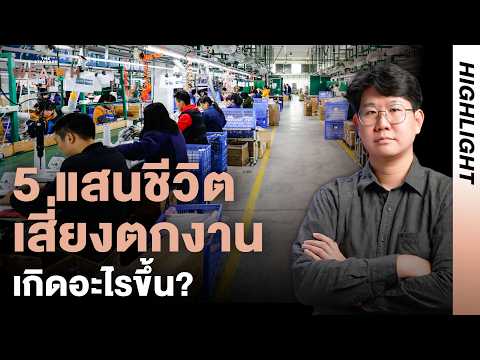
เจาะปมเหตุ ทำไมธุรกิจไทยเจ๊ง แรงงานถูกเลิกจ้างอาจสูงเฉียด 5 แสนคน! l Exclusive Interview Highlight
Audio Summary
AI Summary
Thailand has historically pursued a policy of low wages to attract foreign investment, leading to the establishment of numerous factories. This approach, dating back to the time of Sarit Thanarat, has created an economic system where the country's appeal to investors largely depends on maintaining low labor costs. As a result, the Thai economy has consistently focused on establishing economic zones, particularly in the east, to draw in these manufacturing operations. This strategy has been linked to wage suppression and an obstruction of labor rights, which, while uncomfortable, has become the norm. The consequences of these superficial policies are now being felt.
The current economic model, which relies on attracting factories solely interested in cheap labor, is no longer sustainable. These factories are now moving to other countries, and new technologies, such as EV car manufacturing, are not necessarily creating new markets or better opportunities for Thai workers. The core issue remains wage suppression, which is no longer a strong incentive for international investment. Thailand's government seems to be struggling for new ideas, having been stuck with the same outdated economic policies for too long. This situation is having a direct impact on workers, as good jobs are becoming scarce.
The country's economic landscape has shifted significantly. While Thailand experienced a boom in digital technology during the 70s, 80s, and 90s, the focus is now moving towards manufacturing and assembling cars without producing key components locally. This reliance on assembly, rather than full-scale manufacturing, combined with increasing automation, is turning the automotive industry into a sunset industry in Thailand. The effects of this shift are becoming increasingly apparent.
A recent example highlighting this trend is the closure of Yanapa Company, a prominent pharmaceutical factory that had been operating in Thailand for about 30 years. This closure shocked many, especially since the company was considered a stable employer in the apartment industry. The factory, like many others, faced challenges that led to its shutdown. This indicates that even established and seemingly stable factories are not immune to these economic pressures.
The closure of such factories has a devastating impact on workers. Employees in the automotive industry, who were once considered well-off with savings, investments, and the ability to afford homes and education for their children, are now facing immediate poverty. The shutdown of factories, often without adequate legal compensation, has thrown the lives of hundreds of workers into disarray. This situation demonstrates the instability now faced by those in what was once considered a stable profession.
Thailand is currently experiencing what could be described as deindustrialization, with a significant shift from manufacturing to the service sector. This includes jobs in caregiving, delivery, and various informal services like home massages and cleaning. The domestic industry is increasingly moving towards tourism and casual service jobs, and it is unclear what will replace these declining industrial roles. The rapid advancement of technology makes it difficult to find new solutions.
Concerns about these issues have been raised for a long time, but decision-makers in Thailand have remained indifferent, seemingly complacent about the long-term consequences. This complacency is seen as more detrimental than the potential losses. The transition of workers from the formal to the informal sector has been ongoing for years, and it is accelerating without a clear solution.
The "Singha Boom" of the 80s and 90s, when foreign investment flowed into Thailand, was a period of labor abundance. However, since then, formal employment opportunities have been gradually decreasing. This raises questions about job stability. For those already in the system, holding onto their jobs is crucial, but even stable full-time positions offer no guarantee of long-term security or a path to retirement like previous generations.
Globally, the industrial landscape is changing, with factories increasingly adopting robots and automated machinery for high-volume, fast production. This global instability affects businesses everywhere, not just in Thailand. While there is a global need for skilled technicians with vocational certificates or diplomas to keep industries running, finding good jobs for these technicians in Thailand is becoming difficult. Factories are increasingly incompatible with local labor, as wages are no longer the primary factor, and the focus is on maximizing output with automation.
Workers often have to work six days a a week, 48 hours, and compete for overtime to earn enough to cover the high cost of living. Such jobs are becoming rare. Many workers who migrated from other regions to Bangkok or the eastern provinces for stable factory jobs are now finding that this stability is an illusion. The traditional aspiration of working in civil service or a factory for secure retirement is no longer viable.
A new perspective is needed to address these challenges, as the old paths to stability are disappearing. Without clear solutions or infrastructure, like a proper railway line to support industrial growth, the future remains uncertain for many.