Fleet Unity: The Eridani Expedition - Interstellar Beachhead
Audio Summary
AI Summary
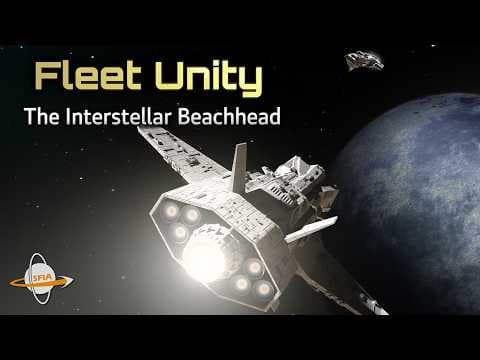
Interstellar exploration commences not with arrival, but with the decision to decelerate. This episode of Science and Futurism with Isaac Arthur continues the Fleet Unity series, focusing on humanity's first interstellar colonization fleets. Unlike traditional single-destination models, these fleets are designed to settle entire star systems, resupply, and then depart for the next. A portion of the crew remains to establish a permanent civilization, while the rest continue their multi-decade journey, rebuilding and expanding using harvested resources.
The narrative follows the vanguard squadron, a smaller, faster contingent that detached from the main Fleet Unity. Their mission: to establish a "beachhead" in the 82G Iridani system, making it habitable for the main fleet's eventual arrival. This vanguard, led by the flagship Emissary, used momentum transfer to decelerate itself significantly while also slowing the main fleet. Their method involved using vast, tightly packed near arrays and minimal propellant, with human crews in cryosleep.
The vanguard's crash deceleration began midway through year 77e, lasting just over a month, a few light-days from Iridani. Their goal was not immediate settlement but the creation of the necessary infrastructure—the "brakes" and logistics—for the main fleet. This mission, the first of its kind, was a high-risk prototype.
Upon emerging from cryosleep, the Commodore, science officer, and deputy engineer discussed the mission's progress. The main fleet had intentionally decelerated earlier than planned, providing a wider window for the vanguard's test. The main fleet, 0.82 light-years behind, would reach its optimal breaking distance in just over a decade. A constructor fleet was also en route to establish infrastructure for the main fleet's arrival.
The concept of dividing individuals, not just the fleet, was introduced as a contingency to address family concerns and offer flexibility for those wishing to settle or travel on. The deputy engineer had a copy of his brain and body made, with one instance remaining on Unity and the other participating in the vanguard mission, a testament to advanced contingency planning.
The immediate next steps involved a deceleration burn using light sails, mag sails, and fusion drives, with automated systems leading the effort. The vanguard would "crash" into the local sun, beaming energy backward to assist the slower elements of their column. They were designed to have more than twice the sails and ships needed, creating a chain reaction of deceleration. Automated pods, deployed with sails, would arrive at intervals, with the fleet slowing itself by firing these pods from mass drivers and incorporating them into the beaming system.
The goal was to establish a trillion-gigawatt beam array, spanning around 10 billion square kilometers, around the sun. This massive structure, though thinner than tinfoil, required advanced guidance for its individual sails to prevent them from being blown away by the solar wind. The pods themselves, weighing billions of tons, exceeded the mass of the entire vanguard squadron.
Contingency plans included using lenses to extend the beam array's range and leveraging local resources for mass and infrastructure. The beachhead operation was crucial for establishing industry and raw materials. The success of this mission was paramount, as the vanguard was essentially building the "brakes" for the entire civilization.
The narrative emphasizes that stopping is a prolonged process, unfolding over years and light-days, requiring infrastructure that must function flawlessly. Deceleration is achieved by building massive, indispensable structures in the path of the incoming fleet. This requires a different kind of leadership than that needed for a long-term, stable fleet like Unity. The vanguard needs a "frontier commodore," someone with a survivalist's impatience.
The beachhead itself was not about planting flags or setting up domes, but about building the logistics. It was established on Clotho, a frozen moon of the gas giant Ion, chosen for its ice content which provides stability, radiation shielding, and a heat sink. This ice-rich environment allowed for the creation of tunnels and caverns, serving as thermal sinks, pressure boundaries, and storage reservoirs.
The process began with fusion-powered cutters drilling into Clotho's surface, followed by the establishment of power nodes, coolant loops, and heat exchangers. These early caverns were Spartan, prioritizing speed and functionality. They served as storage chambers, machine shops, and fuel processing lines, turning water into hydrogen and oxygen—essential for reaction mass, life support, and as a buffer against emergencies.
Above in orbit, the beachhead became visible as logistical elements: beacons, relays, and navigation references. Transportation lanes were established between Clotho and other parts of Ion's domain, treating the system as a network.
The mission expanded to other moons of Ion. Lacasis, a denser, metal-rich moon, became the source of metals. Survey drones and prospecting packages mapped seams, followed by mining rigs and modular smelters. This allowed for repairs and expansion using local stock, enabling the construction of larger machines and components for the beaming array and resupply pods.
Atropose, a geologically active moon with cryovolcanic venting plumes rich in nitrogen and volatiles, became the source of essential atmospheric gases. Collection rigs hovered in the plumes, separating and transferring gases to orbiting tankers, providing the necessary components for new habitats and ecosystems.
The beachhead evolved into a triangle of roles: Clotho for ice and fuel, Lacasis for metals, and Atropose for volatiles. This infrastructure, along with a growing network of traffic lanes and relays, was designed to turn wilderness into a functional system. The vanguard had a decade to prepare for the main fleet's arrival.
The concept of "ahead of schedule" became a warning, as small deviations could consume the scarce resource of time. Instruments continuously monitored the star's output, stellar wind, dust distribution, and orbital resonances to ensure the safety of the massive beam architecture. The universe is not obligated to conform to spreadsheets, and subtle uncertainties could propagate and force changes.
The beachhead was built with deliberate humility, anticipating underperformance and unexpected challenges. Its purpose was not to become the capital, but to survive and build enough infrastructure for Fleet Unity to plug in without reinventing the system under pressure. The decision to commit to braking was load-bearing; the interfaces had to exist, and the system had to catch the fleet.
The tunnels on Clotho, the smelters on Lacasis, and the plumes of Atropose were not side quests but the essential machinery that made safe arrival possible. Interstellar settlement is inherently inefficient, consuming vast amounts of raw material, but this is trivial compared to the resources available in a star system.
The arrival of Fleet Unity marked the end of its long glide, not into a silent void, but into a functioning system. Beacons were lit, tunnels pressurized, metal produced, and the beam architecture extended to meet the fleet. However, arrival did not signify immediate reunion. The vanguard had adapted to Iridani, while the millions aboard Unity still carried the habits of their long voyage. The real test began as the expedition became load-bearing, with no reversal possible without immense cost. The beachhead's role was to make home possible, not to be home itself. The next episode would explore the first decades of permanent settlement, the birth of shipyards, and the decisions involved in planting seeds for the future.