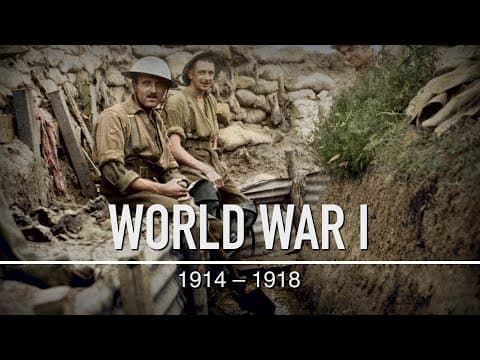
The First World War: The War to End War | WW1 Documentary
Audio Summary
AI Summary
The First World War, or the Great War, dramatically reshaped the world, with consequences felt to this day. At the dawn of the 20th century, Europe was a continent in transition, balancing old Victorian ideals of monarchy and empire with emerging forces like socialism, nationalism, and democracy, amplified by advancements in technology and literacy.
Archduke Franz Ferdinand of Austria-Hungary recognized the instability of the old order. He attempted to stabilize his multi-ethnic empire through diplomacy with Russia and internal reforms, but faced resistance from the ruling elites. The Austro-Hungarian Empire's Balkan holdings were particularly volatile, fueled by ethnic tensions and Serbian nationalism, which was supported by Russia. This created a complex web of alliances: Serbia was allied with Russia, which was allied with France. Austria-Hungary, in turn, was allied with Germany, a rapidly industrializing nation under the ambitious Kaiser Wilhelm II. Wilhelm II sought to challenge the established powers of Britain, France, and Russia, building a formidable military and navy. This led to a costly arms race across Europe, with Britain prioritizing its navy, France maintaining a large standing army, and Russia possessing the largest army in terms of sheer numbers, though lacking in modern equipment and facing internal instability. Despite this military buildup, many believed war was unlikely, relying on deterrence.
The immediate spark for the war was the assassination of Archduke Franz Ferdinand and his wife, Sophie, in Sarajevo on June 28, 1914. The assassins were linked to the Black Hand, a Serbian nationalist group. The date itself was significant, being the anniversary of a Serbian victory over the Turks. The assassination, carried out by Gavrilo Princip, was seen by nationalists as a blow against Austro-Hungarian oppression.
Germany, particularly Kaiser Wilhelm II, saw this as an opportunity. He offered Austria-Hungary unconditional support, the infamous "blank check," and encouraged them to take aggressive action against Serbia. Wilhelm II believed Russia could be quickly defeated due to its military inferiority and internal problems, and that Germany and Austria-Hungary could hold off France. His ultimate goal was German military dominance in Europe. However, Britain's stance remained uncertain. While allied with France through an "entente," it was not a binding treaty, and Britain was wary of Russia.
On July 23, 1914, Austria-Hungary issued a harsh ultimatum to Serbia, widely believed to have been orchestrated by Germany. Serbia accepted most demands but rejected Austro-Hungarian involvement in internal investigations. Using this as a pretext, Austria-Hungary invaded Serbia on July 28, 1914. This triggered a rapid escalation. Russia mobilized, leading Germany to declare war on Russia on August 1st. Germany then declared war on France on August 3rd, invading through neutral Belgium. This violation of Belgian neutrality compelled Britain to declare war on Germany and Austria-Hungary on August 4th.
The war quickly expanded. Germany formed the Triple Alliance with Austria-Hungary and later the Ottoman Empire, becoming known as the Central Powers. The conflict spilled globally, with early actions in Africa and the Pacific. The war's early stages were marked by a disconnect between rapidly advancing military technology and outdated tactics. The machine gun proved devastatingly effective against massed infantry and cavalry charges, leading to immense casualties in the war's first month. Airplanes, initially used for reconnaissance, quickly became vital, playing a role in saving Paris from German advance and leading to the development of fighter aircraft and aerial combat. Submarines also emerged as a significant naval weapon, with German U-boats posing a serious threat to Allied shipping.
The Western Front quickly devolved into trench warfare after an initial German advance was halted at the Battle of the Marne. The pursuit of outflanking maneuvers led to a continuous line of trenches stretching to the North Sea, solidifying a brutal stalemate. The First Battle of Ypres saw heavy losses on both sides, with neither able to achieve a decisive breakthrough.
On the Eastern Front, Russia suffered defeats against Austro-Hungarian and German forces, fueling internal dissent. The Ottoman Empire joined the Central Powers in late 1914, opening new fronts. The war also saw the introduction of chemical weapons, with Germany deploying chlorine gas at the Second Battle of Ypres, causing horrific casualties and leading both sides to adopt gas warfare.
The Gallipoli campaign, an Allied attempt to open a new front against the Ottomans, proved a costly failure. The sinking of the Lusitania by a German U-boat, with American lives lost, significantly influenced American opinion, pushing the United States closer to entering the war. Italy joined the Allies in May 1915, but its offensive against Austria-Hungary also bogged down into trench warfare in difficult mountainous terrain.
By 1916, Britain introduced conscription. The Battle of Jutland, the largest naval engagement of the war, saw a tactical German success but a strategic British victory, as the German fleet was thereafter largely confined to port. The Somme Offensive, launched by the British, became one of the bloodiest battles in history, with staggering casualties on the first day alone. The introduction of tanks in 1916 offered a potential solution to trench warfare's stalemate.
Internal pressures mounted on the warring empires. Ireland saw an Easter Rising in 1916, and the Ottoman Empire faced an Arab revolt. In Russia, the war exacerbated existing problems, leading to the February Revolution in 1917, the Tsar's abdication, and a weak provisional government. Lenin's Bolsheviks seized power in the October Revolution, leading to Russia's withdrawal from the war through the Treaty of Brest-Litovsk in March 1918.
The United States, initially neutral, declared war on Germany in April 1917, influenced by unrestricted submarine warfare and other provocations. American troops began arriving in significant numbers in 1918, bolstering the Allied forces. By late 1918, the Central Powers were faltering. Austria-Hungary collapsed due to internal strife and the strain of war. Germany faced severe shortages, influenza outbreaks, and mounting casualties. The Kaiser abdicated on November 9, 1918, and Germany sued for peace, with the armistice taking effect on November 11th.
The war resulted in over 17 million deaths and 20 million wounded. Its aftermath was profound. The Russian Revolution led to the creation of the Soviet Union and the Cold War. The collapse of the Ottoman Empire led to ethnic violence and the formation of Yugoslavia, which itself experienced brutal civil wars. Victors like Britain and France faced economic hardship and renewed rivalries. Germany, burdened by the Treaty of Versailles, harbored resentment that would contribute to future conflicts. The Great War, a cataclysm of unprecedented scale, irrevocably altered the global political landscape and set the stage for future challenges.