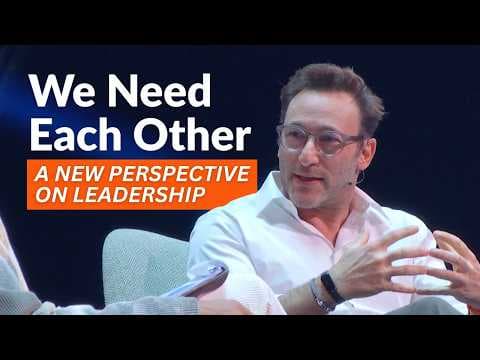
Simon Sinek: Building Real Trust in Work + Life | Amsterdam Business Forum 2025 | Full Conversation
Audio Summary
AI Summary
The speaker emphasizes the importance of staying present and avoiding autopilot, especially in professional settings. He shares his personal experience of feeling detached during presentations, which led him to value conversational formats where he must be fully engaged. This principle extends to individuals in their careers who may feel bored or stuck. He advises them to intentionally introduce challenges and new experiences, even if it means admitting they don't know how to do something. This self-sabotage, or rather, self-challenge, fosters a steep learning curve and can reignite passion.
A key theme is the concept of "availability" over "vulnerability." The speaker suggests that leaders should aim to be available to admit mistakes and ask for help, as this builds trust more effectively than simply offering help. This willingness to be open about not knowing or needing assistance inspires confidence and encourages others to contribute. For team members who desire such leadership, the advice is to embody the qualities they wish to see in their superiors, practicing empathy and offering support privately.
The speaker's work, including his books like "Start with Why" and "Leaders Eat Last," is rooted in personal struggles and observations. "Start with Why" emerged from a loss of passion in his own career, leading him to discover the importance of purpose. "Leaders Eat Last" was inspired by his observations of the military's strong sense of trust and camaraderie, contrasting it with the lack of credit-giving in business. He delves into the biological basis of trust, equating deep trust with love, characterized by the willingness to bear one's soul and hold space for another.
He highlights a fascinating observation about friendship: people are often more willing to share their problems than their successes. This stems from the difficulty of celebrating another's achievements without envy. He proposes that true trust and love involve being available for the full spectrum of human emotions. The speaker also shares a personal anecdote about confronting a friend for denying him the "honor" of being there during a difficult time, emphasizing that friendship is about mutual support through both good and bad. He suggests that people may withhold sharing successes due to guilt, fear of jinxing themselves, or a misinterpretation of healthy self-celebration as arrogance.
The discussion shifts to the concept of "why," which the speaker believes is fixed by mid-to-late teens, shaped by upbringing. Authenticity, he notes, is about living in balance with one's "why." While the "why" itself is constant, checking in with it is important. He also emphasizes the underrated value of a sense of humor in leadership, as it can diffuse tension and foster connection.
Optimism, he clarifies, is not blind positivity but an undying belief in a bright future that acknowledges present darkness. He distinguishes healthy optimism from toxic positivity, which can be disingenuous and harmful. True optimism involves acknowledging difficulties while maintaining faith in the ability to overcome them, especially when working together. He stresses that no one is strong enough to navigate life or leadership alone, and courage is often external, provided by a supportive "net" of friends or colleagues.
The "eight-minute rule" for friendship is introduced as a practical tool. This concept, derived from a study suggesting that eight minutes of focused attention can alleviate feelings of loneliness, provides a code for friends to signal a need for support without burdening each other. While it's primarily for personal relationships, the speaker acknowledges its potential but notes that workplace dynamics might require different approaches.
The speaker's current book focuses on friendship, stemming from the realization that while much attention is given to leadership and romantic love, the art of being a good friend is largely overlooked. He argues that strong friendships are foundational for success in leadership and relationships, providing essential support during challenging times. He critiques the casual way friendships are sometimes treated, contrasting it with the effort invested in romantic relationships or professional conflicts, where counseling and dialogue are common. He laments the lack of "friendship therapists" and suggests that we often take friends for granted, assuming they will always be there. He encourages a conscious evaluation of who we spend our time with, prioritizing those who inspire, celebrate, and support our best and most broken selves.
The conversation then addresses generational differences in the workplace. The speaker advocates for empathy, urging individuals to understand the origins of different behaviors rather than applying labels like "entitlement." He explains that younger generations' perceived entitlement, for instance, may stem from observing decades of corporate short-termism, mass layoffs, and a lack of loyalty from employers, leading them to prioritize immediate gain due to perceived job insecurity. He suggests that leaders should acknowledge this history and create safe environments to build trust.
Regarding AI, the speaker believes it's a choice whether it leads to a more human-centric or a more detached future. He argues that while AI can provide answers, sincerity and the process of struggling through problems are crucial for genuine connection and personal growth. He uses the example of using ChatGPT to apologize, highlighting that the sincerity of the apology, not just the perfect words, is what matters in repairing relationships. He emphasizes the value of the process and the "heart" over the mere "net result."
He expresses optimism about the future, believing that engineers often overlook the "human element." He suggests that societal pressures, particularly the emphasis on speed and short-term results, influence behavior across generations, from children seeking shortcuts in homework to companies prioritizing quarterly profits. He sees an opportunity for Europe, with its richer cultural foundations and greater emphasis on lifestyle, to offer a more long-term, humanistic approach to capitalism.
In response to a question about children and their innate curiosity, the speaker confirms that children are masters of "why" and that adults often lose this inquisitive quality over time. He notes that inspiring people often retain a childlike wonder or curiosity.
Addressing burnout in healthcare, he acknowledges the challenge and the mistake of confusing workload with burnout. He explains that occasional work outside of standard hours, driven by passion, can be invigorating, while constant, uninspired work can lead to burnout. He advocates for leaders to check in with their teams, asking "Are you okay?" and genuinely caring about the answer, considering this a hallmark of good leadership.
When asked about preparing a team for creative freedom, the speaker suggests that sometimes the issue lies with the leader's own narrative and the ease of blaming others. He advises introspection and a willingness to consider if one's own approach might be the barrier.
The speaker identifies his sister as a primary source of inspiration, due to their close bond and shared experiences. He also finds inspiration in artists and military personnel, whom he sees as serving others, sacrificing immensely, and finding a calling in their work.
He addresses skepticism by advising leaders not to worry about convincing skeptics but to consistently show up with empathy. He shares an anecdote about a company that transformed a skeptical employee through unwavering consistency and support.
Regarding healthcare burnout and leaders not addressing environmental factors, he draws parallels with the US military's development of mental health support teams for medical personnel in combat zones. He questions why hospitals don't prioritize similar support for their staff, suggesting cost is a barrier, but long-term consequences are greater. He calls for open conversations and courage from healthcare professionals to voice their struggles.
Responding to a question about unbalanced friendships, he suggests having an uncomfortable conversation with the friend, expressing struggles and asking for their perspective on the friendship's value. He emphasizes the importance of listening and discovering if the friendship can be improved or if clarity is needed.
On the question of a mother being a "best friend" to her daughter, he differentiates between a friendly relationship and being a best friend, suggesting that a parent's primary role is parenting, but a daughter viewing her mother as a best friend indicates strong trust and connection.
He reiterates that friendship is earned through a two-way exchange and that while strangers can offer support, it lacks the depth of trust built with known individuals. He emphasizes that his role is not to be a friend to everyone in the audience, but for them to build those connections amongst themselves.
In his closing remarks, the speaker reiterates the connective tissue of his message: "we need each other." He laments that the progression of the world over the past 40 years has eroded trust and cooperation, creating a demand for his work that he finds embarrassing. He emphasizes that changing the world requires collective effort, urging the audience to become students of leadership, learn "skills of the heart," be there for each other, hold space, and ask for help. He concludes by stating that together, they can create a better future.