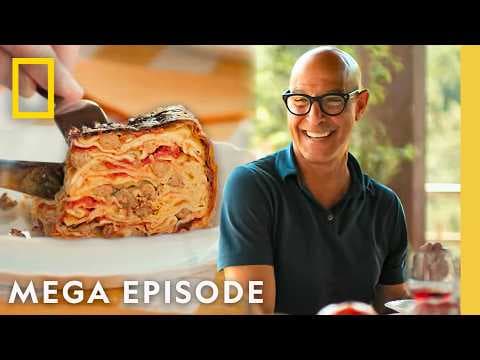
Stanley Tucci's Savory Journey Through Italy | Tucci in Italy S1 MEGA Episode | National Geographic
Audio Summary
AI Summary
Stanley Tucci explores the unique food culture of Italy, focusing on how regional identity, history, and geography shape the cuisine. He emphasizes that food is the best way to understand a country and its people, especially in Italy, where even pasta shapes and sauces speak to identity and differentiate regions.
**Abruzzo: Little Tibet**
Stanley begins his journey in Abruzzo, a rustic, wild, and mountainous region in central Italy, often called "Little Tibet" due to its remote, impenetrable Apennine mountain range. Abruzzo is one of Italy's least densely populated areas, and Stanley investigates how this "brutal, yet glorious geography" impacts its people and food.
He starts in Senarica, a remote mountain village, where Chef Danilo Cortellini invites him to a traditional Sunday lunch with his family. Danilo, who has cooked internationally for 25 years, including as head chef at the Italian embassy in London, still defers to his mother, Lucia, for the traditional feast day dish: timballo. Lucia makes crespelle (thin pancakes, similar to French crepes but made with olive oil and water instead of butter and milk), which are layered with mini meatballs, cheese, and egg wash to create a soufflé-like effect. The dish requires days of preparation and is baked, then carefully flipped. Stanley notes the timballo's resemblance to his family's "timpano," highlighting the shared culinary heritage. He observes that Senarica's isolation until the mid-1960s meant few external influences, making any new impact significant.
Next, Stanley ventures into the Gran Sasso National Park, a vast and peaceful landscape dominated by Corno Grande, the highest peak in the Apennines. Here, he meets food and motor journalist Cristina Bachetti at Ristoro Mucciante, an iconic barbecue joint. This is sheep country, historically known for the "transumanza," where shepherds drove flocks from Puglia to graze. The less fortunate sheep became "arrosticini," simple skewers of cubed mutton grilled in the open air, a tradition that continues. In the 17th century, over 4 million sheep summered here, generating immense wealth. Stanley finds the rustic food, forged from Abruzzo's shepherding roots, appropriate for the vast, unchanged landscape.
The journey continues to Villa San Sebastiano, a village known for a tragic 1955 landslide that wiped it away. The villagers chose to rebuild, starting with the church, then the communal bread oven, which had fed them for centuries. Chef Lucia Tellone now cares for the oven, which had closed due to convenience culture. Lucia resolved to teach the village to bake again, with children becoming her best students. The oven is lit weekly, bringing the community together to cook and share meals, including bread and pan pizzas made from ancient local grains.
Abruzzo's global culinary mark comes from an indulgence: confetti, or sugar-coated almonds, from Sulmona. This town was a crucial stop on the spice trail connecting Italy to Asia, leading to the creation of Europe's first candies. Stanley visits Confetti Pelino, established in 1783, where seventh-generation owner Mario Pelino gives him a tour. The almonds, once abundant locally, are toasted and sugar-coated in a process largely unchanged since the 18th century, using copper machines installed by Mario's great-grandfather. Sugar solution is repeatedly ladled onto tumbling almonds over days, building thin layers. Exotic spices like cinnamon were historically added. These candies are essential to Italian celebrations, crafted into bouquets and trinkets for events like weddings, and are unique to Sulmona. Mario explains that the term "confetti" comes from the tradition of throwing these candies at ceremonies.
Stanley then heads to the Trabocchi Coast, a treacherous 24-mile stretch of shoreline with distinctive wooden fishing platforms called "trabocchi." These platforms, born from desperation during famine, use winches to hoist fishing nets. Chef Gianluca Di Bucchianico runs a restaurant on a trabocco and shows Stanley the ropes. Gianluca’s menu reflects this history, serving dishes like "torcinello" (mutton offal) with prawns and a reduction of Montepulciano d'Abruzzo wine, and "pancotto" (bread soup). Gianluca also prepares a simple spaghetti with olive oil, garlic, sweet chili, and lobster extract. Stanley notes the ingenuity of the trabocchi and the Abruzzesi spirit reflected in their unique cuisine.
Finally, Stanley visits Castrovalva, a hamlet hit by population decline, surrounded by mountains. Chef Davide Nanni, who emigrated and then returned permanently, prepares "pecora al cotturo" (mutton stew), a defining dish of his childhood. The economy here was devastated by WWII, challenging topography, and earthquakes, prompting many to leave. Davide's return, like many others, is driven by Italy's food culture. Stanley concludes that Abruzzo's isolation has fostered a robust and pure cuisine, making its appeal understandable.
**Lazio: Rome's Larder**
Stanley then travels to Rome, where he revisits a sandwich he discovered during a previous stay, made by the Trecastelli brothers, Nicoló and Manuel. This sandwich highlights Lazio's reputation as Rome's larder. Lazio, located halfway up Italy's shin, has Rome as its heart, fed by the Tiber River and the region's abundant produce from quaint villages and green fields.
Rome itself is a blend of ancient history and modern chaos. Historically, the city has been nourished by seasonal produce, leading to distinct Roman dishes like carbonara and cacio e pepe. "Un buon rapporto qualità prezzo" (value for money) is crucial in Rome. Stanley's first stop is a humble trattoria with Lavinia Martini, a Roman food writer. She explains that trattorias are essential community hubs, offering regional, family recipes that change daily with the seasons. They order springtime dishes: artichoke alla Romana and zucchine alla concia, noting the simple, loving preparation. Stanley enjoys "pajata" (veal intestine with mother's milk), a dish born from a "no waste" culture, while Lavinia has "cacio e pepe." He praises the trattoria's familiar, comfortable atmosphere, crucial for a healthy society.
Roman pizza, thin and crispy unlike Neapolitan versions, is another favorite. Stanley visits A Rota in Tor Pignattara, run by Sami El Sabawy and his father Ramadan, two of Italy's 20,000 Egyptian pizza makers. He marvels at the simple, crispy pizza, where ingredients speak for themselves—a hallmark of Roman cooking.
Venturing beyond Rome, Stanley visits Ariccia, one of the Castelli Romani towns, once a powerful rival to Rome. Ancient Romans sacrificed pigs here, and later, it was a hunting ground for nobles. Today, it's famous for "porchetta." Local winemaker Remigio Sognatesori takes Stanley to a porchetteria where Eleonora Mancini reveals the mix of garlic, rosemary, and other herbs that flavor the pork. Stanley is amazed by the "f***ing good" porchetta, especially the skin. Locals pair it with a fizzy white wine, believed to cut through the fat. He calls Ariccia's porchetta a testament to doing "one thing and doing it really well."
In Remigio's hometown, Frascati, famous for its wine since antiquity, Stanley visits a "fraschetta" (wine shop) that has been in Remigio's family for over 100 years. Remigio assembles a "fagotto," a combination of local products, reflecting the tradition of visitors bringing their own food to accompany the wine. He shares buffalo mozzarella and roast potatoes with breadcrumbs. These specialties showcase the artisanship in these villages.
Further out, near the borders with Umbria and Tuscany, Stanley visits Marta, on Lake Bolsena, one of three lakes formed by collapsed volcanoes. Fisherman Daniele Papi explains the quality of their fish, once prized across Italy. Giuliano Rocchi, president of the fishermen's cooperative, prepares "sbroscia," a traditional stew using fish left after the most prized have been sold. The name means "slops," but the recipe calls for pure lake water, with oil, lard, onion, garlic, and chili, and an aroma of mint and marjoram. This unique stew is found only in this corner of Lazio. Stanley finds it delicious and notes the men's pride in rustic, underrated ingredients.
In Trevinano, a village in the northwesterly corner of Lazio, Stanley visits La Parolina, a Michelin-starred restaurant run by Iside de Cesare and Romano Gordini. They left Rome to harvest countryside flavors and create elegant Lazian dishes, like hazelnut steak tartare and an elegant pasta transformed by a refined take on sbroscia. Their neighbors, Giuliano and Simona, also left IT jobs in Rome to make wine, seeking a more authentic, genuine life despite the physical work. Iside explains they wanted to share the beauty of the landscape, which resembles Tuscany. Their daughter, Maia, appreciates the beauty but misses the variety of Rome and plans to experience other places before returning. Stanley notes these "dreamers" are culinary pioneers.
Finally, Stanley returns towards Rome to Castel Giuliano to explore lamb, a delicacy cherished by Lazians, especially in springtime. Giancarlo Gentili, who left a career in economics to return to his flock, and his brother Giuseppe cook "abbacchio scottadito" (freshly slaughtered suckling lamb ribs). "Scottadito" means "scorched fingers," reflecting the way the meat is grilled. Three generations of the Gentili family live on the farm, with their produce destined for Roman tables. Stanley finds the lamb delicious, a glimpse into Lazio's past and present. He concludes that rural Lazio, once unknown to him, is a well-deserved larder for Rome, sharing a culinary soul of uncomplicated, delicious food.
**Tuscany: A Masterpiece**
Stanley arrives in Tuscany, a region he calls a masterpiece, the cradle of the Renaissance. He explores how its historic artistry is reflected in its food. His journey begins in Florence, where he spent a memorable year as a child. Florence, under the wealthy Medici family in the 1400s, became an epicenter of art and culture. Despite this affluence, many Florentine recipes are peasant dishes, like "lampredotto," universally beloved and inexplicably eaten for breakfast.
Australian-born food writer Emiko Davies, who writes about Florentine food, takes Stanley to Sergio Pollini’s kiosk, serving the "best lampredotto" in Florence for 25 years. Lampredotto, popular since the Dark Ages, is the fourth stomach of the cow. Florentines were ingenious at using leftovers. The dish is named after the lamprey eel, a delicacy reserved for nobility, making lampredotto the poor people’s version. Emiko explains that the bread is dipped in broth, making it super juicy, and that the darker part of the meat is lean, while the whiter part is fattier and tastier. Stanley finds it delicious, soft, sweet, and similar to a juicier pastrami sandwich.
On the other side of Florence, in Santo Spirito, Stanley visits Dalla Lola, a restaurant run by Chef Matilde Pettini, who comes from a family of Florentine restaurateurs. Matilde opened Dalla Lola in 2021 to revive long-forgotten peasant recipes. Chef Marteen introduces dishes like "Francesina di lingua" (stewed beef tongue) and "fake tripe." Matilde explains that the tongue takes 24 hours to cook and is incredibly delicate. The fake tripe, an ancient recipe for when offal was unavailable, is a uniquely Florentine creation. Stanley is amazed by how these "poorest of foods" are elevated into beautiful creations.
In the northern Apuan Alps, the marble mountains that built Italian cities, Stanley visits Colonnata, a secluded mining town. Fabrizio Cattani, from a family of quarrymen, runs a butchery producing "Lardo di Colonnata," a decadent cold cut made here since the earliest days of marble mining. The same marble used for Renaissance masterpieces is vital to its unique curing process. Back fat is salted and rested in marble basins for up to 10 months, with each family having a closely guarded spice recipe including cinnamon, allspice, and nutmeg. Stanley notes that the quarrymen's greatest invention was crafting food from stone. He samples lardo with rabbit stew, prepared by Roberta, Fabrizio's aunt. He finds the rabbit incredibly moist and delicious, a creation as worthy as carving angels from marble.
Stanley then travels to the Maremma, the southernmost corner of Tuscany, Italy's wild west. He visits Tenuta di Alberese, a 900