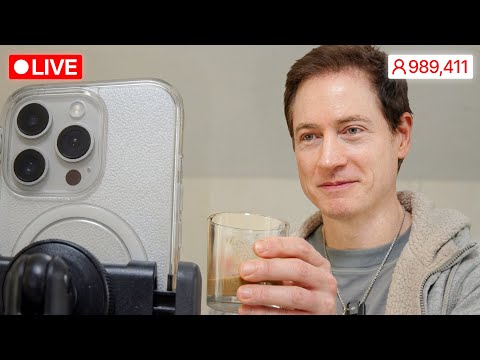
I Tried Psilocybin for Science (Livestream Highlights)
AI Summary
In this highly quantified experiment, longevity enthusiast Bryan Johnson explores whether psilocybin, the active compound in magic mushrooms, can function as a therapy to slow or reverse biological aging. This session marks the second of three planned doses in a protocol designed to measure the substance's impact on 249 different biomarkers. Johnson, joined by a team of experts and his son, Talmage, approaches the experience not as a recreational trip, but as a rigorous scientific inquiry into the "speed of aging" and the potential for cellular rejuvenation.
The experiment begins with a baseline measurement phase. Ryan Fields, the founder of Kernel, explains the use of a specialized device described as a "pulse oximeter on steroids." This technology maps brain activity by measuring oxygen levels, allowing the team to observe brain health and drug interactions in real-time. Before ingesting a "heroic dose" of 5.32 grams of mushrooms, Johnson expresses significant nerves. He notes that during his previous experience, his mental inhibitions were "washed away," removing the usual cognitive checks that prevent a person from saying or thinking inappropriate things. Despite this trepidation, he proceeds, consuming the dose in a lemon-infused mixture to aid ingestion.
As the psilocybin takes effect, Johnson’s demeanor shifts from clinical focus to a state of profound sensory and emotional openness. He describes the onset as a change in his "setting of consciousness," where the usual filters of perception are replaced by a more raw, vibrant reality. He reports physical sensations of his body vibrating and feeling "nimble, supple, and loose." The visual environment begins to pulsate, and he perceives the room as being "alive." In a particularly striking observation, Johnson explains that interacting with others requires him to "preload human models" in his mind, consciously activating the brain structures necessary for conversation rather than relying on the usual autopilot.
While Johnson is deep in the experience, a panel of experts provides context on the science of psychedelics. Dr. Carl Seager, a longevity physician, discusses preclinical trials suggesting that psilocybin might reverse biological aging in human cells. The conversation delves into the "epigenetic" theory of aging, which posits that the root of all disease is the shifting of gene expression over time. The experts suggest that molecules found in these mushrooms might act as a "cheat code" to reset the epigenome, essentially signaling cells to return to a more youthful state.
Pharmacology expert Hamilton provides insight into the "T-max," or the point of highest concentration of the substance in the blood, which typically occurs 1.5 to 2 hours after ingestion. The discussion also touches on the broader medical potential of psychedelics, citing research by Gul Dolan on "critical periods." This theory suggests that these tools can reopen windows of neuroplasticity, potentially helping stroke victims regain motor control or assisting veterans in overcoming PTSD and addiction. The group emphasizes the importance of "busting open the Overton window," shifting the public conversation from treating psychological disorders to using these compounds to help healthy people live more meaningful and productive lives.
A central theme of the transcript is the emotional connection between Johnson and his son, Talmage. Talmage observes his father’s "childlike" state with joy, noting that the roles have temporarily reversed, placing the son in a protective, parental role. Johnson, stripped of his usual professional persona, expresses deep, unfiltered love for his son, describing him as a "majestic being." This emotional transparency is presented as a hallmark of the high-dose experience, where social judgments and personal filters are temporarily suspended.
Despite the intensity of the "peak," the protocol requires Johnson to perform several tasks to collect data. In a scene that balances humor with clinical rigor, Johnson struggles to provide a saliva sample and complete a reaction-time test while the world around him is "dancing." He describes the difficulty of maintaining motor control while his mind is pulled "deep into the experience," demanding silence and inward reflection. He notes that at this high dosage, the sensory experience is so rich that speaking feels like a "lower dimensional expression" that detracts from the beauty of the moment.
The experiment concludes with a reflection on the universal connectivity Johnson feels during the trip. He expresses a sense of being "pure experience," having outsourced his usual analytical self to the surrounding environment. The team highlights that while these substances have been part of human culture for millennia—from ancient Greek mythology to Indian traditions—modern science is only now beginning to legitimize their use through rigorous quantification. Johnson’s "one-man FDA" approach aims to demystify the experience and provide a roadmap for others interested in the intersection of consciousness and longevity. The session ends on a note of gratitude and a shared sense of connection, with Johnson asserting that the experience of deep, unfiltered human bond is "peak life."