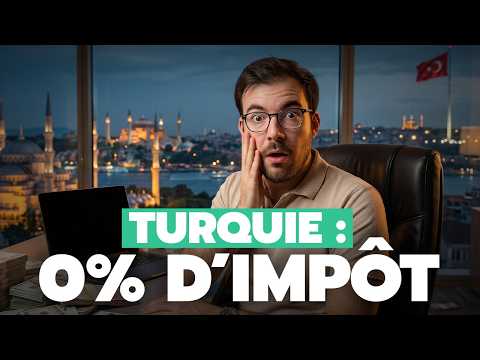
Turquie : la guerre fiscale contre Dubaï a commencé !
AI Summary
Turkey recently announced a significant change to its tax regime, potentially transforming the landscape of expatriation, especially in the Middle East. President Erdogan declared a "non-dom" tax regime, a special system for foreigners, offering 0% tax on foreign-sourced income for 20 years, a mere 1% on inheritance tax, and the complete elimination of annual flat taxes. This timing is strategic, coinciding with an exodus from the Gulf region, particularly the UAE, raising questions about its deliberate nature.
This "non-dom" regime, while not entirely new (countries like Italy, Greece, and Portugal have similar systems), is unique in its specifics. The three key measures are:
1. **0% tax on foreign-sourced income for 20 years:** This is a substantial period compared to other countries.
2. **1% inheritance tax:** A drastic reduction from Turkey's current 30% rate, depending on the family relationship.
3. **No annual flat tax:** Unlike other non-dom regimes that impose a minimum annual tax (e.g., Italy's €300,000 or Greece's €100,000), Turkey's proposal has no such minimum.
The motivation behind this announcement seems to be attracting foreign capital, especially after the recent instability in the Gulf, which has led many to seek alternatives to Dubai. Turkey boasts several advantages, including its strategic geographical location between Europe and Asia, its status as a major airport hub, rich culture, and NATO membership, offering political stability. However, economically, Turkey has faced challenges like high inflation (currently 35-40%, peaking at 75% two years ago), making foreign investment crucial. This move is essentially an attempt to position Turkey as a replacement for Dubai in the minds of expatriates.
However, there are crucial subtleties to consider. "Foreign-sourced income" does not refer to the nationality of your passport or company, but where you physically work and earn the money. If you reside in Turkey and conduct business from there, even if clients are abroad and payments are received in foreign accounts, the Turkish tax authorities will consider it Turkish-sourced income, subject to local taxes. This is a common misunderstanding often misrepresented online regarding territorial taxation.
Furthermore, this is currently just an announcement, not yet law. The bill has not been submitted to the Turkish National Assembly and requires voting, ratification, and official publication before becoming applicable. There's also the question of long-term stability; 20 years is a long time, and tax regimes can change. Finally, for French citizens, if Turkey becomes a country with a preferential tax regime, anti-tax evasion rules could apply.
In conclusion, this announcement is a significant political message. It's particularly beneficial for individuals with substantial assets and passive income. For those with active businesses like consulting or dropshipping, the situation is more complex due to the definition of "foreign-sourced income." While Turkey is culturally appealing, the high inflation rate should be considered. It's essential not to react impulsively to such announcements and to seek professional advice tailored to individual profiles.