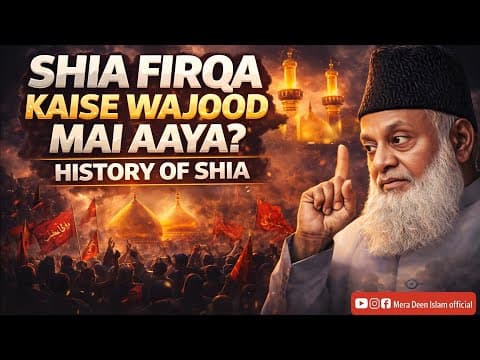
Shia firqa kaise wajood mai aaya? | History of Shia | Dr Israr Ahmed Bayan
Audio Summary
AI Summary
The transcript discusses various historical and religious themes, primarily focusing on Islamic history, leadership, and the concept of justice. It begins by referencing scriptural engagement and mentions figures like "Zahan" and "Jahan," hinting at early Islamic history. A significant portion revolves around the concept of leadership and succession, particularly following the Prophet Muhammad. The text touches upon the idea of "groups" and their actions, mentioning "Germany and southern Britain" in a seemingly metaphorical context.
A central theme is the conflict and division within the Muslim community after the Prophet's passing, leading to internal strife and bloodshed. The transcript highlights a period of civil war where a large number of Muslims perished. It emphasizes the negative impact of this internal conflict on the expansion and progress of Islam, suggesting that internal sabotage halted external growth. The speaker laments this as a "most tragic chapter" in history, particularly during the caliphates of Hazrat Ali and Hazrat Hassan.
The discussion then shifts to leadership qualities and the selection of leaders. It mentions a debate about who should lead, with Hazrat Talha and Hazrat Ali being considered. The concept of "Ashra Mubashara" (ten companions promised paradise) is brought up in relation to leadership. The transcript also touches upon the idea of betrayal and the consequences of not fulfilling promises, referencing a situation where a leader was advised to act decisively but perhaps hesitated.
The text delves into the notion of "control" and how it relates to leadership and governance. It discusses the authority of leaders and the need for them to be guided by divine principles. The concept of a leader's responsibility to their people is explored, with an emphasis on ensuring justice and fairness. The transcript also touches on the idea of divine intervention and the role of faith in overcoming challenges.
A significant portion of the transcript is dedicated to the historical figure of Muawiya and his reign. It contrasts his period of rule with the preceding civil unrest, stating that his time was marked by peace, stability, and the absence of internal conflict. This is presented as a significant historical fact that is often overlooked. The transcript also mentions individuals like Ubayr Muawiya, who was a scribe of the Quran, and emphasizes the positive aspects of the companions' character and their dedication to Islam.
The discussion then explores the challenges faced by the early Muslim community in establishing a stable government. It touches upon tribal loyalties and the need for a strong foundation for governance. The idea of idealism versus realism in leadership is presented, with a preference for a pragmatic approach. The transcript refers to a situation where individuals were expected to take action and the consequences of inaction.
The role of faith and conviction is repeatedly emphasized. The text discusses the importance of believing in divine promises and relying on God's guidance. It also touches upon the concept of resisting injustice and standing firm in one's beliefs, even in the face of adversity. The transcript highlights the sacrifices made by early Muslims and the challenges they overcame.
The transcript then moves to discuss the concept of the Mahdi and the role of Ahl al-Bayt (the Prophet's household) in Islamic eschatology. It references a prophecy about the Mahdi appearing to bring justice and peace. It also mentions Ayatollah Khomeini and his interpretation of this concept, particularly in relation to the Shia community in Iran.
The historical context of Iran and its past glories, referencing figures like Khosrau and Cyrus, is brought up in relation to the Quran. The event of Karbala is mentioned as a pivotal moment in Islamic history, with its profound impact. The transcript emphasizes the importance of understanding history and its underlying causes, suggesting that hidden factors often influence events.
The text also touches upon the idea of divine justice and the ultimate accountability of individuals. It discusses the consequences of actions and the importance of adhering to divine commandments. The concept of spiritual training and purification is mentioned, highlighting the role of scholars and Sufis in guiding the community.
Finally, the transcript touches upon the idea of ongoing struggle and the need for perseverance in the face of challenges. It emphasizes the importance of understanding the lessons of history and applying them to the present. The concept of divine providence and the unfolding of God's plan is a recurring theme, suggesting that despite human efforts and struggles, the ultimate outcome is in God's hands. The transcript concludes with a reflection on the importance of faith, resilience, and the pursuit of justice.