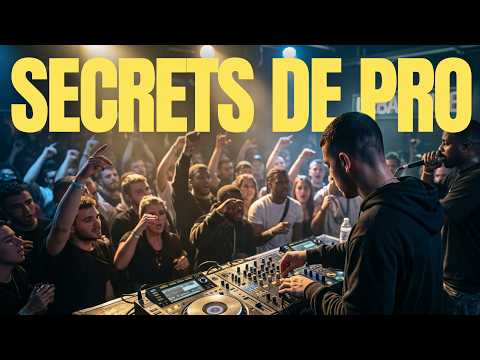
Comment dominer les soirées urbaines et devenir le DJ qu'on s'arrache
AI Summary
This video aims to provide DJs with the essential keys to master urban music events and become highly sought-after professionals in this genre. The speaker, Shubaka, emphasizes that mastering urban music goes beyond merely playing a few tracks; it involves a deep understanding of the genre, developing a unique identity, and becoming the go-to DJ for exceptional urban parties. He promises a concrete surprise at the end of the video to accelerate this journey.
Urban music is highlighted as one of the most in-demand, commercial, and widespread musical genres globally in 2026. Statistics from platforms like Spotify, Apple Music, and Deezer show that styles such as Afrobeat, Rap, RnB, Dancehall, and Reggaeton have dominated charts for over a decade. This widespread popularity translates into significant opportunities for DJs, including more bookings, better financial compensation, and a stronger reputation. The speaker, drawing from 25 years of experience, notes that DJs who truly master the entire urban music universe, not just one or two styles, are highly coveted and can negotiate their rates, building a strong professional reputation. Conversely, those who fail to master this genre often struggle to secure gigs, accept lower pay, and experience career stagnation. Thus, urban music is presented not just as another style to add to a DJ’s repertoire, but as a passport to a distinct and successful career.
The video clarifies the definition of urban music, challenging common misconceptions that it’s exclusively rap, only for young people, or not suitable for all audiences. Citing Wikipedia, urban music is defined as a collection of musical styles originating from Afro-American, Caribbean, and African communities. Therefore, mastering urban music encompasses a wide array of styles, including American and French Hip Hop and RnB, Afrobeat (Nigerian music that has spread globally), Jamaican Dancehall, various Caribbean genres like Zouk from the Antilles and Cape Verde, Kompa from Haiti, Soca from Trinidad, Bouyon from Dominica, Amapiano (South African music that has exploded worldwide), Reggaeton, Dembow, and a rich collection of old-school classics from the 1990s and 2000s that continue to energize dance floors.
The speaker explains why urban music is arguably the most complex musical genre for a DJ to manage, a complexity that also contributes to the rarity of truly skilled urban DJs who can flawlessly manage an entire evening.
Firstly, the BPM range is incredibly vast, requiring seamless transitions between tracks ranging from 60 BPM (current rap and trap) to 160 BPM (certain Bouyon or Soca tracks), with many other styles and their specific BPM ranges in between. DJs must navigate these extremes without disrupting the flow or energy of the crowd, demanding significant technical skill and cultural understanding.
Secondly, the diverse cultural origins of each style mean different histories, dance forms, and cultural codes. A Dancehall-loving audience will react differently than an Afrobeat or rap audience, requiring the DJ to read and adapt to these nuances simultaneously.
Thirdly, the time span of urban music is extensive, covering at least 30 to 50 years, from the origins of Hip Hop in the 80s and 90s, RnB in the 90s and 2000s, to various African music styles like Coupé-Décalé and Ndombolo. DJs must know when to play which track to resonate with different age groups and preferences.
Fourthly, urban music sets are like rollercoasters of energy. DJs must build dynamic sets, transitioning from high-energy Afrobeat, Amapiano, or Baile Funk to more relaxed RnB or Zouk, then back to explosive Trap or Dancehall. Each transition must be carefully crafted to create a journey for the audience, not confusion.
To master this complex universe, three foundational pillars are crucial:
1. **Musical Culture:** This goes beyond simply having a large library of MP3s or knowing popular artists like Drake and Bad Bunny. It means understanding each style’s inner workings: its codes, history, key moments, essential classics, current hits, and major artists. For example, an Afrobeat DJ should distinguish between Nigerian Afrobeat (Burnaboy), Ivorian Coupé-Décalé, and South African Amapiano, as they sound different, come from different cultures, and appeal to distinct audiences. Similarly, for Dancehall, knowing that artists like Sean Paul and Vybz Kartel appeal to different crowds, and that some tracks work in Caribbean urban nights but not in generalist parties, is vital. For Hip Hop and Rap, understanding the differences between old-school Boom Bap, Trap, Dirty South, Crunk, Drill, and French Rap, and knowing when to play each for a specific audience at a specific moment, is key. Old-school tracks from the 90s and 2000s by artists like Notorious B.I.G., Tupac, Jay-Z, Beyoncé, and Missy Elliott are also invaluable for engaging diverse age groups. Developing this culture involves exploring streaming playlists, specialized record stores, researching the history of each style, and strategically building a well-organized music library, rather than just accumulating tracks.
2. **Urban Mixing Techniques:** The focus here is on mastering techniques that genuinely serve urban music, the audience, and the party, rather than flashy, superficial effects.
* **Loops:** Fundamental to urban music, well-placed loops can sustain energy, create tension, facilitate key transitions, and build explosive moments.
* **Stems:** This modern mixing revolution allows DJs to isolate vocals, drums, or melodies, offering infinite creative possibilities for live mashups, smooth style transitions, or even karaoke by removing vocals.
* **Specific Urban Transitions:** Unlike electronic or generalist music, urban music often features short, even extremely short, transitions—mixes over one or two measures, abrupt cuts, and rapid successions of three or four tracks within a minute to build pressure.
* **Wordplay:** Intelligently playing with track lyrics to create seamless and subtle musical puns that the audience unconsciously perceives.
* **Scratching:** While not mandatory for an excellent urban DJ today (unlike the 90s and 2000s), when used effectively, scratching is a powerful tool to surprise the audience and create signature moments.
* **Signature Moments:** These are the two to four key instances that the audience remembers from a party—moments where the DJ’s identity shone through, the dance floor exploded due to a perfectly placed track, a live or pre-recorded transition, or a well-timed micro-animation. These moments can be intentionally created and repeated.
3. **Reading the Crowd (Real-time Public Reading):** This skill distinguishes good DJs from excellent ones. It involves observing the audience’s body language, energy levels, engagement, and reactions to each track in real-time. A DJ must identify when a track is losing the crowd’s interest and anticipate the next track to re-energize the floor. It also means recognizing the different zones within a venue—younger crowds wanting trap at the front, older audiences seeking old-school in the back, and women on the side perhaps wanting Amapiano or Dancehall—and finding tracks that appeal to all or quickly transitioning to satisfy everyone. A DJ must construct the evening like a story, with rising energy, a climax, breathing room, and a gradual descent. This skill is learned through on-the-ground experience or by observing experienced DJs, understanding their split-second decisions and the rationale behind them.
A fourth, bonus element is **professional feedback** on one’s mix. The speaker emphasizes that this is often missing from training programs and is invaluable. Receiving constructive criticism and guidance from an experienced DJ who has achieved success can save years of solo practice and prevent repeating the same mistakes unknowingly.
Shubaka announces the launch of "Urban DJ Pro," a comprehensive program built upon these four pillars, designed to provide the training he wished he had early in his career. The program is structured as follows:
* **Module 1: The Urban Music Universe:** Covers the origins and mapping of all urban styles (Rap, RnB, Afrobeat, Amapiano, Dancehall, Chatta, Reggaeton, Dembow, Baile Funk, Zouk, Kompa), including their BPMs, codes, history, and a playlist of over 1000 tracks organized by style and ambiance for immediate use.
* **Module 2: Live Mixes & In-Depth Analysis:** Features 3.5 hours of live mixes from two real parties (one with a young club audience for current Hip Hop, Afrobeat, Dancehall, Amapiano, Chatta; another old-school party for an older crowd 30-50+ playing 90s-2000s tracks). These are filmed with a double-angle camera to show both the DJ’s actions and the audience’s real-time reactions. Each live mix is followed by 2.5 hours of studio commentary, dissecting every transition, decision, crowd reading strategy, energy build-up, and specific techniques like scratches or cuts.
* **Module 3: Targeted Techniques:** Every technique taught (loops, scratches, transitions, cuts) is directly extracted from the live mixes. The pedagogical loop is unique: observe in live, understand the explanation, then learn how to replicate it on the decks.
* **Module 4: Set Structure & Planning:** Focuses on structuring a DJ set according to different phases (warmup, peak time, identity phase, end of night), anticipating changes in direction, and maintaining a continuous high energy without dead spots.
* **Module 5: Personalized Coaching & Feedback:** Participants film themselves practicing techniques from the course and send them via email. They receive personalized written or video feedback on what to retain and what to improve, with 30 days of access to the instructor’s guidance.
Urban DJ Pro is available at a launch offer, including a €300 discount for a limited time and a three-installment payment option. The speaker emphasizes that this program is an investment in a DJ's future, promising more bookings, higher fees, a strong reputation built on true mastery, and a sense of accomplishment. He offers a 15-day money-back guarantee: if the program doesn’t meet expectations, a simple email will result in a full refund, with no questions asked beyond seeking feedback to improve future programs. This means the risk is entirely on him, not the participant.
The video concludes by encouraging viewers to like, share, and subscribe, and offers a link to a live urban Caribbean party video as a preview of the speaker's style and what can be expected from the training.