“Tried To Paint Me As A PERVERT!” - Nick Shirley TORCHES Newsom Over $1B Hospice Fraud
Audio Summary
AI Summary
The discussion begins by critically examining Gavin Newsom's political aspirations for the presidency, suggesting that his wife, Jennifer Newsom, might be his "Achilles heel" due to her public speaking potentially undermining his image. The conversation then shifts to a detailed exposé of alleged fraud in California, spearheaded by investigative journalist Nick Shirley. Shirley is credited with systematically uncovering fraudulent activities within the state, particularly focusing on large-scale identity theft and hospice fraud.
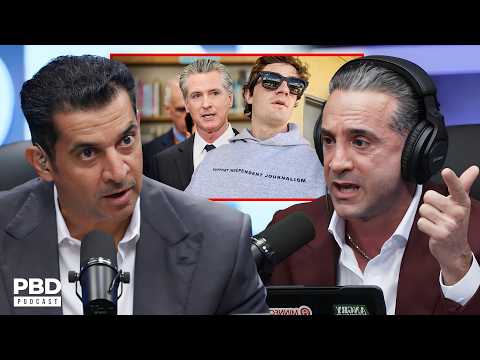
Gavin Newsom publicly announced that California is "leading the charge" against such fraud, specifically targeting 14 providers for billing Medi-Cal for non-existent hospice services using stolen identities. Nick Shirley, however, challenges Newsom's narrative, pointing out that Newsom's administration previously attempted to discredit Shirley for exposing these very frauds, leading to threats against him. Shirley asserts that Newsom is now taking credit for combating a problem that he either created or allowed to fester, positioning himself as the solution to a problem of his own making. This tactic is compared to how governments often operate, creating problems and then presenting themselves as the saviors.
A specific example of alleged fraud is highlighted through Nick Shirley's investigation into "Healthy Life Adult Daycare." Shirley reports that this facility has billed $19.8 million over the past few years. His on-site visit to the location, which appears almost dismantled from the outside, reveals a lack of adult activity despite the substantial billing. Inside, while there are workers and amenities like a pool table, there are no adults present, suggesting the facility might be set up "for a show." Further attempts to contact the facility via phone reveal a full voicemail inbox, indicating a lack of operational capacity for a legitimate daycare of its supposed scale.
The broader implications of this alleged fraud are discussed, with the speaker suggesting it's not merely incompetence but a systemic issue where various entities—bureaucrats, consultants, contractors, and political figures—all benefit. The sheer scale of the financial crimes, involving hundreds of millions, if not billions, of dollars, is emphasized. A comparison is drawn to high-profile financial criminals like Bernie Madoff and Allen Stanford, who received lengthy prison sentences for stealing from others. The question is raised about when accountability will come for those involved in these governmental frauds.
The conversation then addresses a recent announcement by California Attorney General Rob Bonta regarding a major hospice fraud bust in L.A. County, dubbed "Operation Skip Trace," which uncovered a scheme that defrauded Medi-Cal of $267 million. While acknowledging the bust, the speaker criticizes the timing, suggesting it's a reactive measure prompted by Nick Shirley's exposures. It's labeled an "election year response," designed to allow Newsom to claim he took action when cornered. The underlying concern is that these investigations are launched only when public pressure mounts, rather than as a proactive measure against long-standing issues.
A key point of inquiry is the tracking of funds, specifically whether any of the fraudulent money flows back to political campaigns or Political Action Committees (PACs). The speaker speculates that, similar to alleged activities in Minnesota, money might be routed offshore or back to PACs, creating a "veil" that allows candidates to claim ignorance while still benefiting from the funds. The idea that Governor Newsom, as the "CEO of California," would be unaware of such massive financial irregularities is dismissed as implausible.
The discussion further alleges systemic corruption, noting that officials like Bonta have faced their own scandals. These figures, it's argued, only pretend to address corruption when it's publicly exposed, hoping people will forget. The Minnesota fraud case is brought up again, suggesting that the "crisis" of riots and protests was used as a distraction from the corruption within the state. Similarly, it's suggested that any actions taken in California now are a distraction from the larger systemic issues that Nick Shirley is uncovering.
Nick Shirley is lauded for his impact, particularly for his role in exposing fraud in Minnesota, which allegedly led to Governor Tim Walz not seeking re-election. Shirley is now focused on California, and the question is posed whether he can achieve a similar outcome with Gavin Newsom. Newsom is portrayed as a highly skilled politician who, despite not having clear policy achievements for California, excels at maintaining a positive public image.
The segment concludes with a promotional announcement for the re-opening of a merchandise store, featuring a new, limited-edition "America 250" hat. The hat is described as a tribute to 250 years of "bold decisions" and "builders who moved before certainty." It's made with premium materials and is limited to 250 pieces, expected to sell out quickly. Information is provided on how to purchase the hat and other merchandise.