Pourquoi j'ai plus de Bitcoin que d'Or dans mon portefeuille ?
Audio Summary
AI Summary
The speaker begins by expressing enthusiasm for the morning podcast format, noting its relaxed atmosphere. He shares personal updates, including a recent trip to Portugal and the launch of a new, extensive video on his sports channel, "Lovig," titled "The Iceberg of Sport." He also discusses the progress of his second channel, "Iril 2," which focuses on macro topics beyond crypto, highlighting videos on Palantir, MTA, and the oil industry. He emphasizes the high production pace, having released 18 videos across his channels in March.
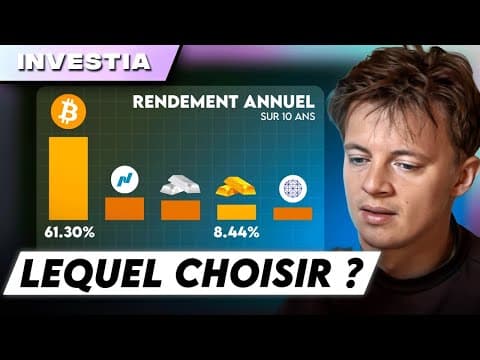
The core of the podcast delves into a comparison between Bitcoin and gold as stores of value. The speaker outlines three key criteria: portability, scarcity, and historical data.
**Portability:** Gold's physical transportation incurs significant costs (2-4% of value) and is complicated by geopolitical crises. In contrast, Bitcoin allows for near-instantaneous, permissionless global transfers of any amount, with transaction fees being the primary downside. The speaker highlights real-world examples of individuals in crisis situations (Ukraine, Argentina, Iran) who relied on Bitcoin's portability for their savings.
**Scarcity:** Gold's annual production is around 1.5%, and while its price has increased significantly, production has only doubled. However, uncertainties remain regarding technological advancements that could lower production costs or even the potential to transmute lead into gold. Bitcoin, on the other hand, has a mathematically guaranteed scarcity of 21 million units, hardcoded into its protocol and unaffected by external factors. The halving mechanism further reduces Bitcoin issuance over time. The speaker notes that attempts to create Bitcoin alternatives have failed, reinforcing Bitcoin's unique scarcity. A debate is raised about whether Bitcoin might lose velocity as it approaches its supply cap.
**Historical Data:** Gold boasts 5,000 years of monetary history, having endured wars, empires, and civilizations, lending it universal legitimacy rooted in all cultures. Bitcoin, at only 15 years old, lacks this historical depth, which is acknowledged as its primary weakness. Despite its youth, Bitcoin has maintained 15 years of network uptime without interruption and has seen accelerating institutional adoption, including Bitcoin ETFs and companies accumulating the asset. The speaker questions whether 15 years is sufficient to validate a long-term store of value but notes that each year without a major incident strengthens its case. He also contrasts Bitcoin's stability with events like the Ethereum Classic fork.
Ultimately, the speaker concludes that the question isn't which asset is "better," but which is more suitable for an individual's portfolio based on their needs and profile. His personal preference is for more Bitcoin than gold due to its amplified response to currency devaluation, driven by global liquidity. He believes Bitcoin has the potential to develop a "store of value" attribute beyond just hedging against currency devaluation, specifically in protecting capital during stock market downturns. He also mentions a free investor profile quiz he created to help listeners identify their profile and biases.
The podcast then shifts to a surprising aspect of the finance profession: the "coffee raiders" at the New York Stock Exchange. These 38 individuals are responsible for tasting and rating coffee aromas to help set prices for the global coffee futures market, valued at $250 billion annually. The job requires a high degree of sensory discernment, focusing on identifying flaws in coffee beans. Becoming a coffee raider is extremely difficult, involving at least five years in the coffee industry and a notoriously challenging exam with a low success rate. The speaker highlights a looming issue: many of these graders are aging, and the younger generation is less inclined towards this profession, potentially leading to a shortage of qualified individuals to manage the global coffee market. This illustrates how human expertise, even in seemingly niche areas, remains crucial and irreplaceable, contrasting with the perceived automation in finance.
Next, the speaker discusses Newton's third law of motion ("every action has a reaction") and its extension to inaction. He introduces the concept of "omission bias," the human tendency to judge inaction less severely than action, even when both lead to negative outcomes. He uses the example of running: ceasing training leads to a decline in cardiovascular fitness within days, a clear reaction to inaction. This principle applies to various domains, including business, where "cost of inaction" can be substantial, leading to lost market share, talent departure, and diminished competitive advantage. Inaction is comfortable short-term because it avoids the risk of making a mistake, but it allows for slow degradation that is difficult to perceive until it's too late. The speaker suggests reframing the question from "What did I do today?" to "What will my inaction today produce in three months?" He cautions against extreme optimization, emphasizing the need for a sustainable rhythm and balance.
The podcast then features the story of Katsushika Hokusai, the Japanese artist famous for "The Great Wave off Kanagawa." Hokusai spent 90 years of his life relentlessly pursuing artistic perfection, changing his stage name over 30 times to signify new phases of his work. Despite producing an immense body of work and influencing Western art, he never considered himself a master, constantly striving to improve and learn. His late-life pronouncements reveal a profound humility and a recognition of how much more there was to learn. The speaker uses Hokusai's story to illustrate that true mastery often involves recognizing the vastness of what one doesn't know, which fuels further motivation rather than discouragement. This principle, he argues, applies to all careers, including investing and surgery, where continuous learning and a persistent sense of discomfort are signs of ongoing progress, while complacency is detrimental.
Finally, the podcast touches on new scientific discoveries about dinosaurs. Two recent studies challenge the conventional image of dinosaurs as predominantly gray or green. One study, examining fossilized skin from a Diplodocus, identified melanosomes, indicating patterned skin with variations in shade, likely brown to black, similar to modern reptiles. This provides the first direct evidence of coloration in a sauropod. A second discovery in China revealed a new dinosaur species, "How Dongi," covered in quills, a feature never before seen in dinosaurs. These findings suggest that our understanding of dinosaur appearance is limited, and that intuition and assumptions have filled gaps where evidence was lacking. The speaker concludes by reiterating the dynamic nature of science, where new techniques constantly challenge and refine existing knowledge. He ends by encouraging listeners to like, subscribe, and take the investor profile quiz.