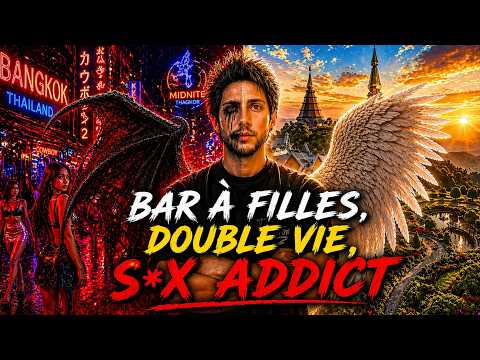
Il est le diable à Bangkok et l'ange à la campagne
AI Summary
The podcast features a Belgian guest named Noctis, who has a diverse background, including owning a bar in Bangkok and extensive travel in Southeast Asia. He explains that his nickname, Noctis, comes from a video game character whose story resonated with his own journey of changing his psychology and business upon arriving in Thailand.
Noctis shares his initial experiences in Thailand, which began over a decade ago when he was 25. He had taken a sabbatical from his work in Belgium, where he owned four hair salons. He highlights the stark contrast between the ambitious and positive mindset of people in Thailand compared to the more envious and less ambitious attitudes he perceived in Belgium and France. He recounted an anecdote where a Thai taxi driver applauded a passing Lamborghini, expressing admiration rather than jealousy, a reaction he found refreshing and indicative of a different societal mindset.
He explains that his decision to leave Belgium was driven by the high taxes and the lack of financial education, despite earning a significant income from his salons. He realized he had paid over a million euros in taxes over ten years but only had 20,000 euros saved, having spent lavishly on cars and dining. He felt limited by the local nature of his salon business and sought a broader impact.
Noctis admits that a significant draw to Thailand was the women, expressing a preference for their less "psychorigid" and more spontaneous approach to relationships compared to women in France. He describes his dating philosophy as "on the way," meaning he doesn't force encounters through apps like Tinder but rather lets relationships unfold naturally. He believes in focusing on self-improvement and allowing the right person to enter his life, emphasizing that true connections happen organically. He also differentiates between "easy" women, whom he calls "liberated," and those he seeks for serious relationships, noting that being "easy" doesn't equate to being "bad."
He shares his aversion to drama in relationships, which he attributes partly to the complexity of the French language, where detailed communication can lead to unnecessary debates. He finds Thai culture, with its more direct and less complicated approach, more appealing. He describes managing relationships like caring for a dog, with unconditional love and an understanding that if someone isn't interested, he moves on without excessive pursuit. He seeks peace in his relationships, contrasting it with those who enjoy conflict or drama, which he believes often stems from internal emptiness or a lack of personal projects.
Noctis organizes his relationships into three circles: well-being, vision, and action/work. He interacts with people based on their alignment with these circles. For instance, he doesn't discuss business or vision with family members who aren't open to such topics, keeping them within the "well-being" circle. This approach helps him manage interactions intelligently and avoid conflicts, allowing him to maintain relationships even with people who have different interests or mindsets.
He then recounts his experience opening a bar on Soi 22 in Bangkok with his current partner. He met her at her bar, where she was handling accounts. He was immediately attracted to her independence and entrepreneurial spirit, seeing her as someone who didn't need him to "complete" her. He found her challenging and admired her blend of traditional and modern Thai values.
Noctis decided to help his partner improve her bar's business. He describes a moment of nostalgia when he saw her handling cash, reminding him of his past as a salon owner. He realized that since moving to Thailand, his income came solely from online ventures, making him a "taker" of money from the internet rather than a "depositor" of cash from a physical business. This experience reignited his passion for tangible commerce.
He implemented marketing strategies, such as creating flyers with promotions and encouraging the bar's "hostesses" to distribute them on the street during slow periods. This led to a significant increase in clientele, making their bar one of the busiest on Soi 22. He also played a coaching role, engaging with customers in conversations that often extended beyond simply buying drinks, offering advice and building rapport. He estimates that he attracted 30-40% of the clientele, and his efforts boosted his partner's income from 2,000 euros to 8,000 euros per month.
However, their success was short-lived. The landlord, seeing the bar's profitability, decided to triple the rent from 65,000 baht to 150,000 baht upon contract renewal. Noctis and his partner refused, believing it was unfair to work solely for the landlord's benefit. After they left, the bar quickly failed, demonstrating that its success was largely due to their management and not just its location. This event deeply affected his partner, who had invested 2 million baht of her life savings into the business and fell into depression. Noctis, whose online crypto business had recovered, then supported her, reversing their previous roles.
Noctis is now looking to open another bar in Bangkok, but he's waiting for a market correction. He believes the city's real estate and business rents are inflated due to factors like Russian investment and predicts a bubble burst, similar to what happened 10-15 years ago. He aims to acquire a bar at a significantly reduced price when this occurs, possibly in areas like Pridi 2 or 3, which he sees as emerging hotspots. He emphasizes that he would only act as a coach, with his partner managing the business and staff, particularly given the visa requirements for foreigners.
He also shares details about his life outside Bangkok. They own a home in his partner's village, Tungsung, near Nakhon Si Thammarat, which he describes as a small, peaceful town. He spends three weeks there and three weeks in Bangkok, finding a sense of peace and discipline in the village that contrasts with the hustle of Bangkok. He appreciates the traditional family environment and the simpler, less materialistic lifestyle, which helps him reconnect with fundamental values and avoid the relentless pursuit of wealth.
He reveals his monthly expenses in Bangkok range from 3,000 to 7,000 dollars, with a minimum of 2,000 euros. In the village, however, he spent only 5,000 baht (about 120 euros) over three weeks, primarily on groceries, due to the lack of rent and the family support. He cherishes the privacy and tranquility of his village home, referring to it as his "tomb of Jesus," a place where he can escape and find security.
The conversation then takes a humorous and somewhat controversial turn regarding his personal life. He claims to have slept with approximately 2,000 women, 300 in Belgium and 1,700 in Thailand, mostly professionals. Despite this, he states he has never caught an STD or impregnated anyone. He attributes this to his "donor" energy, believing that positive energy repels illness, while fear attracts it. He recounts an anecdote about a friend who contracted a rare STD despite using protection, which he links to the friend's "taker" energy and fear. He acknowledges that his views might be misinterpreted and emphasizes the importance of protection, but reiterates his personal philosophy.
The hosts conclude the podcast by thanking Noctis for his candidness and colorful stories, acknowledging that some parts might require extensive editing for YouTube. They encourage listeners to subscribe, comment, and connect with Noctis on his social media channels.