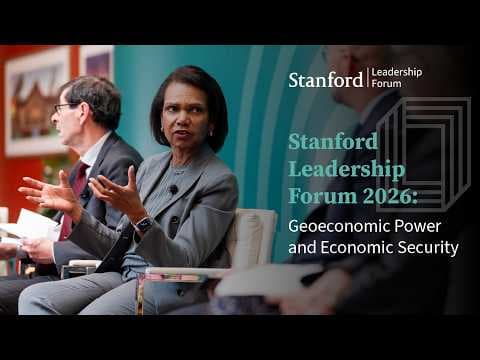
Stanford Leadership Forum 2026: Geoeconomic Power and Economic Security
Audio Summary
AI Summary
The panel discussion, moderated by Gillian Tett of the Financial Times, focused on the rise of geoeconomic power and economic security, a shift described as the "fourth big zeitgeist shift since 1900" in how the global political economy is imagined. This transition moves from a world addicted to globalization and free-market capitalism to one of geo-economics and geo-finance, a phenomenon not widely encountered in recent generations. The timing of the discussion was highlighted as particularly relevant, given current geopolitical events in the Strait of Hormuz and the foresight of the organizers in delving into these issues years ago.
The panel featured H.R. McMaster, Maurice Obstfeld, Condoleezza Rice, and Matteo Maggiore. Each speaker offered insights into whether the swing towards geoeconomics is temporary or permanent, and its implications for companies, countries, and the economics profession.
Condoleezza Rice, speaking as a political scientist, argued that the current discussions about national security and economics are a reflection of the international system's evolution since World War II. After WWII, the US and its allies built an international economic system designed to be positive-sum, promoting free trade, currency stability, and capital movement, protected by American military power. This system also bet on the "democratic peace" theory, encouraging democracies like Germany and Japan. Initially, the Soviet Union's isolation from this system meant national security and economic issues remained separate. However, China's admission to the WTO in 2001 fundamentally altered this. China, neither a democracy nor part of American security arrangements, benefited from the system while simultaneously challenging it. Xi Jinping's 2015 speech, declaring China's intent to surpass the US in frontier technologies and integrate these advancements with the military, marked a "hinge point" where national security and economic issues became inextricably linked. Rice stressed that this is a structural swing, not a short-term blip, driven by long-term secular trends and a growing US resentment over carrying a disproportionate security burden.
Maurice Obstfeld echoed Rice's sentiments, asserting that the linkage between security, foreign, and economic policy is not novel. He characterized the period from 1990 to 2010 as a historical anomaly, suggesting a return to form. Obstfeld referenced Alexander Hamilton's historical arguments for connecting national wealth, independence, and security with manufacturing prosperity and robust public credit. While the current administration recognizes the importance of manufacturing, Obstfeld criticized its methods and actions, particularly regarding financial infrastructure, undermining the Fed, and fiscal deficits. He agreed that the post-WWII multilateral system was farsighted but unstable, largely due to China's rise as a revisionist power. Obstfeld expressed concern that the current administration lacks a non-conflictual strategy to deal with China, potentially leading to China's "dream scenario" by 2030. He questioned whether a polarized nation like the US can effectively act as a great power, quoting Hamilton on the dangers of disunion.
H.R. McMaster, approaching the topic as a historian, concurred with Rice and Obstfeld on the stakes and trajectory. He framed the fundamental issue as a competition between free-market economies and democratic societies against an "axis of aggressors" (China, Russia, Iran, North Korea, and regimes like Venezuela and Cuba). This axis coalesced after the West's post-Cold War assumptions—that history guaranteed the primacy of free societies, great power rivalry was over, and Western prowess ensured security—proved false. Strategic shocks like 9/11, the Iraq and Afghanistan wars, the 2008 financial crisis, the opioid epidemic, social media's impact, and manufacturing job losses fueled polarization and a perception of Western weakness among adversaries. McMaster argued that this perceived weakness emboldened the authoritarian axis, citing Xi Jinping's 2015 speech, the "no limits" partnership between China and Russia, and Iran's actions. Despite this, McMaster expressed optimism, believing the aggressor axis is overextended. He highlighted the importance of integrating economics, military power, and diplomacy, and fostering cooperation among free societies. He proposed a "five I's" framework for action: insulate (economies from Chinese aggression), incentivize (investments to reduce vulnerability and grow competitive advantages in critical sectors like AI and quantum), immigration (human capital, attracting global talent), integrate (geopolitics into public and private decision-making, avoiding investments that aid adversaries or jeopardize long-term viability for short-term gains), and internationalize (collaborating across the free world). Responding to a question about US overextension, McMaster argued that the US capacity for innovation, private sector strength, energy abundance, and democratic society far outweigh the vulnerabilities of Russia or other authoritarian regimes.
Matteo Maggiore addressed the question of whether the economics profession needs radical rethinking. He agreed with Obstfeld that the post-1990 period was an aberration. The tools developed by modern economics, assuming a self-contained, unpolluted system, are now challenged by the re-emergence of geo-economic issues. He referred to Albert Hirschman's work on Nazi Germany weaponizing its economy, suggesting a return to a "depressing time" for economic thought. However, Maggiore argued that recent economic tools can be adapted to incorporate dependency. He critiqued current US policies, such as the mismanagement of the US's dominant financial infrastructure (e.g., abusing allies like Europe who control parts of the system, and monetizing with stablecoins rather than innovating for public good) and blanket tariffs (which alienate allies and are ineffective in closing trade deficits, as the cost is often borne by domestic consumers). Maggiore stressed that the loss of US leadership credibility means the old world order is permanently broken. He advocated for restraint in the use of economic power, reserving severe punishment for egregious actions like invading Ukraine, and never using it for short-term commercial gains or against allies. He emphasized the understated importance of alliances and the need for Europe to increase defense spending and lower barriers. Maggiore concluded by emphasizing the importance of rebuilding national characteristics like reputation and doing the right thing, which requires public conversations.
In the Q&A, Condoleezza Rice further emphasized the importance of immigration for attracting global talent and the need for a two-way conversation with European allies, who must also step up their contributions to security. She believed NATO would survive but needed to rethink its structure and responsibility redistribution, especially with new members like Finland and Sweden, and a battle-hardened Ukraine. She stressed the need for a vision for the transatlantic relationship under new conditions. McMaster reiterated the global nature of competition with China and the role of capable alliances in preventing war. Both Rice and McMaster highlighted the necessity for the US, as a global power, to manage multiple fronts simultaneously without losing sight of key strategic competitors.
Regarding the role of business school students, Rice and McMaster urged them to recognize their role as players in the international order and national security. They encouraged leadership in the private sector to foster meaningful discussions and contribute to a better future. On the topic of public backlash from tariffs and strained alliances, Rice suggested that repairing relationships requires more than just government action, extending to business and university interactions. She noted that great powers are not always popular and that America's best representation often comes from its citizenry and private sector, not solely from government diplomacy.
Finally, in response to a question about NATO eastward expansion contributing to Russia's invasion of Ukraine, Rice firmly rejected this, stating it was "reading Vladimir Putin's talking points." She noted that Putin never raised NATO expansion with her or George W. Bush during her eight years as Secretary of State, except for specific missile defense systems.
Gillian Tett concluded by summarizing three key takeaways: the rise of geoeconomics is a permanent, long-term shift not solely attributable to Donald Trump; governments are struggling to adapt their policies to this new age, with US policy facing criticism and Europe needing a serious rethink; and students of business and economics must discard outdated models and recognize political risk as a new reality affecting all assets.