PREPARE: The Trump MACRO SUPER CYCLE is STARTING
Audio Summary
AI Summary
The video discusses the macro super cycle, the significance of the Chinese summit, and recent market news. Kevin Worsh has been confirmed as a member of the Federal Reserve board, with Jerome Powell's term as chairperson ending soon. Yields are showing signs of breaking out, and recent PPI numbers were concerning, largely attributed to rising oil prices with Brent crude at $106. Despite the ongoing closure of the Strait of Hormuz, markets are anticipating either a resolution or alternative oil routes.
A key focus is the upcoming Chinese summit, a bilateral meeting between Donald Trump and Xi Jinping. The summit aims to boost U.S. product and service sales to China, reduce the trade deficit, and involves numerous U.S. executives from various sectors. Expected deals include a significant Boeing order for 737 Max jets and other aircraft. Tim Cook is attending to explore expanding supply chains for rare earths and the iPhone ecosystem. Elon Musk is seeking FSD approval, and the Cargill CEO is aiming for agricultural purchase commitments. Financial institutions like BlackRock, Blackstone, and Visa are also present to gain access to Chinese financial markets.
A major point of interest is Nvidia's position. Initially banned from selling chips to China, Nvidia's CEO, Jensen Huang, reportedly made a donation to a Trump event, after which Nvidia was allowed to sell H200 chips, subject to Commerce Department approval. However, Nvidia has not yet sold any H200 chips to China, while Huawei is developing its Ascend 950 series to compete with U.S. chips. China is a significant player in chip manufacturing and AI research, producing 60% of mainstream chips and employing 50% of the world's top AI researchers. While not yet producing the most advanced chips, China is rapidly catching up, with AI chip makers already holding a substantial market share. The speaker believes Nvidia could see a significant breakthrough in China, potentially pushing its stock price higher.
The video also touches upon the impending expiration of tariffs on November 10, 2026, which could impact China's suspension of rare earth exports to the U.S. There is hope for a negotiated deal to extend these tariffs and increase purchases of American products. Additionally, there's speculation that China might assist in resolving the Iranian war, given its significant oil purchases from Iran. China's economic incentives to strike a deal are considerable, stemming from its real estate and manufacturing deleveraging and its need for buyers to sustain its manufacturing capabilities. Xi Jinping is described as a brilliant strategist, focused on long-term economic benefits for China, which could fund military expansion and potential actions regarding Taiwan. The U.S. has reinforced its "silicon shield" for Taiwan with a trade agreement and continues to sell arms to Taiwan. Germany is also looking to re-arm due to potential U.S. troop withdrawals and reliance on NATO.
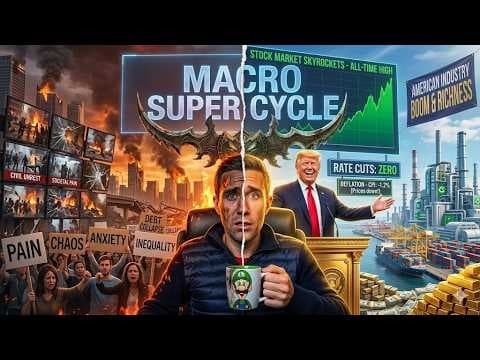
These developments are seen as reiterating the "macro super cycle," a concept suggesting that deglobalization will lead to increased domestic spending, potentially higher short-term yields, but long-term productivity gains and disinflation. The speaker aligns with this view, believing that the current decade is favorable for real estate investment despite high rates. The argument is that decades of underinvestment due to globalization are ending, and increased protectionism, while potentially causing short-term inflation, could ultimately lead to lower yields. The speaker anticipates a return to a "great moderation" with declining interest rates, possibly starting around 2032. Currently, however, yields are rising, with negative news on PPI and CPI. The oil crisis is expected to resolve, leading to lower yields, coinciding with disinflation from AI-driven capital expenditure. In the interim, concerns about rate hikes persist. Despite short-term challenges, the speaker is optimistic about the macro super cycle and foresees a return to strong performance in software-related stocks after a current hardware run.