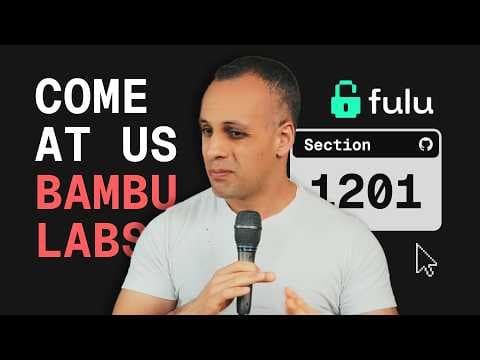
Hey Bambu Lab: come sue us.
Audio Summary
AI Summary
Lewis Rossman discusses Bamboo Labs, a 3D printer company, and their controversial authorization controls. These controls, added a year and a half ago, limit how third-party software interacts with their printers, a change that was not present when customers initially purchased the devices. This has frustrated users who appreciate the ease of use but dislike the reduction in freedom.
A key issue revolves around Orca Slicer, a third-party slicer software that allows users to prepare 3D models for printing. Many users prefer Orca Slicer over Bamboo Labs' proprietary system and sought to bypass the authentication. A developer created code to enable this, effectively restoring the printer's original functionality. However, Bamboo Labs issued a cease and desist notice to this developer, threatening legal action and invoking Section 1201 of the Digital Millennium Copyright Act (DMCA).
Section 1201 of the DMCA criminalizes bypassing digital locks, even for legitimate purposes like repairing purchased products. Rossman likens this to lawsuits against third-party ink cartridge manufacturers who create compatible products for printers with DRM. He expresses strong opposition to this law, noting that the Fulu Foundation is dedicated to its reform.
The developer, unwilling to engage in a prolonged legal battle, removed his code. Rossman then offered $10,000 for the code to be reinstated. The developer's primary motivation was to highlight Bamboo Labs' violation of the AGPL (Affero General Public License).
AGPL is a software license requiring that if a program uses AGPL-licensed code, any modifications or derived works must also be made available as open-source, allowing free redistribution and modification. Bamboo Labs utilized AGPL-licensed code in their software but then attempted to impose restrictions on its use.
The developer's "fork" of the software, which allowed users to operate their printers as initially intended, simply reused Bamboo Labs' own AGPL code, including its original user agent and version number. Bamboo Labs claimed this constituted "impersonation" and a deceptive manner of operation, violating their terms of service.
Rossman refutes this, explaining that the developer merely used Bamboo Labs' open-source AGPL code without modification. He highlights that the AGPL license explicitly states that no further restrictions can be imposed on the rights granted. Bamboo Labs' terms of service, which forbid modifying, reverse engineering, or creating derivatives, directly contradict the AGPL license under which they released parts of their software.
Rossman uploaded the code to his own GitHub repository, daring Bamboo Labs' legal team to pursue action. He highlights his extensive history of successfully challenging large corporations like Apple, Google, Cisco, IBM, John Deere, and the medical industry on right-to-repair and open-source issues.
He warns Bamboo Labs that any legal action will be met with a vigorous defense, aiming to expose the flaws in their Section 1201 claim and establish a precedent for reforming the law. Furthermore, he vows to pursue AGPL violations, collaborating with organizations that have successfully challenged companies for misusing open-source code. Rossman pledges to ensure that Bamboo Labs incurs legal fees significantly higher than any costs they attempt to impose on him, expressing absolute confidence in the weakness of their case. He concludes by inviting Bamboo Labs to "make his day."