Paper Cutting & Paper Folding - Tricks & Shortcuts for Placement tests, Job Interviews & Exams
Audio Summary
AI Summary
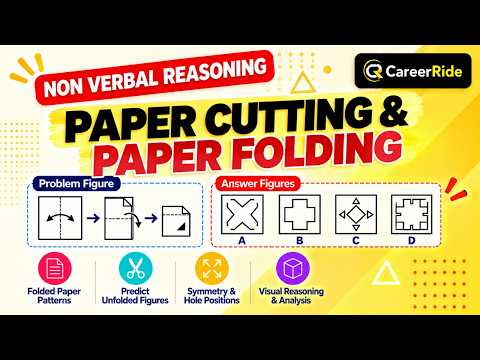
This video focuses on paper cutting and paper folding, a topic often perceived as difficult by students but is, in fact, very easy. The core concept relies on understanding water images and mirror images. If these concepts are clear, solving these problems takes less than 10 seconds.
**Basics of Paper Cutting and Folding:**
When a paper is folded, it creates either a mirror image or a water image.
* **Vertical Folds:** Folding a paper vertically (e.g., in half from left to right) creates a mirror image.
* **Horizontal Folds:** Folding a paper horizontally (e.g., in half from top to bottom) creates a water image. In a water image, the top becomes the bottom and vice versa.
* **Diagonal Folds:** Diagonal folds can also create mirror images, depending on the orientation.
The key is to identify the type of fold and apply the corresponding image transformation. The most effective strategy for solving these problems is through elimination of incorrect options rather than trying to directly find the correct answer.
**Paper Cutting Examples:**
**Question 1:** A paper is folded horizontally, and a circle and a triangle are cut.
* Since it's a horizontal fold, water images will be formed. The top part of the cut will become the bottom, and the bottom part will become the top, with their orientation reversed.
* Eliminating options:
* Option 1 has only three cuts.
* Option 2 shows the circle moved from its place.
* Option 3 has four cuts but the distance between the triangle and circle has increased.
* The correct option is the one where the water images are formed correctly, with the circle at the top and the triangle at the bottom, both reversed.
**Question 2:** Paper folded horizontally, then vertically, then cuts are made.
* Opening the vertical fold will form mirror images, and opening the horizontal fold will form water images.
* Eliminating options:
* Option 4 only shows water images, missing mirror images.
* Option 3 shows an arrow moved from its place.
* Option 1 shows correct mirror images but incorrect water images (triangle orientation is wrong).
* Option 2 correctly shows both mirror and water images with correct orientations.
**Question 3:** Paper folded once, then vertically, then cuts are made.
* When opened, cuts will be formed due to both folds, creating water and mirror images.
* Eliminating options:
* Option 4 shows nothing happening due to water images.
* Option 3 shows the original circle cut moved.
* Option 2 shows a small circle moved from its place.
* Option 1 correctly depicts the resulting cuts.
**Question 4:** Paper folded horizontally once, then vertically once, then cuts are made.
* Opening the vertical fold creates mirror images, and opening the horizontal fold creates water images.
* Eliminating options:
* Options 1 and 4 are immediately eliminated based on the initial cuts.
* Option 2 is eliminated because the triangle's orientation is incorrect.
* Option 3 is the correct answer.
**Question 5:** A paper is folded twice, creating a small final piece where cuts are made.
* When opened, mirror images will be formed in sequence. This implies four elements in each line.
* Eliminating options:
* Option 2 has only three elements.
* Option 4 shows elements moved from their places.
* Option 3 shows incorrect mirror images (triangle orientation is wrong).
* Option 1 is the correct answer.
**Question 6:** Paper folded vertically, then another fold, then cuts are made.
* This setup should result in four distinct elements in each line when unfolded.
* Eliminating options:
* Option 4 doesn't show four distinct elements, and an arrow has moved.
* Option 3 shows only three elements in the first line.
* Option 2 shows an element moved from its place.
* Option 1 is the correct answer.
**Question 7:** A rectangular paper is folded twice, then cuts are made.
* This implies four distinct elements when unfolded.
* Eliminating options:
* Option 4 (bottom line) has only three triangles.
* Option 1 (first line) has only three elements.
* Option 2 shows a circle moved from its place.
* Option 3 is the correct answer.
**Question 8:** Paper folded diagonally, then another small fold, then cuts are made.
* This will create mirror images and reflections across the diagonal fold.
* Eliminating options:
* Option 4 has too few circles.
* Option 2 shows everything formed in one place, with too many circles.
* Option 1 has no mirror image on the opposite side.
* Option 3 is the correct answer.
**Question 9:** Paper folded multiple times, creating a small piece, then cuts are made.
* Focus on the center of the page. The cut in the center and the triangle will create a specific pattern.
* Eliminating options by looking at the center:
* Options 1, 2, and 3 have incorrect patterns in the center.
* Option 4 correctly displays the center pattern.
**Question 10:** A small piece of paper is folded vertically, then horizontally, then cuts are made.
* The key is that the folds are not from the center, so only parts of the paper will form images.
* Eliminating options:
* Option 3 is eliminated immediately.
* Option 1 shows no mirror images.
* Option 4 shows a circle moved from its place.
* Option 2 is the correct answer.
**Question 11:** A circular paper is folded horizontally, then vertically, then cuts are made.
* This will create both water and mirror images.
* Eliminating options:
* Option 3 has no water images.
* Option 2 has no mirror images.
* Option 4 shows a circle moved from its place.
* Option 1 is the correct answer.
**Question 12:** A triangular paper is folded vertically, then a small fold, then cuts are made.
* Expect mirror and water images.
* Eliminating options:
* Option 3 is eliminated.
* Option 2 shows the triangle missing.
* Option 4 shows a circle moved from its place.
* Option 1 is the correct answer.
**Question 13:** A paper is folded vertically twice, then cuts are made.
* Due to the folds, elements will form mirror images.
* Eliminating options:
* Option 2 is eliminated because the bottom elements are not mirror images.
* Option 4 is eliminated for the same reason as option 2.
* Option 3 is eliminated because the central squares are not mirror images.
* Option 1 is the correct answer.
**Question 14:** A square paper is folded horizontally, then vertically, then cuts are made.
* The center cuts will form mirror and water images.
* Eliminating options:
* Options 1 and 3 are eliminated immediately based on the center pattern.
* Option 4 is eliminated because the corner cuts are incorrect ("ear-like" shape instead of a semicircle).
* Option 2 is the correct answer.
**Paper Folding Examples (Reverse Process):**
In paper folding, a paper with an existing drawing is folded, and the resulting image is to be determined. The same elimination technique applies.
**Question 1:** A paper with a filled circle and a vertical line is folded along a horizontal dotted line.
* When folded, the filled circle and the vertical line will move to the other side, forming mirror images.
* Eliminating options:
* Option 1 is missing the filled circle and the line.
* Option 3 shows a semicircle being repeated, which is incorrect.
* Option 4 shows the unfilled and filled circles moved from their places.
* Option 2 is the correct answer, showing the elements correctly mirrored.
**Question 2:** A paper with a curve and a square is folded along a dotted line.
* The curve will overlap, and the square will move.
* Eliminating options:
* Option 1 is missing a circle.
* Option 2 shows the curve moved to the other side.
* Option 3 shows an extra semicircle.
* Option 4 correctly shows the overlapping curve and the moved square.
**Question 3:** A paper with multiple curves is folded along a dotted line.
* The curves will shift and overlap.
* Eliminating options:
* Option 4 shows curves moved to the other side.
* Options 2 and 3 show the number of curves reduced or disappeared.
* Option 1 is the correct answer, showing the curves correctly shifted and overlapped.
**Question 4:** A paper with a circle, triangle, squares, and dots is folded along a dotted line.
* The dots will go inside the circle/triangle, and the square will move.
* Eliminating options:
* Option 1 shows an inverted triangle.
* Option 2 shows the square along the circle, which is incorrect.
* Option 4 shows the dots missing.
* Option 3 is the correct answer.
**Question 5:** A paper with a complex shape (pentagon and circle) is folded along a line.
* The fold will create a mirror image of the existing elements.
* Eliminating options:
* Option 1 shows a circle completely missing.
* Option 4 shows a part missing.
* Option 3 shows an incorrect mirror image of the pentagon part.
* Option 2 correctly shows the mirror image.
**Question 6:** A paper with a small triangle and a line is folded from the center.
* The small triangle and line will form mirror images.
* Eliminating options:
* Options 1 and 3 show the right side of the picture having no impact on the left side.
* Option 2 correctly shows the mirror image of the triangle and line.
**Question 7:** A paper with a complex shape is folded along a vertical line.
* The left-hand side picture should move to the right-hand side, forming a mirror image.
* Eliminating options:
* Option 3 shows the left-hand side picture not moved.
* Option 4 shows a missing triangle.
* Option 2 shows a water image instead of a mirror image.
* Option 1 is the correct answer.
**Question 8:** A paper with arrows is folded horizontally from the center.
* This is a horizontal fold, so water images will be formed (top becomes bottom, bottom becomes top).
* Eliminating options:
* Option 4 has only one arrow.
* Option 3 shows an incorrect water image.
* Option 1 shows both arrows moved to one side.
* Option 2 is the correct answer, showing the arrows correctly transformed as water images.
In conclusion, paper cutting and folding problems are straightforward applications of mirror and water images. The most efficient way to solve them is by using the elimination technique, quickly discarding incorrect options based on the principles of image formation. Consistent practice is essential to develop the speed and accuracy required for these questions.