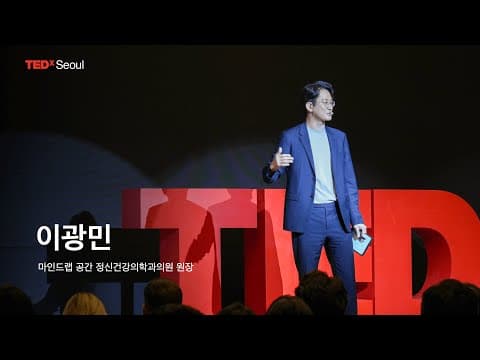
진료실 너머, 차이를 넘어 | Kwang-Min Lee | TEDxSeoul
Audio Summary
AI Summary
Psychiatrist Lee Gwang-min discusses his journey and approach to his profession, beginning with his initial reluctance and eventual embrace of psychiatry. He admits to being quite nervous despite his public appearances, confessing to extreme anxiety before his talk, even shedding tears. He attributes his nervousness to speaking about himself without a prepared manuscript, contrasting his approach with the diligent preparation of previous presenters.
He shares the most frequent question he receives: "Why did you become a psychiatrist?" He reveals that his primary reason was his inability to stand the sight of blood and his aversion to causing pain, common in most medical treatments. This realization left him feeling there was no major he could pursue, leading him to psychiatry as an "act of avoidance and escape." His father's warning, "If you only see crazy people, you're going to go crazy too," highlighted the societal stigma against psychiatric patients.
He challenges the common perception of psychiatric wards as dark, scary places, describing his experience as a comfortable, safe haven where time flows differently, akin to the Hyperbolic Time Chamber. He found patients to be similar to himself – timid, hurt, and afraid of people. Observing patients helped him recognize his own anger, loneliness, and wounds. An elderly psychiatrist taught him the importance of seeing one's own problems within the patient's context and working together to resolve them. He realized that as patients improved, his own issues were also being addressed.
After residency, he chose Consultative Coordination Psychiatry at Seoul National University Hospital, a specialty managing the mental health of physically ill patients. This choice was a significant personal shift, as he had initially avoided physically ill people. He explains the close connection between mind and body, emphasizing that mental health management is crucial for effective physical healing. His fellowship involved treating patients in internal medicine, surgery, intensive care units, and emergency rooms, requiring him to visit various wards daily, often walking 10,000 to 20,000 steps. This role helped him overcome his fear of blood and sick people, working outside the traditional psychiatric ward.
His doctoral research focused on the mental health of cancer patients, a field called psycho-oncology. He advocates for integrating psychiatric care into general cancer treatment, moving away from the "double stigma" of separate referrals. He notes that many hospitals now offer integrated care, acknowledging that cancer is a pervasive reality, with over 38% of Koreans expected to experience it. He highlights the ongoing social prejudice against cancer patients, similar to that against mental illness.
Feeling a sense of guilt and indebtedness within the consulting room, he recognized that complex social problems like isolation, violence, addiction, and suicide cannot be solved solely by treating individual patients. This led him to participate in programs like 'I Want to Know,' striving to step out of the consulting room and become a doctor who cures society. He sees this as a "crossover" – fusing different domains like patient and doctor, normal and abnormal, body and mind, illness and people, and society – to resolve problems and move forward.
He reflects on his "fierce life" and the exhaustion it brings, finding motivation in his grandmother, who prayed for him ceaselessly throughout her life. Her constant refrain, "Gwangmin, I am praying for you," fuels his drive to live diligently and endure fiercely. He encourages others to remember their own precious supporters as they engage in crossovers to lead the era in a better direction.