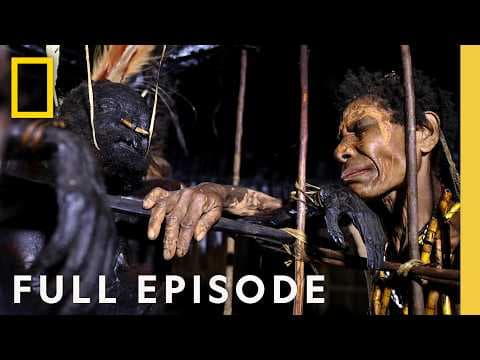
Mystery Mummies of New Guinea (Full Episode) | DOCUMENTARY SPECIAL | National Geographic
Audio Summary
AI Summary
Photographer Ulla Lohmann ventured into Papua New Guinea, a land where sorcery and, until recently, cannibalism are part of everyday life. As the advance member of her team, Ulla sought to investigate the long-vanished practice of human mummification among the Anga people. This region has a deep history of preserving the dead, prompting questions about how these mummies were made, why, and how they survived in such a hot and humid climate, especially since there's no record of human mummification for over a generation.
Walter Eidam, a former missionary who worked in the area in the 1950s, was one of the last Westerners to witness a mummification. He recounted the "terrible smell" of the body before the process began. Ulla, now an "insider" due to previous trips, hoped to be the next to witness this unique ritual. She awaited her team in Koke village, a place she considers her second home, where she knew many mummy secrets could be unveiled. Her return to Koke was met with an emotional welcome by village elder Gemtasu, who adopted her as his daughter years ago. Ulla communicates in Pidgin, the common language among the country's 800+ local tongues, and photographs the faces of loved ones, a practice vital to the Anga.
High above the village, in a shallow cave, lies a cliff gallery of mummified ancestors. Ulla described her initial fear upon seeing these openly displayed dead, whom the Anga believe are alive, spirits that protect the living. They even talk to the mummies, believing that bad things happen when the spirits are upset.
In the 1950s, missionaries like Walter Eidam introduced new beliefs, creating a spiritual dilemma for people like Gemtasu, torn between ancestral customs and Christianity. Moimango, a mummy created about 60 years prior, was brought down to the village for inspection and repair by Ulla's arriving colleagues. After its journey, it needed to be dried, as moisture is a mummy's greatest enemy. An extraordinary family reunion took place when Moimango, long dead, met his son, Gemtasu, who as a boy helped mummify his father. Gemtasu, having not seen Moimango for a long time, expressed a profound wish: he wanted his body preserved like his father's, to become a mummy and follow his ancestors' customs. If his wish is granted, he would be the next mummy, with the crucial step of slow smoking over a fire taking place in a hut.
Gemtasu, trusting Ulla as a friend, planned to reveal the mummification process to her. His brother, who also wanted to be mummified, ended up buried due to missionary influence. Gemtasu's nephew prefers remembering the dead through the actual body, not a flat image, a sentiment Gemtasu shares. Gemtasu, in his 70s and suffering from malaria, has witnessed immense change, growing up in a time resembling the Stone Age and seeing his first white person during World War II. Stuck in a cultural limbo, he has decided to become a mummy.
The mummies of Papua New Guinea can remain intact for about 50 years without restoration, a remarkable feat given the tropical heat and humidity. Biomedical scientist Ron Beckett and anthropologist Andrew Nelson joined the expedition to investigate this longevity and help the Anga restore their loved ones. They navigated dangerous roads to reach Koke village, guided by landmarks like the mummy gallery cliff.
Their first task was to transfer Moimango to a new chair, a delicate operation to prevent the decrepit mummy from breaking. With Moimango now sitting straighter, he resembled his former self, a leader feared for his mysterious powers. Sorcery like Moimango's waned with the missionaries' arrival, leading to a loss of traditional knowledge. Ulla discovered that Walter Eidam, the missionary, had baptized Gemtasu, a surprising connection.
Ron and Andrew found preservation secrets in the mummy gallery, such as a skin coating of reddish ochre that protects and dries the body. Their portable weather station confirmed a cooler, drier, and well-ventilated climate at the cliff compared to the village, ideal for preservation. However, decades of exposure take their toll. Rare 60-year-old footage showed families toiling for a month to prepare a body, resulting in a lasting memento. Gemtasu believed mummification would grant him eternal life, allowing his spirit to return to his body at night.
Gemtasu passed on the tradition to his grandson and nephew, demonstrating the crucial step of extracting body fluids with a strong grip. He described how a stick is used to facilitate the removal of intestines. Using a pig carcass, Gemtasu's clan revealed the process: scraping the skin with a nettle leaf to keep pores open and using sharp sticks to drain fluids, all focused on drying the body. They also revealed the disconcerting practice of applying body fluids to the legs and arms, believing it keeps the ancestor's spirit with them.
The team followed rumors of exceptionally preserved mummies in a distant village, kept indoors as a tourist attraction. Ron and Andrew paid an admission fee to examine them, finding a visible red ochre coating. A small camera revealed internal preservation, with soft tissue and main stem bronchi still intact, demonstrating the effectiveness of the smoked body method. They also discovered deep slashes and stitching across the chest and forehead of some mummies, indicating they were killed—likely in revenge killings, a common practice in warfare, before being mummified.
Back in Koke, Ulla investigated stories of cannibalism, a topic her hosts initially denied but eventually admitted to. While cannibalism is likely extinct, the legacy of warfare remains.
In a nearby village, Walter Eidam described where he witnessed a mummification. Ulla and the team sought this "last mummy," but an armed crowd blocked their path to a sacred stone cliff. After initial resistance, Ulla's persistent arguments and offer were accepted. With climbing partner Franck Tessier, Ulla scaled the cliff, finding an empty cave with only human bones, not the mummy Walter Eidam described. Ron suggested it might be a different type of burial or a different rock.
The next day, a local man led them to another cliff niche, where Ulla immediately found bones. Andrew identified a male adult with preserved soft tissue, confirming it was a smoked body. However, its poor condition offered no new insights. This mummy, possibly the last one Walter Eidam saw being made, underscored the need for restoration.
The team rushed back to Koke to work on Moimango, Gemtasu's father. They aimed to establish a new cultural tradition of mummy restoration using jungle materials like tapa (mulberry bark) for patching and tree sap for glue. They mended Moimango's jaw and applied a protective ochre coating, teaching Gemtasu's grandson this final step. Moimango was then returned to the cliff, ready to keep Gemtasu company.
Ulla's quest for the last mummy led her to what she hoped would be the next one: Gemtasu. She promised to fulfill his wish to become a mummy. Sometime later, Ulla learned through the "bush drum" that Gemtasu had passed away. Overwhelmed, she initially couldn't go, but after five sleepless nights, she returned to Koke three weeks into his mummification.
Entering the dark, smoke-filled hut, Ulla saw Gemtasu's black feet, swollen belly, and finally, his peaceful face. Despite tears and emotion, she smiled, feeling his presence. Surrounded by generations, the ancient practice was passed down, with Gemtasu's son, Awateng, leading the seven chosen family members in the three-month process. They cannot leave the hut area or clean themselves, washing body fluids over their faces, careful not to let them touch the ground, lest the earth scream for more.
Gemtasu had meticulously prepared, building a round house for optimal smoke circulation and a separate house for his mummifiers. Ulla, a scientist