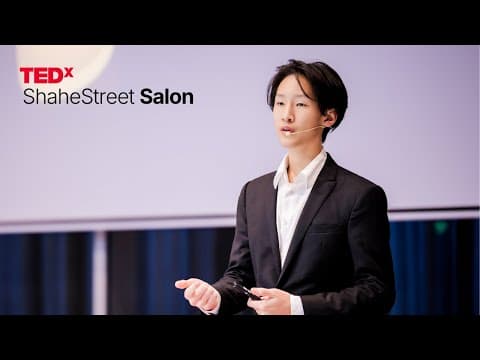
Life Doesn't Come at You, It Comes From You | Zijian Charles Liu | TEDxShahe Street Salon
Audio Summary
AI Summary
The speaker begins by asking the audience to feel their pulse, emphasizing that this rhythm, a signal of life, is always present but often unfelt. He recounts a personal experience from a Wednesday morning at 6:00 a.m. on his Shenzhen apartment balcony. Sitting alone in silence, he initially found himself fidgeting and his mind wandering, seeking distractions from the quiet. This led him to recall nights spent locked in his dorm basement the previous year, processing the trauma of academic failure. During those nights, he merely replayed and carried the experience, not attempting to fix it.
On that particular Wednesday morning, he tried positive affirmations but realized he lacked a fundamental reason to believe in himself. Instead, he simply closed his eyes and focused on his breathing. He became conscious of each slow, steady breath, realizing they came from his own lungs, and the soft heartbeat from his own heart. In that moment, he understood that amidst the world's joys and sadness, its reasons for laughter or tears, hatred or love, all he truly had was himself, breathing in and out. This experience on the balcony marked a significant change.
To explain this change, he refers back to his time in the basement. Like many, he had looked outward, waiting for external validation—a grade, a compliment, a sign—to tell him he was okay. He waited for the world to provide a reason for self-belief, but it never came because that's not how it works. He illustrates this by noting that everyone in the audience chose to be there, a personal decision, whether out of curiosity or a friend's invitation. When life is perceived as something done *to* you, one feels trapped. However, recognizing that you *chose* to be there, that it's your "brushstroke on your canvas," transforms the experience. It doesn't make things easier, but it liberates you from being a prisoner, making you an author of your own life.
This realization on the balcony was that life doesn't come *at* you; it comes *from* you. Every heartbeat and every breath is your own. The source of self-belief and meaning was never external; there's no secret or magic to be found elsewhere. It was always within. Once he found his own "pulse," he began to perceive it in everything else. He describes smiling at flowers in Shenzhen, something he would have ignored months prior. The world hadn't changed; he had.
He then shares another anecdote from a chicken restaurant in Baiuhou, an urban village in Shenzhen. He observed a little girl in a school uniform with a parrot perched on her hand and shoulder. She pressed her lips to the parrot, trying to kiss it, seemingly oblivious to what made sense or what others might think. She simply wanted to love what she loved, and that was enough. When he asked if the bird would fly away, she looked at him as if it were the strangest question, replying "Of course not." He realized she didn't need to find her pulse; it was always there.
The speaker concludes by asking the audience not about meditation, which is his practice, but about what it would take for them to appreciate themselves—not their accomplishments or what others see, but the person who remains when the noise stops and no one is watching. He reiterates that everyone's pulse is unique but always present. He encourages the audience to feel their pulse again, emphasizing that "that's where it all begins."