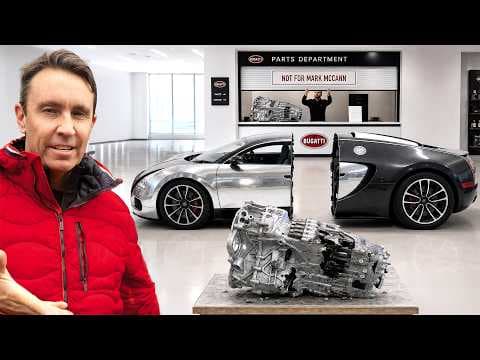
BUGATTI REFUSE TO SELL ME A GEARBOX TO FIX MY BROKEN VEYRON
Audio Summary
AI Summary
The speaker purchased a Bugatti Veyron for £900,000, which has a broken gearbox, rendering it inoperable. Bugatti would not provide a price for a new gearbox, forcing them to seek alternative solutions. A previous attempt to buy a secondhand gearbox resulted in a scam, costing £3,500. The only remaining option was to repair the existing gearbox.
Pascal, a specialist in Holland, was tasked with the repair. Upon stripping the gearbox, he found extreme wear on the clutch plates. The immediate question was whether replacing the clutch would solve the problem or if there was a deeper underlying cause. Since Bugatti would not sell parts, custom replicas had to be manufactured. Pascal undertook the extensive job of researching materials, CAD drawing sizes, and finding manufacturers for bespoke parts.
Four weeks later, Pascal had an update: the custom clutch plates had arrived and a pre-assembly looked good. While he couldn't confirm they were "spot on" to Bugatti's original specifications, they felt good based on his experience. The challenge remained that they couldn't be certain the custom parts were identical to the originals.
Gaskets also needed replacing after the gearbox was stripped for cleaning. Again, Bugatti would not supply even simple gaskets. Pascal, leveraging his experience, created 3D-printed gaskets for testing and developed special paper and high-pressure gaskets. Initially, the exact pressure rates were unknown, but viewers of the video provided critical information, indicating a clutch pressure of around 30 bars, which helped in designing the gaskets. Incorrectly specified gaskets could lead to oil leaks or catastrophic internal failure.
The team still lacked a definitive answer as to why the gearbox failed in the first place, fearing a repeat failure if the root cause wasn't addressed. It was discovered that the car had a new clutch recently installed, raising questions about why it failed so quickly. Another expert, with experience in these clutches, suggested the clutch could be the "smoking gun" for the reverse gear problem. If the clutch was dragging, the gears would continue spinning, preventing the control unit from engaging reverse gear after three failed attempts. This aligned with Jamie's confirmation that the car made three attempts to go into reverse before stopping. The expert also confirmed that a reverse gear problem is often the first indication of a clutch going bad due to heat, causing plates to warp and drag.
With a warped, burnt-out clutch identified as the problem preventing reverse engagement, a solution seemed in sight. However, the previous "fix" with a new clutch failing quickly still puzzled them. Pascal proceeded to reassemble the gearbox with the new clutch. The underlying cause for the extreme heat and burn marks on the clutch remained unknown, leading to concerns that the new clutch might suffer the same fate. The extensive effort involved in manufacturing parts and shipping the gearbox back and forth raised the fear of entering a "never-ending circle" of repairs.
Solving the "why" required expertise beyond their current capabilities. Pascal suggested that without the original gearbox manufacturers, finding the problem would be nearly impossible. The gearbox was designed and built by Ricardo, a British company specializing in state-of-the-art gearboxes. A critical breakthrough came when Rob Barnes, who wrote the gearbox software for the Veyron at Ricardo, reached out after watching their video, offering his help. Rob was part of the original design team and could potentially provide the answers needed.
Rob revealed that the original project cost £40-50 million and took 5-6 years to develop, starting in 2001 and finishing in 2006. His main role at Ricardo was the clutch, making him an ideal resource for understanding the issues. Bugatti's brief for the Veyron gearbox included achieving rapid acceleration, high top speed, and ultra-smooth gear shifts, necessitating a dual-clutch transmission, which was revolutionary in the early 2000s when most cars used manual gearboxes and supercars produced less than half the Veyron's 1000 horsepower.
Rob explained that the Veyron's gearbox functions as two separate four-speed gearboxes connected to the engine via two clutches. This allows for pre-selection of the next gear, enabling instantaneous and smooth shifts. The system is primarily hydraulic, with gears being an "interesting part" of the hydraulic system. This innovative design was far ahead of its time.
Revisiting the initial problem, Pascal found no damaged gears when investigating the reverse gear issue but did discover swarf in the intricate oil cooling channels. The theory emerged that during a previous service, a rounded sump plug was drilled out, allowing debris to enter the system and initiate the four-year saga. This human error theory was the best-case scenario, suggesting that with a clean gearbox, problems should cease.
Regarding the "spot burning" on the clutch, Rob confirmed it was due to heat, causing the plates to warp or "pringle." He explained that if cooling valves, like those in the transmission's center plate where swarf was found, are jammed or malfunctioning, the clutch overheats, leading to thermal damage. The Veyron uses a dry sump system where oil is precisely sprayed to cool vital parts like the clutch, especially during high-stress operations like launch mode, pumping 30 liters per minute. If oil isn't removed quickly, it can froth and lose effectiveness. This supported the theory that swarf could block tiny oil spray holes, leading to localized overheating.
However, Rob pointed out a crucial oversight: while the gearbox would be cleaned, the oil tank and associated pipes also needed thorough flushing, as swarf would inevitably have circulated back to the tank. This meant removing all hydraulic system parts from the car for deep cleaning.
Rob then raised a significant concern about the newly manufactured replacement clutch. The original Bugatti clutches had a surface process that resulted in small carbon fibers. During the initial "bedding in" process, these fibers detach and block filters. Bugatti's clutches undergo a rig test where they are opened and closed multiple times, with a separate filter system catching these fibers before the clutch is installed in the car. Rob warned that their new clutch, lacking this pre-bedding, would release fibers immediately upon driving, potentially clogging the system and causing the clutch to burn out again within minutes, as Borg Warner tests showed a clutch without cooling flow was destroyed in 60 seconds.
This revelation meant simply fitting the new clutch and rebuilding the car was not an option, as it would lead to a "never-ending cycle of damage." They needed a test rig to bed in the clutch and flush out fibers. Ricardo, being the original manufacturer, had such rigs, but their contractual obligations to Bugatti prevented them from directly assisting. Ricardo's response confirmed they could only help if Bugatti approved the request, which was problematic given Bugatti's unresponsiveness.
The team then searched for external test rig providers. Several UK and German companies were contacted, but the cost estimates for building a bespoke rig were astronomical, ranging from £300,000 to £500,000. This was deemed too expensive for a single-use application, eroding the financial buffer they had on the car's value.
Desperate for an alternative, the speaker looked outside the automotive sector, realizing that hydraulic gearboxes are also used in heavy machinery like forklifts and diggers. JCB, a major UK digger manufacturer, was identified as a potential solution. JCB's hydraulic gearboxes, while scaled differently, share the principle of using hydraulic pressure for precise shifts and cooling through sprayed oil via small channels to reduce power loss and disperse heat, similar to the Veyron. JCB also has a history of speed records, including a 350 mph car designed with Ricardo's help.
JCB's head of engineering confirmed that "hot spotting" on clutches is often due to lack of cooling or lubrication, aligning with their problem. He explained the extreme cleanliness required in their hydraulic systems, with clearances as small as 5-15 microns (a fraction of a human hair). JCB uses ultrasonic washing and three-micron filtration systems to ensure no contamination, even dust particles, remains. This stringent process underscored the necessity of a test rig and flushing for the Bugatti gearbox.
The critical question was whether JCB's test rig could accommodate the Bugatti gearbox. Craig, a JCB manager, explained that despite similarities, the differences in oil, setup, drive chain, electronics, and diagnostics meant their rig was specifically configured for JCB products and would not work for the Bugatti.
Despite this setback, significant progress was made: the gearbox was fully reassembled by Pascal with a new clutch, gaskets, and seals, and all solenoids were tested. Pascal also agreed to flush the entire hydraulic system, including the oil tank and pipes, to remove any remaining debris.
The team now faced the dilemma: their gearbox was ready, but without a test rig to bed in the clutch and flush out fibers, reinstallation would lead to immediate self-destruction. Ricardo, with the perfect rig 15 minutes away, remained inaccessible due to Bugatti's refusal to cooperate. The cost of building a custom rig was prohibitive.
The speaker made a public plea for assistance, outlining the requirements for a test rig: a filtration system, 6,500 RPM capability, and software to control gear changes and clutch operation. The goal was to find someone who could provide this crucial service to get the Bugatti Veyron back on the road.