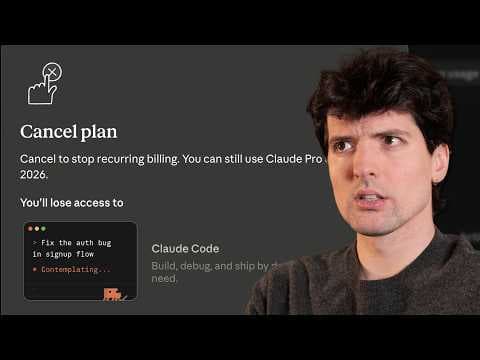
I’m done.
Audio Summary
AI Summary
Anthropic has announced changes to its Claude Code subscription plan, set to take effect on June 15th, which have generated considerable frustration within the developer community. Previously, Anthropic had been vague about the permissible uses of Claude Code subscriptions, particularly concerning programmatic access and third-party tools. The new policy introduces a dedicated monthly credit for "programmatic usage," covering the Agent SDK, Claude-P, and Claude Code GitHub actions. However, this change is viewed by many as a significant restriction and a misleading attempt to reframe existing capabilities.
The core issue stems from Anthropic's historical stance on subscription usage. While API calls have always been billed separately, there was an understanding that Claude Code subscriptions could be used for local development and experimentation, including through tools built on the Agent SDK. This was particularly important for open-source projects and alternative interfaces that offered a better user experience or more advanced features than Anthropic's own offerings, such as Claude Code's terminal interface or the desktop app.
The new policy divides usage into "interactive" and "programmatic." Interactive use, defined as direct interaction through Anthropic's UIs (like the Claude.ai chat or the Claude Code desktop app), will continue to draw from the existing subscription limits. Programmatic use, which encompasses anything that isn't directly interacting with Anthropic's official interfaces, will now be drawn from a new, limited monthly credit. For a $200/month subscription tier, this programmatic credit is capped at $200, a drastic reduction from the estimated $5,000-$7,500 in inference value previously available through the subscription for such uses. This represents a 25x to 40x decrease in usable value for programmatic tasks.
This change disproportionately affects developers who have built tools and integrations on top of Anthropic's services, relying on the previous understanding of subscription usage. Many developers, like the creator of T3 Code, invested significant effort in building open-source alternatives and wrappers, such as T3 Code itself, Zed, and Gene, leveraging the Agent SDK and Claude-P. These tools were created to offer superior user experiences or functionalities that Anthropic's native tools lacked. The rationale for this shift, according to Anthropic, is to prevent the subsidization of API-level usage through subscriptions, which they argue leads to excessive consumption and costs, particularly when external tools do not cache effectively or introduce inefficiencies.
The new policy requires users to manually "claim" their monthly credit, which resets each billing cycle and does not roll over. If this credit is exhausted, further programmatic usage will incur API rates, or usage will pause if usage credits are turned off. This manual claiming process is seen as an additional hurdle, and the limited nature of the credit is considered a "poisoned chalice" – a seemingly beneficial offer that is actually detrimental.
A key point of contention is Anthropic's perceived attempt to control the user interface and lock users into their own closed-source software. The previous ambiguity allowed for innovation and the development of a richer ecosystem around Claude models. By drawing a hard line between "interactive" (Anthropic's UIs) and "programmatic" (anything else), Anthropic is effectively discouraging or penalizing the use of third-party tools, even those that simply provide a better interface for tasks that were previously covered by the subscription.
The move is seen as an "attack on open source" because developers building open-source tools now face significantly higher costs for programmatic use, while closed-source use cases within Anthropic's own ecosystem remain subsidized. Previously, using the Agent SDK or Claude-P with a subscription was a way to leverage Claude models programmatically without incurring direct API costs. Now, these activities are capped by the limited credit, forcing developers and users to either accept severely reduced inference or pay API rates.
Anthropic's justification for this change often centers on preventing abuse and managing computational resources. They argue that external tools like OpenClaw and Hermes Agent, for instance, are "token farms" that burn through resources without proper caching, leading to unsustainable costs. However, critics point out that Anthropic's own tools, like the Claude Code terminal, are also prone to inefficiency and can be expensive to run. The argument that external tools are inherently less efficient is contested, with some suggesting that Anthropic's primary goal is to maintain control over the user experience and prevent developers from building alternative interfaces that might compete with their own offerings.
The change also impacts tools that were built specifically to work around Anthropic's limitations, such as using Claude-P as a programmatic interface to Claude Code. Even using Claude-P directly in a personal terminal, which was previously understood to be covered by the subscription, now falls under "programmatic usage" and is subject to the reduced credit. This means that developers who relied on Claude-P for scripting or automation within their local development workflows are now facing a significant cost increase.
The frustration is amplified by the fact that developers had previously sought clarification from Anthropic for months. Many had invested time and resources into building on top of the Agent SDK, based on the implicit or explicit understanding that this usage was supported. The abrupt change, with its drastic reduction in value for programmatic tasks, is perceived as a betrayal of trust.
The speaker highlights that Anthropic's business model appears to rely on subsidizing personal use to drive adoption and then profiting from enterprise-level API usage. Users who become accustomed to high inference through subsidized subscriptions may then use Claude models extensively in their workplaces, where companies pay API rates, thus generating significant revenue for Anthropic. The new policy, by limiting programmatic access, seems designed to push users towards these higher-cost API plans sooner, especially for commercial applications.
One of the core criticisms is that Anthropic is punishing users and developers who are trying to improve the Claude experience. Instead of embracing third-party innovation, Anthropic is making it prohibitively expensive. The speaker notes that while Anthropic's stated goal might be to offer a credit for experimentation, this credit is not applicable to truly external tools like Open Code or Open Claw, and it's drastically reduced for programmatic use of Anthropic's own tools.
The announcement has led to a strong backlash, with developers like the speaker considering switching to alternative models and providers. The speaker plans to adapt T3 Code to offer users a choice: either accept the reduced limits for a better UI or revert to using Anthropic's less functional terminal interface to retain higher inference capacity. This highlights the dilemma developers face: either compromise on user experience to stay within the limited subsidized credits or pay significantly more for programmatic access.
In conclusion, Anthropic's new policy regarding Claude Code subscriptions has been met with widespread disappointment and anger. The introduction of a limited monthly credit for programmatic usage, while framed as a benefit, is seen as a severe restriction that undermines previous understandings and penalizes developers who have built tools and integrations on their platform. The change is perceived as a move to consolidate control over the user experience, discourage open-source development, and push users towards more expensive API plans, ultimately damaging trust within the developer community.