EEVblog 1744 - NEW Micsig DP700 High Voltage Differential Probe
Audio Summary
AI Summary
The video introduces the Mixig DP700, a new high-voltage differential probe, and compares it to previous Mixig models and the benchmark Sapphire HVP70. The DP700 is a 100 MHz bandwidth, 20:1 high voltage differential probe, capable of handling 700 volts maximum. This new model is a single-unit design, incorporating all features into one shell, unlike its predecessor, the dual-head MDP700. The DP700 includes auto-zero functionality and a 5 MHz bandwidth limit, similar to the MDP series. Mixig offers various models, including one up to 300 MHz, though the 100 MHz version is reviewed.
The unboxing reveals standard accessories: grabbers, crocodile clips, banana-to-banana extenders, a BNC-to-BNC cable, a USB-C cable with an Australian adapter, and a calibration certificate. The probe is powered via USB-C or a small barrel jack, though the barrel jack is noted as non-standard.
A significant portion of the video focuses on testing the Common Mode Rejection Ratio (CMRR), a critical specification for differential probes. The reviewer uses a Roden Schwarz MX04 oscilloscope for precise measurements due to the very low-level signals involved. The test setup involves a 100 MHz signal generator with an inline 50-ohm terminator. The input leads of the probe are twisted and shorted together, then connected to the positive output of the function generator to apply a common mode signal. The output signal is fed into the second channel of the oscilloscope. The importance of twisting leads to prevent unequal noise pickup is highlighted, as is the extreme sensitivity of these low-level measurements to external coupling, even from a hand.
To accurately measure the CMRR, the reviewer employs several advanced oscilloscope features, including 50 times averaging and AC RMS measurements, which remove any DC component, crucial for low-level signals. The probe's attenuation is set to 20 volts per volt to account for its 20x division ratio, ensuring accurate readings.
At 10 MHz, the DP700 achieves a CMRR of -42.4 dB, exceeding its specified -30 dB. At 100 MHz, it measures -31 dB, also surpassing its -26 dB specification for that frequency. While these results are good, the reviewer notes that the HVP70 still offers superior CMRR performance, as Mixig deliberately lowered their specification after finding they couldn't match the Sapphire design's performance. The DP700 is positioned as a lower-cost alternative with slightly less performance but still acceptable.
A real-world test using an Infineon GAN high-voltage generator with a 100V peak-to-peak signal shows the DP700 performing comparably to the HVP70, with slight differences in high-frequency ringing due to probing variations. The reviewer emphasizes that for high-frequency differential probing, the probing solution itself is paramount, making extremely high bandwidths (like 300 MHz) potentially impractical without specialized fiber optic probes.
A teardown of the DP700 reveals impressive internal design and construction. Mixig confirmed that the DP700 will replace the dual-head MDP700, offering similar pricing but with improvements. The internal structure features cross braces, a separate shielded can for the BNC input, and a custom-molded plastic block for high-voltage insulation, particularly beneficial for higher voltage models. The strain relief for the cable is noted as robust, using metal threaded inserts.
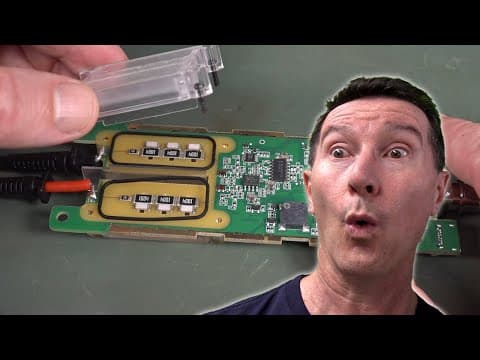
A key finding is the presence of O-rings around the input divider resistors, designed to prevent moisture ingress. This is highlighted as an exceptional feature for a budget-friendly probe, as moisture can significantly degrade CMRR by unbalancing the input components. Isolation slots are also cut between individual resistors to prevent creepage. The input divider network uses 1 Megohm resistors, each compensated with bypass capacitors to maintain bandwidth.
The heart of the probe's differential receiving capabilities lies in an Analog Devices AD8130A differential receiver, a 270 MHz bandwidth chip. The reviewer notes that the chip itself is not the limiting factor for CMRR; rather, it's the matching of the input network components. The probe also incorporates a TI voltage reference for precision, a DC-to-DC converter, and an EFM8 microcontroller, which includes integrated DACs and ADCs for offset adjustment and other functions.
The bottom side of the PCB reveals another differential receiver, an AD8129A, which is a lower noise, 200 MHz version. This indicates that the DP700 uses two discrete paths: one for higher voltage and another tapped off at a lower point in the input string, allowing for a lower noise floor on the front end. This design choice, potentially different from the earlier DP1007, sacrifices an extra chip for improved noise performance and potentially higher bandwidth. An OPA4872 high-bandwidth switch is also present.
In conclusion, the Mixig DP700 is presented as a well-designed and robust high-voltage differential probe, offering good performance that meets or exceeds its specifications, albeit not quite matching the top-tier Sapphire HVP70 in CMRR. Its integrated design, internal shielding, moisture protection, and use of quality components are particularly impressive for its expected price point, making it a valuable tool for safe high-voltage measurements.