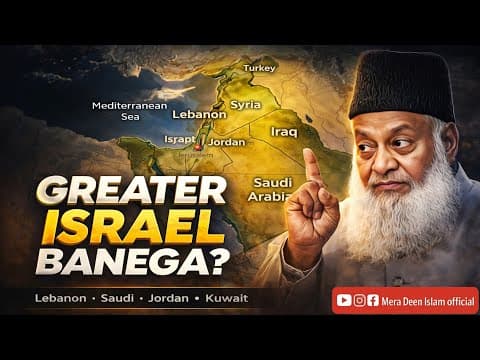
GREATER ISRAEL BANEGA? | Lebanon, Saudi, Jordan, Turkey | Dr Israr Ahmed Bayan
Audio Summary
AI Summary
The provided transcript appears to be a highly fragmented and disjointed collection of audio, making a coherent summary challenging. It contains numerous instances of what seem to be misinterpretations of spoken words, repetitions, and a lack of clear thematic progression. Despite these limitations, I will attempt to extract and synthesize the discernible points, focusing on recurring themes and any passages that exhibit a semblance of structure or argument.
A significant portion of the transcript seems to revolve around religious and historical interpretations, particularly within an Islamic context. There are references to the Quran, with mentions of specific chapters or verses ("Surah Al-Asr" is repeated multiple times) and discussions about its teachings and their application. The concept of "guidance" (both for general humanity and specific groups) appears in relation to these religious texts.
The figure of "Zulqarnein" is mentioned, alongside discussions about his historical context and the locations associated with his actions. This suggests an exploration of biblical or Quranic narratives and their historical or geographical interpretations. There's a sense of questioning and seeking information about these historical figures and events.
The transcript also touches upon theological concepts, including the nature of God ("Allah"), divine will, and the relationship between humanity and the divine. There are phrases that suggest a belief in divine assistance and guidance, as well as warnings against straying from religious paths. The idea of "rulership" or "governance" is also present, sometimes linked to divine authority.
Interspersed within these religious and historical discussions are elements that suggest a critique of certain societal or political trends. There are mentions of "liberals," "fundamentalism," and "new world order," indicating a discourse that may be engaging with contemporary socio-political issues from a particular ideological or religious standpoint. The concept of "freedom" is also discussed, often with caveats or qualifications, suggesting a nuanced view on its implementation.
There are recurring references to historical periods and events, including the 4th century, 1917, 1943, 1967, and 1973, which seem to mark significant "landmarks" or "stages" in a historical narrative, possibly related to geopolitical events or religious movements. The "end of the game" is a phrase that appears, suggesting a sense of culmination or decisive turning point in these historical processes.
The transcript also includes references to "Jews" and "Christians," and the relationship between these groups and Muslims. There are discussions about alliances, enmities, and theological differences. Phrases like "do not take Jews and Christians as allies" appear, pointing to a specific theological interpretation of interfaith relations.
The concept of "science" and "logic" is mentioned, sometimes in relation to religious or philosophical inquiry. There's an indication that these disciplines are being considered alongside or in contrast to religious teachings. The idea of "awakening" or "enlightenment" also surfaces, suggesting a process of gaining knowledge or understanding.
The transcript contains numerous fragmented phrases that might relate to specific arguments or examples. For instance, there are mentions of "ships," "hands," and "holding on," which could be part of allegorical explanations or discussions of practical matters. The idea of "protection" and "safety" is also present.
The latter part of the transcript seems to delve into a discussion about "Islam" and its "reality," with mentions of "freedom Islam" and its connection to an "elite international." There's an assertion that Islam might be the "optimal amount of reality." This section also touches upon the "fundamentalism versus liberalism" debate, suggesting it's a significant conflict in contemporary times, not just within Islam but also within Judaism and Christianity. The role of historical authors and their perspectives on these issues is also alluded to.
The transcript concludes with a series of fragmented sentences that seem to be summarizing or reinforcing previous points about Islam, its teachings, and its place in the world. There's an emphasis on divine aid and guidance, and a call to rely on God and His messengers. The idea of "people's sight" and "perilous influence" suggests a warning against external forces or ideologies that could lead people astray.
Overall, the transcript presents a complex tapestry of religious, historical, and socio-political commentary. Despite its fragmented nature, recurring themes of divine guidance, historical interpretation, interfaith relations, and contemporary ideological struggles can be identified. The speaker or speakers appear to be engaged in a deep, albeit often unclear, exploration of these interconnected subjects.