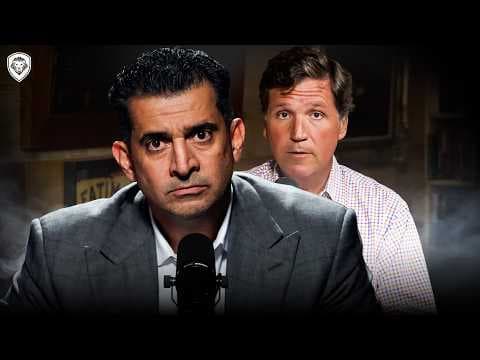
My Response to Tucker Carlson
Audio Summary
AI Summary
The speaker begins by referencing a podcast where Patrick Bet David discusses the perceived issue between Catholics and Jews, noting that while Jews may mock Christians, Catholics also have an issue with Jews. The speaker highlights the centralized power of the Catholic Church, with 1.2-1.3 billion followers worldwide, compared to 15 million decentralized Jews who lack a single supreme leader. This contrasts with the Catholic structure where the Pope holds significant authority, and any criticism of him is met with strong reactions.
The discussion then shifts to the concept of theocracies, mentioning that only Catholicism (the Vatican) and the Islamic Republic of Iran are major theocracies. The speaker draws a parallel between the Vatican and the "Nazi Iranian government," stating they are "basically the same" due to complicated dress, centralized power, and a perceived hatred for Jews. The speaker labels the claim that Catholics have a problem with Jews as "slander" and an "attack on the world's largest and oldest Christian denomination," asserting that this sentiment originates from Israel, specifically the Netanyahu government. The speaker clarifies that the issue is not Israel as a concept or all Jews, but rather the Netanyahu government and those who uncritically support its decisions, no matter how violent. Those who oppose it are labeled "Nazis," and their religion is deemed "inherently anti-semitic."
The speaker then addresses Tucker, acknowledging his formidable voice and ability to communicate messages effectively. He recalls offering Tucker a $100 million contract after selling his company, even discussing it on Megan Kelly's show and visiting Tucker's home in Maine. The speaker expresses admiration for Tucker's humor, quirkiness, and communication skills, but notes Tucker's tendency to twist words, citing examples like "He hates Catholics" or "Catholics hate the Jews."
The speaker then shares personal details, emphasizing his "America first" stance and identifying as a non-denominational Christian. He highlights his Armenian heritage, noting that Armenians were the first nation to accept Christianity, a point sometimes debated by Assyrians, which he humorously links to his parents' multiple marriages and divorces. He reiterates his desire for America to remain the greatest country and for capitalism to be widely understood as a path to achieving dreams. He questions Tucker's current alignment, suggesting a shift from his past views.
The speaker then challenges Tucker on several points. First, he addresses Tucker's recent statement that "Sharia law has made Islamic societies more advanced than the West," calling it a "bold statement" that seems to promote Sharia law over America. Second, he brings up a guest on Tucker's show who argued that capitalism should be separate from Christianity, claiming Christianity is inherently socialist, and noting Tucker's apparent agreement. The speaker ironically suggests Tucker might soon host figures like Alexandria Ocasio-Cortez or Ilhan Omar.
Drawing on personal experiences, the speaker recounts working with Mormons for seven and a half years, reading extensively about them, and having "zero" bad experiences. He also worked with Seventh-day Adventists and learned about their practices, again without issues. Regarding Jews, he notes their negotiation style but states he has "never" had issues with them in business. He built an insurance company with 60,000 agents, 54% of whom were Hispanic Catholics, and "never had one issue with a single Catholic."
The speaker then directly refutes Tucker's praise of Sharia law by sharing his 11 years of living with Muslims in Iran under IRGC and Hezbollah laws, where his mother and sister feared walking outside. He contrasts his experience of living in poverty in Iran with Tucker's wealthy upbringing and current lifestyle. He points out that while Tucker experiences the "best side" of places due to his wealth, the speaker lived through the "worst."
He further illustrates his nuanced view by mentioning his Muslim Turkish chef, despite the historical Armenian and Assyrian genocides committed by Turks. He expresses love for his chef as an individual but maintains concern about Islam's potential impact on America, citing examples in Minnesota and New York.
The speaker then quotes Charlie Kirk, who allegedly said, "Islam is the sword the left is using to slit the throat of America," and asks Tucker if he agrees. The speaker affirms his agreement, expressing concern about excessive tolerance leading to the acceptance of values that differ from American ones, and criticizing the approach of "let's just be tolerant" towards Sharia law and unchecked immigration. He clarifies that while he supports individuals making personal choices like converting to Islam, his priority remains "America first," focusing on enabling young men to build successful lives, marry, have children, and pursue their dreams in various professions.
As a non-denominational Christian, the speaker declares "Christ is king" and shares his personal conversion experience on January 21st, 2004, a truth he would openly share with anyone. He describes his daily life as a business owner, running companies with 165 employees, and expresses gratitude for living in America.
The speaker concludes by stating he doesn't want to be enemies with Tucker, believing Tucker genuinely loves America. He acknowledges Tucker's significant influence and predicts that "Israel control" and APAC will be ballot issues in 2028. He expresses a desire for debate and questions Tucker's political motivations, speculating whether he supports figures like Thomas Massie or aims to dismantle the GOP.
He then addresses accusations leveled against both of them – Tucker for taking money and the speaker for being a "Zionist" taking money from Israel. The speaker vehemently denies ever taking money from Israel or APAC, stating he has never even visited Israel and only fears God. He proposes an audit of their finances by three accounting firms (one chosen by each, and a mutually agreed third party like KPMG, PWC, or BKD) to verify if he has ever received payments from Israel and if Tucker has received payments from Qatar or Pakistan. He acknowledges the cost and potential discomfort of such an audit but affirms his willingness for transparency.
The speaker expresses his repeated attempts to build a relationship with Tucker, acknowledging the challenges. He reiterates his faith as a Christian man, guided by God to show grace, and expresses belief in Tucker's abilities. However, he emphasizes that his belief in God and America surpasses his belief in any individual. He vows to continue using his voice to promote America's greatness, recalling his family's escape from Iran, time in a German refugee camp, and his proud service in the US Army 101st Airborne Division. He extends an open invitation for Tucker to call him for a conversation, while also expressing concern about potential attacks from Tucker's followers. He closes by reflecting on the emotional impact of Charlie Kirk's death on his son and his willingness to contribute to important movements.