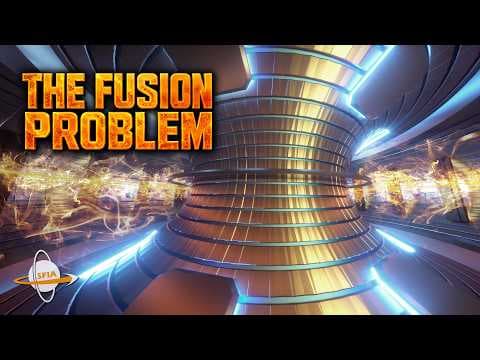
The Tokamak Problem: Can We Ever Make Fusion Practical?
Audio Summary
AI Summary
Fusion power, often portrayed as a perpetual promise, has a reputation for being "20 or 30 years away, and always will be." This skepticism, while understandable due to media overhyping genuine breakthroughs, is somewhat misplaced. Physicists haven't typically promised miracle timelines. Early on, there was an understandable over-exuberance, given the rapid progress of nuclear fission, from the first controlled reactor in 1942 to commercial reactors in the mid-1950s. Fusion, which powers the sun and was demonstrated in hydrogen bombs by 1952, seemed like the obvious next step. Early concepts like the stellerator and the Tokamak, developed in the 1950s, showed promising initial results, leading to optimistic extrapolations that fusion power was only a couple of decades away.
However, despite decades of research and billions of dollars spent, fusion power does not yet power our homes. The core problem isn't that fusion doesn't work—it has been produced in laboratories for almost a century. The real challenge is making it steady, controllable, affordable, and reliable enough to function as an economical power plant rather than a physics experiment.
**Why Fusion is So Appealing**
Fusion's allure stems from its promise of an ideal energy source:
* **Extraordinary Energy Release:** Fusion releases immense energy from tiny amounts of fuel, as seen in E=MC².
* **Abundant Fuel:** The most common fusion reactions use hydrogen isotopes extractable from ordinary water, making energy scarcity obsolete if practical fusion is achieved.
* **Inherently Safer Failure Modes:** Unlike fission, fusion reactors don't rely on chain reactions. If conditions aren't right, the reaction simply stops, and the plasma cools. Fusion tends to fail quietly, not dramatically.
* **Reduced Radioactive Waste:** Fusion produces radiation and can make reactor components radioactive, but it doesn't generate the same long-lived, high-level waste that requires isolation for tens of thousands of years, sidestepping a major political and social obstacle faced by fission.
**Why Fusion is Hard: Outperforming a Star**
Despite these advantages, fusion demands conditions far beyond everyday engineering experience. It's not just about heat. While the sun is hot, fusion doesn't care about temperature alone; it also requires specific density, pressure, confinement time, and stability.
* **Sun's Inefficiency:** The sun is an inefficient fusion reactor. Its power output per kilogram is low; individual protons can drift for millions of years before fusing. It works due to its enormous mass and gravity, which provides pressure and confinement. A cubic meter of the sun's core produces only about 275 watts of fusion power, comparable to a few incandescent light bulbs.
* **Earthly Requirements:** For fusion to power civilizations on Earth, reactors must produce vastly more energy per unit mass than the sun, on human timescales, within building-sized machines, under precise control. We aren't trying to copy a star; we're trying to outperform one.
**What Fusion Actually Is (and Isn't)**
Fusion is the opposite of fission. Fission splits heavy, unstable atoms. Fusion forces the smallest, simplest atoms (usually hydrogen isotopes) together at incredibly high speeds to form heavier elements like helium. This process releases energy because the resulting nucleus has slightly less mass than its constituent parts.
* **The Coulomb Barrier:** A major challenge is that atomic nuclei have positive charges and repel each other (the Coulomb barrier). To fuse, they must overcome this repulsion and get close enough for the strong nuclear force to take over. This force is much stronger than electromagnetism but has an extremely short range, only acting when nuclei are essentially touching.
* **Not a Chain Reaction:** Unlike fission, fusion is not a chain reaction. Every single collision must be manually forced against the repulsive force.
**The Sun: Hot, But a Terrible Reactor**
The sun's core is about 15 million°C, but for a proton, this is "quite chilly." Most protons aren't moving fast enough to overcome repulsion, bouncing off each other for millions of years. The sun's immense mass maintains pressure and insulates heat, allowing it to succeed through sheer volume and patience, not intensity.
* **Earth's Challenge:** On Earth, we lack the sun's gravity and millions of years. To achieve practical reaction rates, we need to aim for 150 million°C or higher—10 times hotter than the sun's center. We must create conditions more violent than the heart of almost any star in the galaxy.
**Quantum Tunneling: Winning by Statistics, Not Strength**
Fusion occurs due to quantum tunneling. At very small scales, particles behave as probability distributions. A nucleus might not have enough energy to classically cross the Coulomb barrier, but quantum mechanics allows for a small, non-zero chance of "tunneling" through it.
* **Statistical Process:** Fusion is a statistical process. Most collisions fail, but given vast numbers of particles colliding repeatedly, these rare successful events add up. Higher temperatures increase collision frequency, but temperature alone isn't enough.
* **Deuterium and Tritium:** We use hydrogen isotopes like deuterium and tritium for fuel because they have a lower Coulomb barrier and come with pre-installed neutrons, making fusion easier than the proton-proton fusion in stars, which relies on a rare internal conversion of a proton to a neutron during a brief merger.
**Holding the Fire: The Plasma Problem**
At fusion temperatures, atoms dissociate into plasma—a turbulent mix of bare nuclei and free electrons. Plasma is highly conductive, generates magnetic fields, and reacts violently to disturbances. Crucially, plasma cannot touch solid walls; contact would vaporize the wall, cool the plasma, and stop the reaction.
* **Magnetic Confinement:** The only practical tool to hold plasma without touching it is magnetism. Charged particles spiral along magnetic field lines, allowing magnetic fields to act as invisible walls.
* **Plasma Instabilities:** Plasma constantly tries to escape. Magnetic fields must be precisely shaped, tuned, and adjusted to prevent instabilities, turbulence, and heat leakage. The hotter and denser the plasma, the harder it is to control.
* **Tokamaks:** This challenge led to the Tokamak design (Toroidal Chamber with Magnets). Tokamaks are not elegant or easy, but they solve multiple problems: closing the magnetic bottle, stabilizing plasma motion, and allowing fuel to circulate long enough for fusion. Other approaches like stellarators and z-pinches face similar or different challenges. The z-pinch, for instance, is highly unstable.
* **Engineering Challenge:** The core engineering challenge isn't just lighting the fire, but holding it reliably and controllably within a machine that fits inside a building and justifies its cost.
**What Tokamaks Actually Solve**
Fusion research has made astonishing progress, often overlooked when focusing solely on the "finish line."
* **Orders of Magnitude Improvement:** Early Tokamaks struggled to confine plasma for even fractions of a second. Over decades, improvements in magnetic field shaping, plasma cross-sections, heating methods (e.g., neutral beam injectors, radio frequency systems), and control systems led to confinement improvements by orders of magnitude.
* **Rising Temperatures and Lifetimes:** Temperatures climbed from millions to over 100 million degrees Celsius. Plasma lifetimes extended from milliseconds to seconds, and eventually to minutes.
* **Triple Product:** The "triple product" (plasma temperature, density, and confinement time) has outpaced Moore's Law for much of its history, indicating thousands of times better performance than initial machines.
* **Psychological Threshold:** By the 1990s, facilities like Jet demonstrated deuterium-tritium fusion producing megawatts of power, with a recent sustained burn releasing 59 megajoules of energy over 5 seconds. While not powering cities, this proved that fusion plasmas could be hot, dense, and stable simultaneously, revealing the real bottlenecks.
**The Tokamak Problem Precisely Stated**
Today's Tokamak problem isn't whether fusion reactions happen or if plasmas can be confined. They do, and they can. Violent Tokamaks routinely reach fusion temperatures and hold plasma for sustained reactions.
* **Net Energy Output:** The problem is that this doesn't automatically translate into a useful power plant. A Tokamak can produce fusion energy while still consuming more energy overall to heat the plasma, run magnets, power cooling, and operate control systems.
* **Neutron Damage:** Fusion neutrons carry about 80% of the reaction energy, but capturing this energy efficiently without destroying the reactor is extremely difficult. These neutrons slam into reactor walls, causing "activation" (making materials radioactive) and physically rearranging atoms, turning tough alloys brittle.
* **Operational Demands:** This leads to a cycle of downtime, maintenance, and replacement that current designs don't scale well for. A power plant needs to run continuously for years, not in brief experimental bursts.
* **Economics and Engineering:** The Tokamak problem is about whether we can turn an impressive fusion experiment into a device that produces electricity steadily, predictably, and cheaply enough to be economically viable. Fusion has moved from "impossible" to "difficult," but difficult problems require clarity, honesty, and persistent iteration.
**ITER and the Limits of Scaling**
ITER (International Thermonuclear Experimental Reactor) is often misunderstood. It's not designed to power cities or generate electricity for the grid.
* **Specific Goal:** ITER's crucial role is to answer a very specific question: what happens to a Tokamak when scaled up to near power plant size? Its goal is to demonstrate a fusion gain factor (Q) of about 10—producing 10 times more fusion power *in the plasma* than the energy injected to heat it. This will prove whether plasma physics behaves as models predict at scale.
* **Uncertainty Reduction:** Scaling up is critical because confinement improves with size, and turbulence and instabilities behave differently. ITER will test these theories directly.
* **Exposing Real Problems:** Simultaneously, ITER will expose the other half of the problem: if the reactor structure around the plasma falls apart. High-energy neutrons will damage materials, degrade superconducting magnets, and activate components. Efficient heat extraction and maintainability are key challenges that ITER will illuminate, even if it doesn't solve them. It will tell us "how bad they really are."
**Other Approaches and the Future of Fusion**
Tokamaks are not the only approach. Stellarators offer continuous confinement but involve complex geometries. Inertial confinement fusion (using lasers) has made dramatic progress but faces challenges in repetition rate and converting bursts into continuous power. Private fusion startups are exploring diverse concepts.
* **Universal Constraints:** Regardless of the approach, all fusion concepts face the same fundamental constraints: they must produce more energy than they consume, survive their own neutron flux, and operate reliably, maintainably, and cheaply enough to compete with other power sources. There are many paths, but no shortcuts.
Fusion is no longer science fiction or an unsolved physics problem; it is an ongoing test of how far controlled engineering can be pushed against extreme forces. If it becomes practical, it will arrive quietly, after decades of iteration, scale testing, and brutal honesty about costs and tradeoffs. Even if it never fully achieves commercial power, fusion research has already driven significant advances in superconductors, plasma physics, material sciences, and high-power control systems, with spillover benefits for countless other technologies. The journey continues to pay dividends,