Steam Controller Review - This Was a Triumph!
Audio Summary
AI Summary
The speaker, accustomed to mouse and keyboard for competitive shooters, has historically avoided controllers due to their perceived lack of accuracy. Mice, being position-based input systems, allow for precise, muscle memory-driven movements where stopping the mouse instantly stops the cursor. In contrast, joysticks are rate-based, translating stick angle into velocity, meaning the cursor continues moving until the stick is reset to neutral. While controllers are used by many competitive gamers, the speaker finds them less accurate than a mouse and keyboard, which explains the common availability of aim assist for controller users.
Two methods for introducing position-based input into controllers are gyroscopes and touchpads. Gyroscopes measure tilt, acceleration, and velocity, translating these into precise positional input. Sony was an early adopter of touchpads, but primarily for secondary functions, with movement and aiming still reliant on sticks. The original Steam Controller, however, was a pioneer in using touch-sensitive areas for primary controls like walking and aiming. This original model featured two touch-sensitive areas but lacked a traditional D-pad and had only one analog stick. The speaker found it lackluster upon its release, primarily due to its deviation from traditional controls and the significant tweaking required to make it compatible with most Steam games.
A new Steam Controller has now been released, addressing many of the shortcomings of its predecessor. It incorporates traditional controls, including two sticks and a D-pad, alongside a gyroscope and improved touch-sensitive pads. The speaker notes that these enhancements have fundamentally altered their perception of controller gaming.
Ergonomically, the new controller weighs 292 grams. While not excessively heavy, its relatively large and wide grip initially caused hand fatigue, though this subsided after the first day. The layout is well-designed, with the D-pad, buttons, and sticks naturally falling under the hands. The touchpads are ideally positioned directly below the sticks. The back buttons offer satisfying tactile and auditory feedback, actuating with just the right amount of pressure. A minor design criticism is its thick, chunky aesthetic, contrasting with the more elegant design of controllers like the PlayStation 5's.
The controller features TMR (tunneling magnetoresistance) sticks, which are touted as superior to Hall effect technology. They boast tighter dead zones, enhanced durability, and, crucially, lower energy consumption, leading to noticeably longer battery life. The sticks and D-pad provide excellent in-game feel, with the D-pad resembling the high-quality one found on the Steam Deck. The gyroscope also performs exceptionally well, enhancing gameplay in titles like Doom. A capacitive strip on the bottom allows for engaging and disengaging the gyro without needing to touch the sticks. Although the controller's polling rate of 250 Hz is lower than the 1000 Hz seen in some high-end controllers, it still feels smooth and responsive to the speaker.
The touchpads are highlighted as a defining feature of the new controller. These two small, laptop-style trackpads are equipped with haptic motors for tactile feedback. They are the same size as those on the Steam Deck, albeit with a slightly different orientation due to tilt. These versatile input devices can be assigned to movement, providing direct, position-based control that stops instantly when the finger is lifted. They can also be configured as radial menus for weapon selection or split into quadrants for quick-swapping items. This flexibility makes them particularly effective for games designed for mouse and keyboard. Out of the box, the touchpads can control the mouse cursor on a desktop, functioning like a laptop trackpad. They also facilitate faster typing than sticks, with each touchpad covering half of a virtual keyboard. The combination of traditional controls, effective gyros, and excellent touchpads creates a superior gaming experience.
For optimal wireless connection, the controller utilizes a 2.4 GHz dongle. The included USB-A to USB-C cable connects the dongle to a computer, though USB-C only laptops will require an alternative cable. The dongle also serves as a magnetic charging port, offering a convenient and well-designed charging solution that doubles as the wireless receiver. This connection delivers super low latency, feeling as responsive as a wired connection. The speaker's child, playing Geometry Dash, found the controller capable of handling the game's tight, near frame-perfect input requirements without issue. One dongle can reportedly connect up to four controllers with no measurable latency impact, a claim supported by the speaker's testing with two devices. While Bluetooth connectivity is available, it introduces a nominal amount of latency.
The new Steam Controller shares the same number of inputs, buttons, touchpads, and sticks as the highly popular Steam Deck. This shared layout benefits from a vast library of community-created profiles and developer optimizations, ensuring excellent out-of-the-box support for many games. This widespread compatibility is crucial, as even exceptional hardware would be frustrating if extensive setup and customization were required for each game.
Unlike the original Steam Controller, the new model lacks a two-stage trigger, a feature often used by Rocket League players for functions like throttle and boost. This omission is likely due to Valve's desire for one-to-one mapping with Steam Deck profiles.
Disassembly reveals seven Torx screws on the back. Inside, a capacitive sensor for gyro engagement/disengagement is visible, along with metal dome buttons for the back triggers, explaining their tactile snap. The battery is easily removable, not glued or screwed in, simplifying potential future replacements. While most components are designed for repairability, the TMR sticks are soldered directly to the board, a decision likely reflecting Valve's high confidence in their durability. Large haptic motors and the triggers/shoulder buttons are also visible on the black PCB.
Battery life is impressive, with the speaker reporting approximately 30 hours of use before needing a recharge, even with heavy gaming. Valve claims 35+ hours, a figure the speaker considers realistic, acknowledging that usage patterns, such as constant button mashing in games like Ninja Turtles, can affect drain rates.
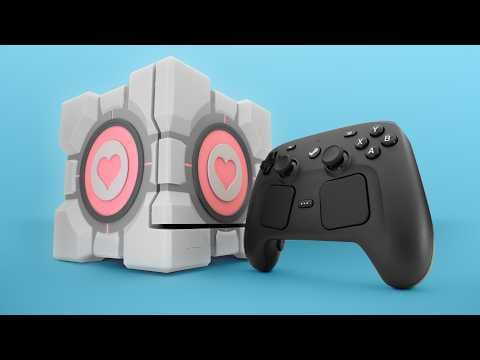
The new Steam Controller is priced at $99 US and will be available on May 4th. While the speaker had hoped for a lower price point around $80, given the quality of other controllers in the $50-$60 range, they believe $100 is at the upper end of acceptable pricing. The controller is also expected to launch alongside a "Steam machine," a cube-shaped gaming PC, which can fit into a Dbrand Companion Cube prototype, enhancing the Portal-themed experience.