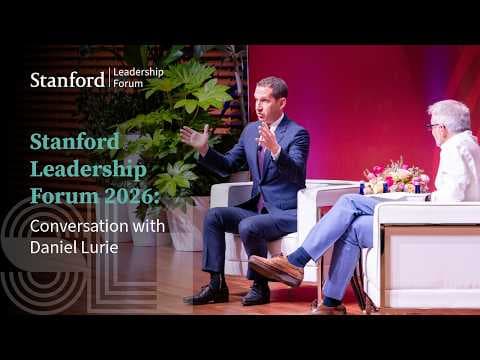
Stanford Leadership Forum 2026: Conversation with Daniel Lurie
Audio Summary
AI Summary
Daniel Lurri, the Mayor of San Francisco, discusses his background, policy initiatives, and vision for the city. Born and raised in San Francisco, Lurri majored in political science at Duke University and earned a master's in public policy from UC Berkeley. In 2005, he founded and led TippingPoint Community, an organization focused on anti-poverty initiatives in the Bay Area. He also chaired the host committee for Super Bowl 50.
Lurri opens by acknowledging San Francisco's progressive values but emphasizes that there is nothing progressive about allowing people to suffer on the streets. His administration is focused on common-sense solutions, particularly addressing homelessness and the drug crisis. Last year, San Francisco established 600 treatment and recovery beds. While a campaign promise was made to create 1,500 shelter beds, the administration realized that traditional shelters were not suitable for individuals with fentanyl addiction. Instead, they prioritized the "right kind of beds"—recovery and treatment beds. Lurri highlights that the city's previous approach of allowing people to use and die on the streets was not taking care of its residents. Overdose deaths, which were 850 three years ago, decreased to over 620 last year, indicating progress but still unacceptable numbers.
On public safety, Lurri reports significant strides. Citywide crime was down 30% last year, and 40% in the downtown corridor. These numbers continued to decline in the first quarter of the current year, with the exception of an increase in the homicide rate, though last year's homicide rate was the lowest since 1954. Rebuilding the police force is a high priority. A recent academy graduation saw 41 new officers, the largest class since 2017. Applications to become police officers are also on the rise, with 10,000 expected this year, compared to 5,000 last year. Lurri attributes these successes to common-sense solutions and policies that the majority of San Franciscans support.
When asked about the ease or difficulty of implementing these changes, Lurri states that "easy" is not a word often associated with his job. He highlights a new approach centered on collaboration across city departments and with the Board of Supervisors, a notoriously challenging relationship. He personally reaches out to supervisors, fostering a collaborative spirit. Weekly department head meetings, where the top 20 departments gather to share information, were not a common practice before his administration. He also emphasizes showing appreciation to police officers and firefighters, shaking their hands and thanking them, believing "little things go a long way."
Addressing the intensely political nature of issues like housing, transportation, and land use, Lurri acknowledges San Francisco's active interest group environment. He shares his approach to a difficult budget situation, where a projected billion-dollar deficit in four to five years necessitates reigning in spending. He has been transparent with all interest groups, telling them consistently for seven months that "we all are going to have to take some of the pain." He believes in honesty and treating everyone equally, avoiding catering to specific groups. Lurri notes that he entered office without prior elected experience and with limited support from interest groups, which he sees as an advantage, allowing him to focus solely on fixing the city he grew up in and is raising his children in, without political aspirations beyond his current role.
Regarding his experience leading TippingPoint Community, Lurri emphasizes the importance of collaboration between city hall, philanthropy, and the business sector. TippingPoint acted as "seed capital" or "risk capital" for innovative anti-poverty solutions, and if successful, these models were then offered to government for broader implementation. As mayor, he continues to engage non-profit and business sectors, recognizing that City Hall cannot solve problems alone. He points to new initiatives like the Partnership for San Francisco and a downtown development corporation aimed at revitalizing Union Square and the financial district.
On regional issues, Lurri acknowledges San Francisco's role within the larger Bay Area. He highlights that while the Bay Area is economically significant, San Francisco is not even its largest city. However, he asserts that San Francisco is now the epicenter of AI and the tech ecosystem, with venture firms establishing offices there. Despite this, he stresses that tourism remains San Francisco's most important industry, which underscores the criticality of public safety and addressing homelessness. His third priority is making San Francisco a business-friendly city again through improvements in permitting and support for small, medium, and large businesses.
Lurri discusses the challenge of changing San Francisco's national and international narrative, which has often been negative. He admits that many criticisms were true, prompting his run for office. He believes the city is now receiving more positive coverage because "it's true"—San Francisco is on the rise due to its restaurants, arts, culture, and the collaborative efforts of city leadership. He notes that two years ago, only 22% of San Franciscans thought the city was on the right track, but a recent poll showed that number at 70%. While progress is evident, Lurri remains unsatisfied, acknowledging there is still much work to do, citing personal observations of street conditions.
He sees events like the recent Super Bowl as crucial for showcasing the city, noting that 12,000 credentialed media members reported largely positive experiences. He recognizes that some "haters" will always have a negative view, but the focus is on those open to seeing the city's improvements.
Looking to the future of innovation, Lurri attributes San Francisco's consistent ability to foster new industries (from computers to the internet to AI) to its "creative class." To sustain this, he emphasizes the importance of housing, educational opportunities, and childcare. San Francisco is the first city in the country to offer free early childhood care to families earning up to $230,000 per year, and 50% off for those earning up to $310,000. These initiatives aim to retain young families and creatives, driving the city forward. He believes his job is to handle the basics—safety, clean streets, housing, and recovery—to allow neighborhoods to thrive, which then empowers the business community, entrepreneurs, and creatives to innovate.
Addressing the long-standing issue of affordability and gentrification, Lurri rejects the idea of the city remaining "the same," advocating for evolution and growth. He admits that San Francisco has been "not progressive" in its resistance to building housing. His administration has focused on rezoning the west and north sides, increasing building heights from four to six stories along commercial corridors and transit hubs. This effort has been met with lawsuits from both "YIMBYs" (for not going far enough) and "NIMBYs" (for changing neighborhoods), suggesting they've found a middle ground.
Lurri discusses the mechanics of building housing, emphasizing zoning as a key control within his power. He acknowledges macroeconomic factors like the cost of construction and labor are beyond his direct control. However, he is open to innovative solutions, such as modular housing factories, citing a successful TippingPoint project that built affordable housing at a fraction of the typical cost. The goal is to align incentives and create the right zoning to make building affordable housing feasible.
On regional housing, Lurri recognizes that San Francisco has added more new housing than some other Bay Area communities. He believes transit agencies must make land available for development along transit corridors and that investment in transit is essential for moving people effectively across the region, as not everyone can live in San Francisco, San Jose, or Oakland. He highlights the financial difficulties of transit agencies, arguing that they need help from the state and federal government, as transit is often treated as a local issue in the U.S., unlike other countries.
Regarding relationships with state and federal governments, Lurri states his philosophy is to "control what I can control." He maintains strong relationships with local elected officials in the state legislature and works with the "big city mayors" of California to advocate for funding. While acknowledging the efforts of federal partners, he expresses that the city is "not counting on a whole lot" from them currently. The focus is on getting city costs under control and aligning revenue with spending, as the city has historically relied on one-time funding for ongoing support, which he deems irresponsible, especially given impending federal cuts to healthcare and food access.
Lurri envisions San Francisco regaining its status as the greatest city in the world within a few years, not five or ten, if the city gets the "basics right." He believes the world is cheering for San Francisco and that the narrative of its comeback is already taking hold.
Finally, offering advice to GSB students, Lurri encourages them to "go try things" and not limit themselves. He shares his own diverse career path before TippingPoint and becoming mayor. He emphasizes pursuing passion and not needing to have everything figured out early in one's career. His ultimate advice: "Do the little things well." He believes that mastering the small tasks is foundational to achieving larger successes.