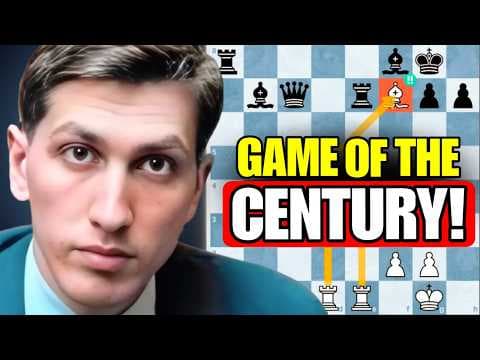
Bobby Fischer TEACHES US The Ruy Lopez! Then Plays GOD MOVE That DESTROYS The Soviet Chess Empire!
AI Summary
This transcript details a pivotal chess match, round six of the World Championship, between Bobby Fischer and Boris Spassky, often dubbed "the game of the century." Fischer, referred to as "the goat" and "humanity's last hope," faced off against Spassky, the reigning world champion and a "prodigy child of the former Soviet Union." The narrative emphasizes that this was more than just a player-versus-player or championship game; it represented Fischer, who taught himself chess, against the entire Soviet chess establishment.
Fischer opened with his favorite, the Ruy Lopez, characterized by the moves e4 e5 knight f3 knight c6 Bishop b5. The Ruy Lopez is described as a "weapon" Fischer intended to use to "bulldoze through Spassky." It's a highly analyzed opening, strong for white, with the core idea of pressuring the e5 pawn with the knight and then its defender, the c6 knight. The "Spanish bishop" on b5 is highlighted as crucial.
Spassky responded with the "old main line," the Morphy defense, a6, questioning the bishop. Fischer played the standard Bishop a4, retreating. Both players then followed the main line leading to the "closed Ruy Lopez." Black played Knight f6, pressuring e4. Fischer, instead of defending, short castled, leaving e4 hanging but setting up pressure on the semi-open e-file. Black chose Bishop e7, leading to the closed Ruy Lopez. Fischer played Rook e1, defending e4. Black played b5, releasing tension on the c6 knight but potentially exposing the b5 pawn.
Black then played d6, a standard move in 1972, defending e5 and preparing to castle. Fischer played c3, intending d4. After black castled, Fischer played h3, a prophylactic move to prevent Bishop g4 if he were to play d4 immediately. This marked the "real starting point of the closed Ruy Lopez." White's ideal formation involves c3 and d4, with a pawn on d4 defended by c3.
Black had many ideas, including the Chigorin variation (knight a5), Bishop b7, and the Breyer variation (knight to b8). Spassky chose the Breyer, a favorite of many champions including Magnus Carlsen. The Breyer aims to regroup pieces, with the knight on b8 allowing for c5 later, and the overall plan of Bishop b7, knight b to d7, Rook e8, and Bishop f8 to maximize pressure on the e4 pawn.
Fischer advanced d4, gaining central space. Black played knight b d7. Fischer developed knight b d2, then black played Bishop b7, creating pressure on e4. Fischer responded with Bishop c2, defending e4. Black played Rook e8, intending Bishop f8. Everything was standard until this point.
Instead of the typical knight f1 maneuver, Fischer played b4, aiming to gain space on the queenside and fix the b5 pawn as a weakness, intending a4. Spassky played Bishop f8, and Fischer followed with a4. Spassky then made a critical decision, opting for the active knight to b6, pressuring a4 and supporting d5. Fischer immediately responded with a5, gaining more space and forcing the knight to retreat to d7. This wasted two tempos for black but fixed the queenside structure, potentially strengthening c5.
Fischer played Bishop b2, placing the bishop on a strong diagonal. Spassky played Queen to b8, a creative move to activate the queen and indirectly support e5. Fischer then played Rook b1, a seemingly simple but strong move, anticipating that lining up the rook with the queen on b8 would eventually be advantageous.
Spassky played c5, a key idea in the closed Ruy Lopez. Fischer, instead of d5 which would lock the center and allow black's knight a strong d6 square, chose to open the center with b takes c5. He aimed to activate his "Ruy Lopez bishops" on b2 and c2. After black recaptured, Fischer took on e5, further opening the game. The resulting pawn structure featured white with a classical four-versus-three majority on the kingside and black with a three-versus-two majority on the queenside, setting up attacks on opposite sides of the board.
Fischer began his kingside attack with c4, activating his bishops. Spassky, under attack on d5, found the strong Queen to f4, keeping his queen active despite its vulnerability. Fischer, instead of weakening his kingside with g3, made a "very committal" move: Bishop takes f6. This sacrifice gave up his dark-squared bishop, requiring deep calculation to ensure it worked in his favor.
Fischer then won the b5 pawn with c takes b5. Spassky played Rook e d8, lining up with the queen. Fischer responded with Queen c1. Spassky played Queen c3, pressuring d2. Fischer moved Knight f3, and Spassky captured the a5 pawn with Queen takes a5, gaining queenside activity and threatening b5.
Fischer, ignoring the threat, played Bishop to b3, "resurrecting" the Spanish bishop by lining it up with the king and the f7 pawn. Spassky took on b5, and Fischer initiated an attack on the black king with Queen to f4, targeting f7.
Spassky tried to defend with Rook to c7. Fischer continued with Knight e5, pressuring f7. Spassky played Queen c7, pinning the knight. Fischer played Rook b d1, setting a trap: if black took on d1, it would lead to a forced checkmate starting with Bishop takes f7, followed by Knight g6 check and Queen h4 mate.
Spassky saw the trap and played Rook e7. Fischer then played the "god move" Bishop takes f7, a clean bishop sacrifice. The bishop was attacked three times (rook, queen, king) but defended twice (knight, queen). The idea was that if black took the bishop, and then the knight, Rook d7 would hit the king and the bishop, winning back material. Spassky took the bishop, and after a series of captures, black played Bishop e4, trying to win back a pawn.
The game transitioned into a "very technical, complicated end game." Spassky had two passed pawns on the queenside (b5 and c5), while Fischer had the exchange (rook versus bishop) and was up material by one pawn. The commentator notes that in 1972, without Stockfish, the exact evaluation of the position was unknown.
Fischer began with Rook d7, hitting the king, which moved to f6. Fischer then played Rook b7 (missing the stronger King f1, which would centralize the king). Spassky played Rook a1, pushing the king to h2 and cutting it off. Spassky then played Bishop d6, hitting the king, and G3 blocked the attack. Spassky advanced b4.
Fischer played King g2 to centralize his king. Spassky played h5, which was deemed a mistake (Rook a6 was suggested). Fischer capitalized with Rook b6, pinning the bishop to the king. After Rook d1 defended, Fischer continued his king march with King f3. Spassky played King f7, escaping the pin. Fischer played King e2, attacking the rook. Spassky retreated Rook d5. Fischer advanced f4, creating his own pawn chain.
After some pawn exchanges and advances, Spassky played Bishop e5, seemingly finding a way to create a fortress with two strong queenside pawns. However, Fischer played Rook b5, pinning the c5 pawn to the rook. Spassky played King f6. Fischer then captured the b4 pawn with Rook takes b4. If black recaptured, Rook takes d5 would win back the piece and the game.
Spassky defended c5 with Bishop e4. Fischer continued his attack with Rook b6, hitting the king. After King e5, King f3, Rook d8, Rook b8, Rook d7, Fischer offered a rook trade with Rook 4 b7. After Rook d6, Rook b6, Rook d7, Spassky played Rook g6, attacking the g5 pawn. King d5. Rook takes. Bishop e5. F6. King d4.
Finally, on move 56, Bobby Fischer played Rook b1. Boris Spassky, "humbled by the goat," resigned. The commentator concludes by reiterating that Fischer "wielded his Ruy Lopez opening to absolute perfection," and Spassky was "no match in the end for the goat."