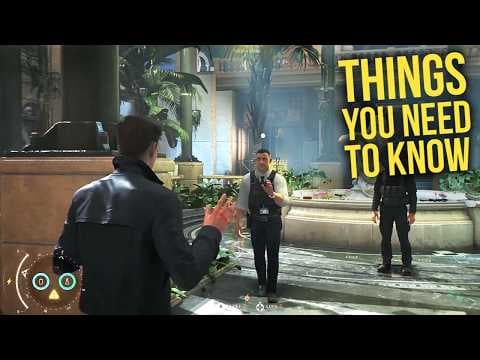
007 First Light - 10 Things You NEED TO KNOW
Audio Summary
AI Summary
007 First Light, the first James Bond game in over a decade, is developed by IO Interactive, known for the Hitman series. This preview covers ten key aspects of the game.
Firstly, it's an origin story, focusing on a young, 26-year-old James Bond early in his career as he's recruited by MI6. The game aims to let players experience Bond's journey into espionage for the first time, making it accessible to newcomers while still including classic Bond elements like cars, fashion, and familiar characters like Moneypenny and Q.
Secondly, the game's structure is a blend of Hitman's open-ended assassination missions and more linear, third-person action-adventure gameplay reminiscent of Uncharted. Missions are divided into distinct, large explorable areas with multiple approaches to objectives, which then funnel into more focused action sequences. An example is a London art museum gala where players can find various ways to bypass guards to reach their objective, such as impersonating a photojournalist or manipulating a guard's schedule. Unlike Hitman, players cannot simply kill everyone and steal their clothes; stealth, pickpocketing, eavesdropping, and dialogue choices are key. The areas are designed to propel the story forward, and the game will need to handle improvisation when things go wrong. It's described as "Hitman-light," featuring stealth and gadgets but without the need to hide bodies or incapacitate and disguise guards.
Thirdly, stealth mechanics are straightforward, with crouching and hiding in tall grass. A core element is Bond's tech-filled watch, functioning like a suite of gadgets. It can activate environmental elements to mask sound or distract enemies, and a built-in laser can temporarily blind guards or be used to damage locks. Using these gadgets consumes a blue power meter, which can be replenished by finding batteries in the environment, often by interacting with electronic devices. A green resource is also present, used for items like poison darts that can incapacitate enemies temporarily, allowing for pickpocketing or escape. Other gadgets mentioned include a pen, lighter, and earbuds.
Fourthly, the game features a bluffing system, utilizing a lightning bolt resource earned through gameplay. This can be used to lure enemies or, more importantly, to talk your way out of suspicious encounters. When an enemy becomes suspicious, the bluff option allows Bond to de-escalate the situation temporarily, preventing immediate detection. The dialogue options in these situations are noted as clever and humorous.
Fifthly, there's a "license to kill" system. Shootouts are reserved for specific moments when there's a direct threat, such as an enemy drawing a gun or during story-driven sequences. This system emphasizes that guns are not to be used indiscriminately, reflecting a more traditional spycraft approach.
Sixthly, third-person shooting combat is described as fluid, with smooth movement, cover mechanics, and vaulting. It feels similar to older-generation cover shooters but is more responsive. Ammo is scarce, encouraging players to move between cover and find new weapons or even throw their current one at enemies. Combat is fast-paced and improvisational, often requiring players to face heavily armed opponents with limited resources, necessitating the use of gadgets and environmental interactions like shooting chandeliers or hacking systems. Multiple difficulty modes are available.
Seventhly, hand-to-hand combat is also improvisational, featuring hits, dodges, and parries. Bond can grab and throw enemies, using them to interact with the environment, such as pushing them into tables or walls. Environmental objects can be used as makeshift weapons. The combat is compared to Uncharted but with more depth and contextual actions.
Eighthly, the game's length is estimated to be around 20 hours, though this is not officially confirmed and may vary based on mission approach and difficulty. Replayability is expected due to the open-ended nature of some missions.
Ninthly, a "Taxim" mode, a tactical simulation mode similar to Hitman's Freelancer mode, will allow players to replay levels with increased challenge modifiers and unlock rewards, notably cosmetics.
Finally, remaining questions include performance on consoles, the extent of driving mechanics (only a linear sequence has been shown), and overall pacing to maintain engagement throughout the game. The game releases on PS5, Xbox Series X/S, and PC on May 27, 2026, with a delayed Switch 2 version coming later in the summer. Multiple editions are available, including a $300 Legacy Edition with a replica golden gun. Pre-ordering any edition grants a deluxe upgrade with exclusive cosmetic items. The video advises caution regarding pre-ordering.