Je donne les PIRES positions à ce 2750 ELO pour voir s’il peut me BATTRE !?
AI Summary
The video features a challenge where the presenter, an International Master with a 2300 Elo rating, attempts to defeat Javokhir Sindarov, a top 5 global player with a 2750 Elo rating, in three chess games. The concept involves playing three matches: a standard game, a game starting with a significant advantage for the presenter, and a game starting with a winning position for the presenter. The goal for Sindarov is to win all games despite these handicaps.
The first match begins with Sindarov playing E4, and the presenter responding with E6, initiating a French Defense. Sindarov plays quickly, with only 3 minutes on the clock for each player and no time increment. The presenter expresses unfamiliarity with some of Sindarov's moves, such as Fou F4, and notes Sindarov's speed. The game progresses with the presenter developing pieces and attempting to castle for king safety. Sindarov's C3 move is noted, and the presenter considers attacking a bishop with KC5. The presenter contemplates castling kingside or queenside, eventually making moves like G5, which he later regrets as it makes his king vulnerable. He finds himself with his king in the center and little time on the clock, believing the position to be a slight advantage for White. Sindarov captures a pawn, and the presenter recaptures. Sindarov plays Dam H5, threatening F3, which would force the knight on E4 to move. The presenter considers F5 to block this, but worries it would weaken his position. He eventually plays F5, which Sindarov responds to by taking en passant. The presenter is unsure whether to recapture with the bishop or the knight. Sindarov plays Dam H6, and the presenter plays Tour G8, feeling the position is unclear and that he might even be able to attack Sindarov's king. With little time left, the presenter plays H F3, then Tour G7, aiming to double rooks on the G-file. Sindarov moves his king. The presenter plays Dam G8, attacking the G2 pawn. Sindarov plays Cavalier F5, which the presenter captures. Sindarov recaptures. The presenter plays Tour F8, noting that Sindarov has an extra pawn but it's not the end of the world. The presenter makes a mistake, allowing Sindarov to play G4, which prevents further attacks. He quickly moves his pieces, but ultimately loses a piece due to a fork.
The second match starts with a significant advantage for the presenter. He feels confident, noting his strong position and Sindarov's passive pieces. He attacks the D5 pawn and believes he is sure to beat the top 5 player. Sindarov appears to be reflecting deeply on the "garbage" position. The presenter considers playing Cavalier E5 to centralize his knight, thinking it's a strong move. Sindarov plays Cavalier F6, potentially aiming for E4. The presenter considers F3 or Fou F3, or B3 to attack the C4 pawn. He questions whether the initial position truly gave White such a large advantage. He plays B3, Sindarov responds with B5, and they exchange pawns. The presenter notes that Sindarov has a dangerous passed pawn on C4. He aims to exchange as many pieces as possible to achieve a draw against the top 5 player. Sindarov takes with the D pawn, surprising the presenter. The presenter attacks the B pawn, which Sindarov defends. The presenter spots a potential move, Cavalier prend C4, believing Sindarov's position is weak. He envisions a sequence where he eliminates the knight on D6 and then captures the bishop on B7. Sindarov takes with his knight, and the presenter realizes he can recapture with Fou prend G2. The computer analysis indicates a preference for Black. The presenter feels he has made Sindarov uncomfortable. Sindarov threatens with K G5, aiming for F3. The presenter dismisses this, believing he is in a good position, but then realizes a fork. He acknowledges he is still in the game due to his dangerous passed pawn. He moves to G6, attacking the D6 bishop. He realizes he will lose a rook and then the D5 pawn, leaving him in a losing position. He concludes he is totally losing.
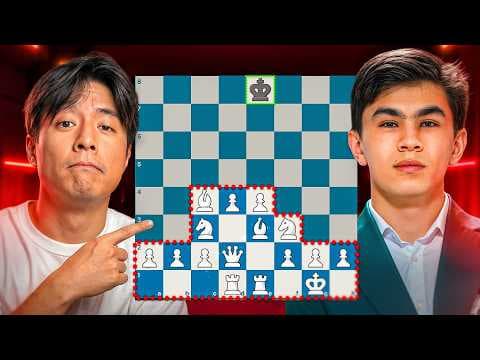
The third and final match begins with a "totally winning" position for the presenter. He has a significant advantage, all pieces developed, and although Sindarov has three extra pawns, his king is in the center, and his position is described as "garbage." The presenter plans to bring his rook to E1 and knights to F4 and F3. He notes Sindarov's deep thought. With an extra minute on the clock, the presenter believes he just needs to convert this winning position. Sindarov plays C6. The presenter considers Cavalier F4, threatening the D5 pawn, or placing his rook in the center. He then makes a critical mistake, forgetting that Sindarov can castle queenside (grand rock). This oversight shocks him, as he believes he was in a winning position and now dislikes his own position. Sindarov attacks his queen, and the presenter activates his queen to A4. Despite being down three pawns, he tries to stay positive. Sindarov plays Tour E6, a seemingly bizarre move where he sacrifices his rook for no apparent reason, allowing the presenter to capture it with his bishop and double Sindarov's pawns. The presenter questions Sindarov's intention, but decides to take the rook, believing he is now winning again. He then struggles to find a clear plan or good squares for his pieces, feeling uneasy. Sindarov plays G3, attacking the knight, which moves to D3. Sindarov's knight is strong. The presenter saves his rook by moving it to E2. He then moves his queen, forgetting to take on G3, calling himself "stupid" and realizing the position is impossible.