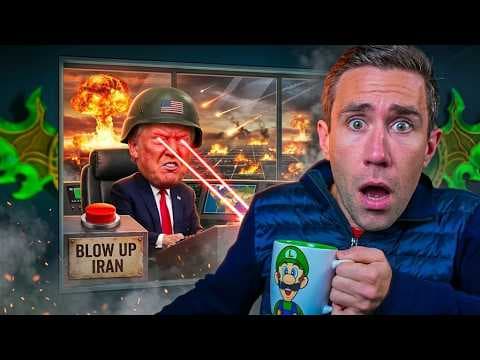
TRUMP IS PISSED: PREPARE FOR TUESDAY
Audio Summary
AI Summary
The financial markets are experiencing a slight downturn, with futures for the Dow, S&P, and NASDAQ all down by about half a percent. This follows reports that the United States fired upon an Iranian ship during a ceasefire, leading to speculation about the stability of the ceasefire and its broader implications. Goldman Sachs, however, is providing insights into significant money flows that investors should be aware of.
The recent incident involved the US Navy enforcing a blockade in the Arabian Sea, not the Strait of Hormuz, as some might assume. An Iranian ship attempted to bypass this blockade and was intercepted. The US Navy contacted the Iranian vessel via radio, instructing the crew to abandon the engine room before firing a 5-inch MK45 cannon at the ship. The intent was not to cause harm to individuals but to disable the ship and send a clear message that the blockade must be respected. This action has been interpreted by some as an escalation, but it aligns with a broader "escalate to de-escalate" strategy.
This event occurs amidst ongoing negotiations with Iran. Donald Trump has stated that if Iran does not agree to a deal, bridges and power plants within the country will be targeted. He emphasizes that the US is offering a "very fair and reasonable deal" and hopes Iran accepts it. Critics, however, point out similarities between the proposed deal and the 2015 Obama deal that Trump previously repudiated, questioning the economic and strategic costs incurred to reach a similar position.
The United Arab Emirates is reportedly considering requesting a preemptive bailout, seeking cheap access to US dollars, in case the situation with Iran deteriorates. This suggests growing concern among regional players about the prolonged instability and its impact on oil and natural gas exports.
Regarding military readiness, the US has utilized a significant number of interceptors, such as Patriot missiles, in the past 40 days. Replacing these could take up to five years. This has led to discussions about potentially converting car factories into missile production facilities, similar to efforts during World War II, to accelerate the manufacturing of munitions and pressure existing defense contractors like Raytheon and Lockheed Martin.
Despite the geopolitical tensions, there have been commercial ships successfully transiting through the Strait of Hormuz, with reports of up to 35 ships passing through over a recent weekend. However, many ships are still making U-turns, suggesting continued apprehension. Some analysts believe that any ceasefire extension would primarily serve as an opportunity for Trump to "reload" or regroup. The Economist views the blockade as an effective economic pressure tool against Iran, though its impact takes time, and there's a concern that Iran might be more patient than the US.
Goldman Sachs' analysis reveals interesting market dynamics. Systematic positioning in US equities has shifted from short to modestly long, though only at the 50th percentile, indicating that even at all-time highs, the market isn't overly extended. NASDAQ positioning remains depressed despite the NASDAQ 100 reaching new highs, suggesting potential for further upside. Emerging markets have already seen a dip that was quickly bought up.
The current market setup is compared to Q1 2025, where "left tail scenarios" (recessions) were removed, leading to an earnings-driven market rally. With earnings season beginning, there's optimism for continued growth. Demand from commodities trading association members has been historically high, and this group also invests in tech stocks. Historically, such demand has led to an average 2% return for the S&P 500 in one month and 8% over three months. Call options are being aggressively bought, indicating a "bid in risk."
Goldman Sachs also notes the ongoing strength of the AI trade. As long as the AI sector continues to perform, the base case is that AI-themed investments will materially outperform over the next one, three, and six months due to stronger-than-expected earnings and revisions. This suggests that hardware companies will benefit first, followed by software as it becomes more attractive due to its relative affordability.
Credit quality remains healthy and stable across commercial and consumer sectors, with consumer spending showing recent acceleration. This positive economic data, combined with the market insights, suggests that while geopolitical events create volatility, the underlying market conditions remain robust. Despite the current red in futures, there are expectations that these dips will be short-lived, presenting buying opportunities.