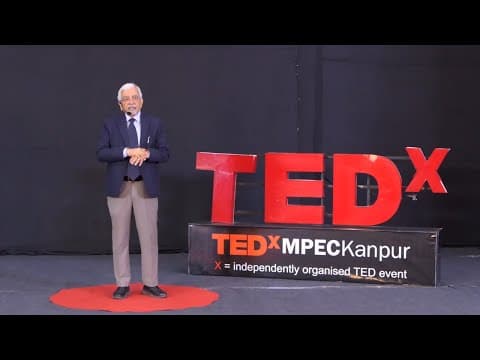
Leadership in the era of disruption | Dr Anil Bajpai | TEDxMPEC Kanpur
Audio Summary
AI Summary
This video discusses leadership in the era of disruptions, framing disruption as a recurring theme throughout history, starting with the story of Adam and Eve and continuing through figures like Isaac Newton and Steve Jobs, each associated with an "apple" that dramatically altered their respective fields. The speaker contrasts past eras of scarcity and slow change, where obtaining a phone could take years, with the current economy of plenty, where instant gratification is expected.
The discussion then delves into the concept of disruption, moving beyond the commonly cited VUCA (Volatility, Uncertainty, Complexity, Ambiguity) model to the even more challenging "BANI" world. BANI stands for Brittle, Anxious, Non-linear, and Incomprehensible. This BANI world, the speaker argues, is significantly worse than VUCA, characterized by unpredictability where simple calculations like "2+2=4" may no longer hold true.
To illustrate the impact of disruption, the speaker recounts the story of Metal Box of India, a once-dominant company that failed to adapt to changing market dynamics and eventually disappeared. This cautionary tale is paralleled with the decline of Nokia, emphasizing how entire industries can vanish due to disruptive forces.
A significant portion of the talk focuses on Generation Z as a distinct and challenging form of disruption. The speaker notes their unique characteristics, such as a disinclination towards traditional classroom settings, examinations, strict discipline, and perhaps a different approach to respecting elders. The speaker shares personal experiences of working with this generation over 15 years, initially finding it difficult to manage.
This personal challenge led the speaker to re-evaluate the traditional hierarchical model of education, where students, who are the primary stakeholders and pay for their education, were often treated with fear or disrespect by educators. The speaker advocates for an inverted pyramid approach, placing students at the top. An anecdote is shared about the speaker's first day as director of a business school in Odisha. Instead of going to their cabin, the speaker went to the canteen and engaged with students directly, asking them where their manners were for not offering tea. This act of direct engagement, followed by six years of providing respect, listening, and allowing freedom, proved highly effective in fostering student growth and development.
This approach is linked to the concept of "backroom support" leadership, inspired by the book "The Trillion Dollar Coach." This type of leader, like Bill Campbell, coaches from behind the scenes, enabling others to succeed without seeking personal fame. The speaker identifies with this role, explaining a career shift from a lucrative corporate CEO position to education with the ambition of nurturing 100 individuals who will surpass them.
The speaker dismisses the notion of a "generation gap" as a misunderstanding, suggesting it's merely the older generation feeling "hurt" when the younger generation, naturally thinking differently due to their era, doesn't conform to older norms. Disruptions, including technological advancements and societal shifts, mean that younger generations like Gen Z and Gen Alpha are inherently different and cannot replicate the experiences of previous generations.
The video broadens the scope of disruption to include global events like geopolitical tensions, wars, and the COVID-19 pandemic, all of which have significant global impacts. It asserts that while the nature of leadership required may change, the ability to lead through disruption remains a human capacity. Modern leaders, according to the speaker, need to evolve from being authoritative figures to becoming better listeners, more compassionate, and prioritizing emotional intelligence (EQ) over intelligence quotient (IQ).
The concept of "Ramraj" from Indian scriptures is invoked as an example of leadership that navigated disruptions, suggesting that even in idealized eras, challenges existed. The speaker emphasizes that we are not just in an era *of* disruptions, but that disruption *is* the era itself, making certainty a luxury.
In conclusion, the speaker reiterates the importance of understanding the VUCA and BANI frameworks in navigating today's world. The core message for leadership in this complex and ever-changing landscape is to pause, reflect on what is permanent versus what is changing, and strategize for survival and success. The talk ends with a thank you for patient listening and a hope that attendees will take valuable insights away.