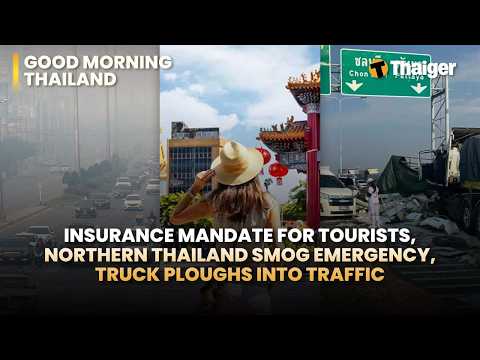
Thailand News: Thailand Tourist Insurance Rule, Smog Crisis and Truck Crash
Audio Summary
AI Summary
Good morning, Thailand. This Tuesday, April 7th, we are heading into Songkran, and I'll be dressing the part all week. Please subscribe to The Thaiger to stay updated on all things Thailand.
Today, we'll discuss a new policy mandating medical coverage for visitors to Thailand, northern provinces being given emergency status due to severe smog, and rainmaking operations to alleviate the problem. We'll also cover a tragic murder-suicide involving an international student and his girlfriend, and a massive pileup caused by an out-of-control truck that injured almost 20 people. In ASEAN news, a Cambodian company has been approved for casino operation despite alleged ties to scam center operations. Later, the Royal Thai Navy has approved the acquisition of a new frigate as maritime concerns continue to mount.
Before we dive in, a word from our sponsor, FazWaz, the number one real estate portal in Thailand. If you're looking to buy, rent, or sell property, visit fazwaz.com.
Also, I've launched my YouTube channel, "A Tourist." You can find the link in the description below. My first episode explored Khao San Road in Bangkok, showcasing its history, culture, and nightlife. Please check it out, like, subscribe, and share. I'll be releasing new videos every Sunday evening, with the next one featuring Pattaya.
I also have comedy shows coming up. Our last Wednesday show at Upper Deck Sports Bar exceeded expectations, with 40-45 people attending. For the next show, I'm bringing in professional comedian Brian Ilward as the headliner, along with other international acts. Entry is free with the purchase of food or drinks. To reserve your table, message me at TripleL Comedy on Instagram. This will be our last show before Songkran, after which we'll resume weekly Wednesday shows.
For Songkran, I'll be in Phuket, participating in Fight Circus and Songkran events. I'll also be hosting a comedy show in Rawai, Phuket, this Saturday, April 11th, at Happy Jack Gastro Bar. John Nutter will also make an appearance. Tickets are 300 baht and can be purchased at the door or reserved by messaging TripleL Comedy. I'm hoping to make more Phuket comedy events happen in the future, so please come support us.
Now, for our first story, which is a significant update for tourists visiting Thailand: mandatory medical coverage will be required for visitors to protect public hospitals from unpaid bills. Thailand is implementing this new policy, requiring all foreign tourists to have valid health insurance before entering the country. This initiative aims to reduce the financial burden on state-owned medical facilities caused by unpaid bills from international travelers. Government officials believe that insured visitors will prevent local taxpayers from subsidizing emergency treatments for foreigners. The plan comes after years of rising debt in the public health sector attributed to uninsured tourists. Authorities are working on specific entry requirements and coverage minimums to streamline the transition. While having travel insurance for international travel is always a good idea, it hasn't been a requirement in Thailand for a long time. The accumulation of unpaid bills in the public health sector has led to this change. It's unclear what happens to those who leave without paying, whether they are barred from returning or if they have to pay the bill upon re-entry. This is a significant change, so if you're planning a trip later this year, stay updated on the policy to avoid being turned away. This is especially important if you're engaging in activities like renting bikes, which carry an element of danger. Always wear your helmets.
Next, the northern provinces have been placed under emergency status due to severe smog. A formal disaster declaration has been issued for northern Thailand as air quality levels have reached hazardous thresholds. The government has officially designated the region an emergency zone to unlock rapid funding and resources for local administrative bodies. Residents face significant health risks as fine particulate matter continues to blanket major cities and rural communities. This legal move allows for more aggressive enforcement of burning bans and the distribution of protective gear to vulnerable populations. Local leaders are urging citizens to remain indoors while the thick haze persists. I'm curious if those in Chiang Mai are seeing any actual actions taken by the local government to mitigate the damage to collective health and quality of life. While the emergency declaration frees up funds, the question remains whether these public funds are being used effectively, as this problem has persisted longer than usual.
Something is being done about it, which leads to our next story: cloud seeding operations are being launched to clear the skies over Chiang Mai. Authorities have dispatched a fleet of specialized aircraft to perform rainmaking missions over northern provinces suffering from toxic air by dispersing salt and chemicals into the atmosphere. The Royal Rain Making Department hopes to trigger downpours that will wash away lingering dust particles. This aerial strategy specifically targets the dense pollution trapped in the valley surrounding Chiang Mai. Experts remain hopeful that artificial precipitation will provide temporary relief for residents struggling with respiratory issues. The operation is a key component of the broader tactical response to this seasonal environmental crisis. If we have the technology, we should use it. Cloud seeding was also part of Beijing's strategy during the 2008 Olympics to address pollution concerns. This kind of technological development, controlling the weather, feels like science fiction. It can be inspiring and hopeful, but also dystopian and depressing. Do you think this strategy will work, or is it a "dog and pony show" to make people feel like something is being done? Let me know in the comments.
Now, a tragic and violent incident involving international students in Pathum Thani has made headlines. A violent incident at a residence resulted in the deaths of a Chinese exchange student and his Thai girlfriend. Investigators report that the man attacked the woman before falling to his death by jumping from a high-rise building. Emergency responders found the female victim with fatal injuries inside their shared apartment. Police are interviewing witnesses and reviewing security footage to reconstruct the events. Cryptic messages written in blood were found inside the apartment, alluding to potential disputes about money, including the phrase "understanding is important, not just money." This devastating event has shocked the local academic community and prompted calls for better mental health support for students. The man was reportedly 30 and the girlfriend 21. He allegedly murdered her, then wrote messages in his own blood on the walls before jumping to his death. The involvement of money in the dispute is unclear but suggests a possible motivation. This crime of passion is preventable. Many relationships are motivated by finances, which can lead to disastrous outcomes. Men are afraid of shame, while women are afraid of being murdered by men, as seen in this horrific situation. The perpetrator chose a cowardly way out instead of facing consequences. As someone in the comments noted, he could have just left her; there were many options to avoid this. Mental health support is crucial, especially in cultures where it's not openly discussed. Hopefully, bringing these situations to light will encourage people to seek help when desperate. If you're feeling overwhelmed or driven to extremes, get out of the situation; there's no need to harm anyone.
Moving on, a massive pileup caused by an out-of-control truck left many injured, though fortunately, no fatalities were reported. A heavy trailer truck crashed into a line of stationary vehicles in Chachoengsao, resulting in 16 people being rushed to nearby hospitals. The collision occurred when the driver allegedly failed to brake, causing a chain reaction that crushed several cars and motorcycles. Rescue teams worked for hours to extract trapped passengers from the wreckage. Witnesses described a chaotic scene as the large vehicle plowed through traffic during the busy morning commute. Law enforcement officers are investigating the truck's mechanical state and the driver's conduct. It's a lot of twisted metal, terrifying stuff. We don't have updates on the conditions of those hospitalized. The big question is whether it was mechanical or driver error. We've seen both: trucks modified illegally to increase economic viability, and drivers under the influence, falling asleep, or using drugs like Yaba, which is common in the transport industry. Answers are needed, and if the company is at fault for pushing employees to meet unrealistic goals, that should be considered, given the lives at risk and forever altered by this traumatizing event. As Tony noted, drivers often use Yaba to stay awake for long hours when coffee and Red Bull don't suffice, raising questions about transport speed expectations. Monitoring truck driver hours, as in the US, could be beneficial. Unfortunately, in Southeast Asia, and even in developing Thailand, corners are still cut.
Now for a more traditional "Tiger story"—a "Foreigners Behaving Badly" bingo card moment. A British man has been apprehended for attempting to export heroin. A traveler from the UK was taken into custody after authorities discovered a stash of heroin hidden in his luggage. The arrest occurred as he attempted to board an international flight from a major Thai airport. Security personnel flagged his bags during a routine screening, leading to the discovery of the prohibited substances. He now faces severe legal penalties under strict local narcotics legislation governing the trafficking of Class 1 drugs. Consular officials have been notified. There were conflicting reports about whether the heroin was found in his luggage or on his person, or if he was apprehended in Australia coming from Bangkok. Regardless, he faces major criminal charges for a kilogram of heroin, which has an astronomical street value and is a highly dangerous drug. The book appears to be thrown at him, no matter where he ends up imprisoned.
Let's move to our ASEAN story, heading to Cambodia, where a controversial casino expansion is proceeding despite ethical concerns. The Cambodian government has moved forward with plans to legalize gambling complexes despite reports of human rights violations at similar sites across the region. Critics argue that the industry is frequently linked to forced labor and human trafficking networks in Southeast Asia. Proponents of the bill focus on potential massive tax revenue and a significant boost to the national tourism sector. Lawmakers are debating regulatory frameworks to prevent criminal elements from infiltrating the new gaming hubs. The decision remains a point of contention between economic strategists and social activists worried about exploitation. It's concerning that some operators with known connections to scam centers, which human traffic people to commit crimes and generate immense wealth, are now seemingly able to buy their way into the lucrative legalized gambling industry. In a country like Cambodia, money talks, and human rights concerns are often sidelined. Amnesty International and others are trying to highlight the eye-popping scale of abuse in Cambodia's scam center operations, making the legal transition of these operations into an often ethically questionable industry like casinos a significant concern.
Finally, back in Thailand, with military news: the Naval Command is moving forward with new warship acquisitions. The Royal Thai Navy has officially greenlit a strategic plan to procure a sophisticated new frigate to modernize its maritime defense. This decision marks a significant step in updating the fleet's capabilities to monitor and protect national territorial waters. The procurement process will involve evaluating international shipbuilders to ensure the vessel meets specific technological and combat requirements. Budgetary allocations have been earmarked after a lengthy review of the military's long-term security needs. Officials emphasize that this investment is essential for maintaining a credible presence and ensuring regional stability. Given global events like the Strait of Hormuz, countries worldwide are emphasizing securing their shipping lanes, as disruptions can destabilize entire economies. It's not surprising to see many countries investing more in naval capabilities to protect sovereign interests, as Thailand appears to be doing. However, I find this frustrating because increased military spending means less money for education, economic development, infrastructure, and healthcare, areas where countries like Germany and Japan (which were restricted from having militaries after WWII and focused on these sectors) have thrived. This direction feels frustrating, but the current political realities seem to justify these moves.
Thank you for joining us on Good Morning Thailand. We'll be back tomorrow and all week until the Songkran holiday. For more news updates, visit thetiger.com or join the conversation at aow.com, Thailand's largest expat forum. Find us on Facebook, TikTok, and Instagram. Please like, subscribe, watch, share, and comment on my new YouTube channel, "A Tourist," to help my algorithmic chances. If you're in Bangkok or Phuket for any of the comedy shows this week, I hope to see you there. Goodbye to our YouTube audience, and hello to our live audience. Please like and subscribe for more Thailand news, and follow us on Instagram, YouTube, or TikTok at The Thaiger.