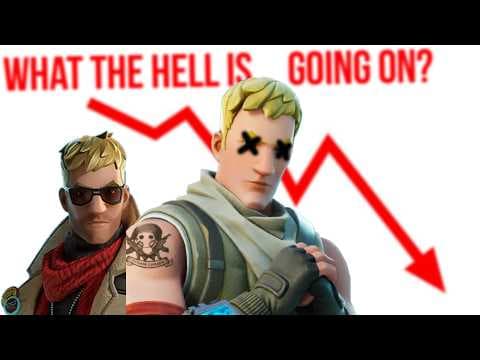
What The HELL Is Going On With FORTNITE?
Audio Summary
AI Summary
The gaming industry is currently in a state of flux, with many companies struggling to adapt. For a long time, Fortnite seemed to be the exception, a constant in a volatile market. Since its Battle Royale mode exploded in popularity in 2018, it has been the gold standard for live-service games, a model that many other companies, like Sony, have tried to emulate with limited success. Fortnite appeared invincible, an untouchable giant.
However, on March 24, 2026, Tim Sweeney of Epic Games announced that over 1,000 developers, or 20% of Epic Games' total workforce, had been laid off. Sweeney attributed this to a downturn in Fortnite engagement that began in 2025, stating that Epic Games was "spending significantly more than we're making" and needed to make "major cuts to keep the company funded." This raises questions, as Fortnite is one of the most lucrative games of all time, reportedly making an estimated $6 billion in 2025 alone. This figure, if accurate, would suggest it was their most successful year, making Sweeney's statement seem contradictory.
The situation surrounding Fortnite is complex. Tim Sweeney, as CEO, has shareholders to consider, so his statements may not always be a straightforward reflection of the company's health. While there's a clear reason for the layoffs, the overall sentiment about Fortnite isn't entirely positive. The question then becomes: is Fortnite genuinely in decline, or is Epic Games simply adjusting its operations?
Fortnite's financial success is undeniable. It has generated an estimated $42 billion in total revenue, making approximately $2.74 million every day. To put this into perspective, Grand Theft Auto V, another massive success, has generated around $9.5 to $10 billion, which is less than a quarter of Fortnite's earnings, despite GTA V launching four years earlier. Even the Call of Duty franchise, with over 20 games spanning decades, has a lifetime revenue of around $30 billion, still significantly less than Fortnite's earnings in under a decade.
From an external perspective, Fortnite seemed to be thriving. In 2024, Disney acquired a $1.5 billion equity stake in Epic Games, and seasonal content has generally received positive coverage. The reported $6 billion revenue in 2025 further reinforces this image of success. However, it's important to note that Epic Games is not a publicly traded company, so these revenue figures are estimates and not officially disclosed, making it challenging to get concrete information.
Despite the apparent success, signs of trouble were emerging. The peak monthly active player count on PlayStation and Xbox consoles dropped by 28% since 2023, indicating a slowly shrinking player base. The average monthly playtime also decreased significantly, from 29 hours per month in 2023 to 15.4 hours in 2025, nearly halving the time players spent in the game.
Beyond Fortnite itself, the Epic Games Store has been an expensive venture, with hundreds of millions invested but only turning a profit because it's the exclusive PC platform for Fortnite. Legal battles with Google and Apple, though ultimately successful for Epic, cost over a billion dollars. This isn't the first time Epic has laid off staff; a significant number were let go in 2023 for similar reasons. Weeks before the recent layoffs, Epic also announced a price increase for V-Bucks, Fortnite's in-game currency, citing increased operating costs. This decision, coming from a company reportedly making billions, struck many players as a "money grubbing" move, further eroding confidence.
The perception of Fortnite began to shift in 2025, which saw intermittent seasons and a lack of exciting new content. Live-service games rely on consistent engagement, and once the "spell breaks" and the fear of missing out (FOMO) dissipates, players can easily move on. While Fortnite is still fundamentally the same game, player confidence has been chipped away by a series of smaller issues, such as lackluster season passes, V-Bucks price changes, and unengaging new modes. The game likely reached its saturation point years ago, meaning that as players leave, there aren't enough new ones to replace them.
While Fortnite continues to generate substantial revenue, the cost of doing business appears to be high and increasing. Epic Games has been channeling significant funds into its creator ecosystem. In 2024, Epic distributed $352 million to creators through its Creative Mode, an 11% increase from 2023, with even larger payouts projected for 2026. This strategy, where creators earn money based on player engagement with their creations, is central to Epic's new direction.
A major factor influencing Fortnite's current trajectory is the rise of Roblox. In 2025, a single Roblox game, "Grow a Garden," reportedly had more concurrent users (16.4 million) than Fortnite ever has. Roblox players spent over 10 billion hours per month on the platform in 2025, compared to under 1 billion in Fortnite. Roblox's daily active user count grew 69% in 2025, with 44% of its active users being under 17—a demographic Epic Games clearly targets.
Roblox, despite its popularity, is often criticized for its exploitative nature and for prioritizing wealth extraction from "clueless parents" over creating genuinely fun games. Its core design is centered around user-generated content and in-platform transactions. Epic Games, seeing Roblox's success with this model, began its "Robloxification" of Fortnite in 2023 with the "island creator program," allowing players to earn money based on engagement with their custom islands. In early 2025, Fortnite further implemented "in-island transactions," where microtransactions purchased with V-Bucks are only compatible with specific islands, mirroring Roblox's monetization strategy.
Epic Games is offering creators an enticing deal: through December 31, 2026, 74% of in-game sales will go to creators, almost 50% more than what Roblox offers. This represents hundreds of millions of dollars in lost revenue for Epic, but it's a strategic move to attract creators and grow market share, similar to how the Epic Games Store offered better revenue splits to compete with Steam.
This shift indicates that Epic Games wants to move away from being a "virtual theme park" business, where it develops all the content, to an "absentee landlord" model, where it owns the platform and collects revenue from user-generated content. This strategy, while potentially profitable, is not without risks. Roblox, despite its massive user base, has never posted a profit, operating in a startup mindset that could lead to ballooning expenses.
If Fortnite's focus shifts from internally developed game modes to creator-made content, Epic Games would require a smaller internal headcount. This transition is already evident, with game modes like Rocket Racing, Festival Battle Stage, and Ballistic being removed entirely.
The current state of Fortnite's creative ecosystem is concerning. The "Discover" tab, meant to showcase user-generated content, is described as a "sea of pure strain horseshit," filled with low-quality, cynical games designed primarily to extract money. While the tools are still relatively new and limited, the overall experience is far from the quality seen in other user-generated content platforms like LittleBigPlanet or Mario Maker, which are driven by passion rather than monetary incentive.
While some of Fortnite's new modes, like Battle Stage, were genuinely fun, and the Battle Royale mode remains largely the same, the game is becoming stale. The move towards a Roblox-like model appears to be a desperation move as much as a calculated business decision. Fortnite is still wildly successful by many metrics, but its current direction, driven by the desire to emulate Roblox, could be a disastrous miscalculation. Epic Games is in a precarious position, simultaneously experiencing unprecedented success and facing significant challenges. While Fortnite may not collapse entirely in 2026, its current trajectory suggests a potential decline.