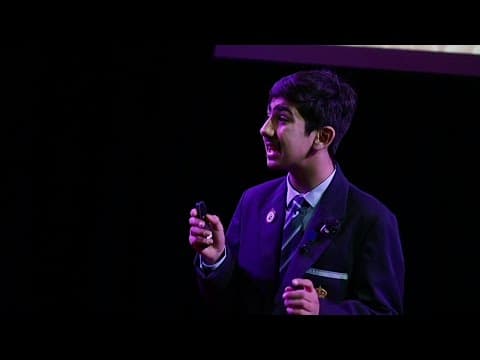
The Unknown Originator of The Atom | Kabir Chadha | TEDxQESB Youth
Audio Summary
AI Summary
Imagine breaking a grain of rice repeatedly. This simple act leads to a profound question: can we divide matter infinitely? While modern atomic theory is often attributed to European scientists like Dalton, the earliest systematic atomistic ideas originated in India with the philosopher Kanada, nearly 2,500 years ago.
Kanada, whose life details are uncertain, outlined his theories in the Sanskrit text "Vaisheshika Sutra," meaning "particularity or distinction." His concept of indivisible particles, which he called "anu" (atom) and "pananu" (subatomic particle), remarkably predates later scientific discoveries. He believed these particles could combine in various ways to form all matter, differing in type and quantity, a notion strikingly similar to our understanding of atoms and elements.
His "Vaisheshika Sutra" identifies nine parts of reality, including the four classical elements (earth, water, fire, air) that constitute matter, and concepts like mind, direction, time, space, and an infinite source. Kanada also described six properties of matter: substance, quality, activity, generality, particularity, and influence, explaining differing object behaviors. He recognized heat as a primary cause of change, aligning with modern understanding of chemical reactions.
Furthermore, Kanada explored ideas of motion and cause and effect, evident in a sutra often translated as "action is opposed by its effects," hinting at principles later seen in Newton's laws. He even touched upon concepts related to gravity, using the term "tattva" for heaviness. Kanada also linked the soul ("atman") to actions ("karma"), suggesting that inner states influence outward behavior. His philosophy, which influenced religions like Buddhism and Judaism, proposed achieving enlightenment without divine guidance. He founded the Vaisheshika school, integrating science, religion, and philosophy.
Kanada's story highlights that scientific inquiry is a global endeavor, with significant ideas often stemming from simple observations and fundamental questions about the nature of reality.