Crossing Vietnam Border to Cambodia 🇻🇳🇰🇭 Here's How
Audio Summary
AI Summary
The speaker embarks on a Vietnam-Cambodia visa run, a necessary trip due to a delay in processing his re-entry e-visa for Vietnam. Having previously held a TRC (Temporary Residence Card) due to working and getting married in Vietnam, this is his first time undertaking a visa run. The online visa system recently switched, and he and his wife missed the application deadline.
He booked a one-way bus ticket to Phnom Penh, Cambodia, for $28 through a company found on Zalo, a popular messaging app. He also pre-booked a hotel for the night in Phnom Penh and applied for his 90-day single-entry e-visa for Vietnam, which cost $25 and was post-dated for approval the following day after exiting the country. He expresses some apprehension about the approval process but anticipates an adventurous trip.
Before the journey, he stops at a Circle K to buy water, cashews, and a banana. He notes the relative affordability of items in Vietnam, with a liter of water costing about 60 cents. The bus ride is expected to take two hours to the Cambodian border, followed by another three to four hours to Phnom Penh.
The bus departs 29 minutes early, and the speaker notes the comfortable facilities, including leather seats and Wi-Fi. The bus company claims that assistance with the visa-on-arrival process at the Cambodian border is included in the ticket price, which surprises him given the typical cost of a visa.
The exit from Vietnam is quick and easy, with passengers simply walking through a gate without much interaction. The border guards collect passports and then return them stamped out.
He mentions the difficulty of obtaining USD cash in Vietnam from a Vietnamese bank account, a process that took him almost an hour due to documentation requirements and currency controls. He had to withdraw Vietnamese Dong and then purchase US dollars, requiring numerous signatures and showing travel documents.
Upon reaching the Cambodian side, he is excited to see the country, noting that his last visit five years prior showed significant modernization and gentrification in Phnom Penh. He expresses curiosity about how the city has developed further, particularly its appeal to retirees and expats.
The visa-on-arrival process at the Cambodian border is straightforward. He presents his passport and pays $30 in USD for a 30-day entry visa. He is impressed by the fluency of the English spoken by the border agent. He observes that the process is significantly easier than the challenges he faced with his Vietnamese visa renewal, prompting him to humorously question his previous opinions about the ease of living in Vietnam. He notes that biometric scans (thumbprints and face photos) were taken, which was new compared to his previous border crossings.
He describes the visa run as surprisingly enjoyable, initially feeling apprehensive but becoming excited once crossing into Cambodia. He looks forward to exploring Phnom Penh, even if only for 24 hours, and considering options for his return, including potentially flying back to Ho Chi Minh City from Phnom Penh's new airport.
During a stop at a gas station in Cambodia, he observes modern and well-decorated facilities, contrasting them with the Vietnamese side. He also notices the presence of Chinese casinos and gaming centers, a trend he recalled from his previous land border crossing. He purchases a local Cambodian beer, Hanuman lager, and tries fried crickets for 5,000 rial (about $1.25), finding them crunchy and good.
While on the bus, he receives an email confirming his Vietnamese e-visa has been accepted. He explains that the total cost for the visa run, including the Cambodian visa, bus tickets, and Vietnamese e-visa, is around $80. He believes this is a more enjoyable way to handle a visa run than simply turning around at the border, preferring to spend a night traveling and exploring.
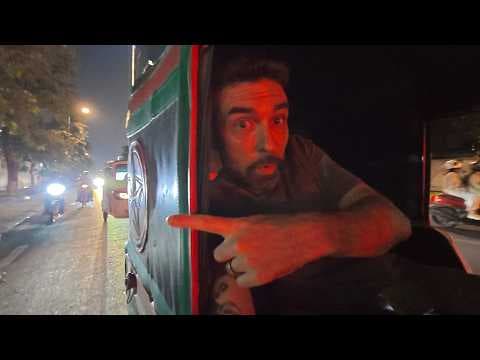
Upon arriving in Phnom Penh, he notes the city's modern and flashy appearance, with large developments like Niagara World and Shangri-La. He attempts to use the Grab app to call a tuk-tuk but makes a mistake with the destination, resulting in a slightly confusing ride. He finds the tuk-tuk experience less safe and more rickety than motorbikes in Vietnam.
His hotel, Vacation Boutique Hotel, costs $20 and is located on the fourth floor with no elevator, which he finds challenging after a long day of travel. The room is simple but adequate for the price, offering a view of the city, AC, and basic amenities.
The next day, he heads to the new Tecmo International Airport in Phnom Penh, describing it as absolutely massive and stunning, resembling airports in Dubai or Shanghai. He notes its modern design, amenities like Starbucks and Burger King, and its ambitious scale, built to function for decades and accommodate hundreds of millions of tourists. Despite its grandeur, he observes local touches like babies crawling on the floor and children playing without supervision.
He experiences a slight delay at immigration due to facial recognition issues, possibly because of a recent haircut. He advises future travelers to get food and drink before security, as options are limited post-check-in.
He reflects positively on his short trip to Cambodia, appreciating its development and friendly atmosphere. He contrasts it with the Ho Chi Minh City airport, which he describes as a "disaster zone." He boards a small Air Cambodia prop plane, taking a bus from the terminal to the aircraft, a paradox given the airport's modern scale.
Upon landing back in Ho Chi Minh City, he anticipates a quick immigration process to get his 90-day stamp, concluding his visa run. He expresses satisfaction with the journey, hoping it provided useful information for others needing to undertake a similar process to live and enjoy Vietnam.