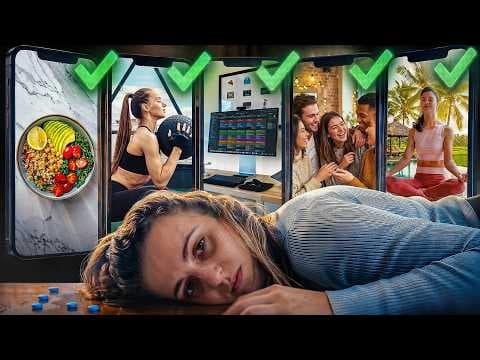
« Deviens la MEILLEURE version de toi » : L'ARNAQUE qui nous détruit
AI Summary
The pervasive culture of hyper-optimization, driven by social media and self-help content, encourages individuals to meticulously track and improve every aspect of their lives, from sleep and exercise to diet, relationships, and even parenting. This constant pursuit of perfection, framed as becoming "1% better every day" or "the best version of oneself," suggests that every minute must be optimized and no time wasted, treating time as a capital to be maximized. While the desire for self-improvement is inherently human, this relentless pressure is paradoxically leading to alarming rates of anxiety, psychological distress, and burnout, particularly among those who strive to do everything "right."
The language used in society has shifted, with terms like "optimizing recovery" replacing "resting," and "increasing physical expenditure" instead of "doing sports." This subtle change reflects a deeper societal shift where the cult of performance has expanded beyond work to encompass all facets of daily life. For instance, running is no longer just for clearing one's head; it requires optimal heart rates and performance tracking. Eating is not just about balance; it involves weighing food and counting macros. Relationships demand constant performance, expressing needs without accusation, active listening, and ambitious shared projects. Parenting extends beyond being "good" to mastering neurosciences and positive discipline to maximize a child's potential. Even maintaining a social life and a tidy home are framed as tasks to be optimized for personal objectives. This creates an expectation of being perfect in all domains, a "complete package" that, if not achieved, implies failure.
The solution often proposed for managing these demands is increased productivity. Advice on productivity is ubiquitous, often suggesting that failure stems from a lack of organization. Methods are sold like instruction manuals, advocating for minutely planned days, time blocking, and intense concentration to achieve "exceptional results." This approach is frequently justified with scientific-sounding vocabulary like dopamine, neuroscience, and biohacking, treating life as a machine to be configured for maximum output. In this paradigm, distractions are considered the enemy, and even free time must be productive – reading for learning, walking for mental clarity. Anxiety itself is reframed as a positive force for performance.
This injunction to hyper-productivity is evident in figures like top YouTuber Mr. Beast, who works almost to burnout, and in trends like "lock-in" or "Winter Arc," which encourage individuals to isolate themselves and cut off from all social interaction and leisure to obsessively pursue goals, often at the expense of sleep and well-being. These narratives increasingly target young people, glorifying overwork and teaching students to endure 12-hour study sessions.
New technologies like smartwatches and tracking apps further fuel this culture by providing data on sleep, activity, heart rate, and mood. While seemingly beneficial, these tools often serve to compare personal data against norms or arbitrary objectives, gamifying life and creating a constant drive for improvement. This can lead to anxiety, as individuals may feel tired simply because their device reports a low sleep score, overriding their actual physical sensation. The pursuit of these metrics often lacks a satisfying endpoint; there's always a margin for improvement. The origin of some widely accepted norms, like the 10,000 steps per day goal, is revealed to be rooted in 1960s Japanese marketing rather than scientific consensus.
This relentless pursuit of "more" can transform beneficial activities into toxic ones, leading to a conditional self-respect tied to achieving goals. This can result in performance anxiety, where the pressure to perform actually diminishes performance, creating a vicious cycle. Performance culture has contributed to generations plagued by anxiety and depression, with stress becoming a chronic state rather than an occasional episode. This phenomenon, known as "socially prescribed perfectionism," is the belief that others expect perfection, driving individuals to constantly strive for it. Studies show a significant increase in this perfectionism among students since the 1990s, starting at increasingly younger ages, as parents' expectations rise. Children may internalize the idea that their worth or love is conditional on their performance, leading to performance anxiety from as early as 3-4 years old.
Despite these negative consequences, society often encourages individuals to push through warning signs of fatigue or stress, valuing being "busy" as a status symbol. This can lead to a sense of detachment or "autopilot," eventually culminating in burnout. Burnout is no longer solely tied to professional activity; there is also parental, relational, and existential burnout, where life itself becomes a field of demands. This exhaustion, rather than being an accident, becomes inevitable under constant performance pressure, yet it's often perceived as a personal failing rather than a systemic issue. The proposed solutions often focus on treating symptoms with quick fixes like productivity coaching or optimized meditation, without addressing the underlying societal pressure.
The root of this performance logic can be traced back to the industrial revolution and practices like Taylorism and Fordism, which aimed to optimize factory production by breaking down tasks into micro-gestures and eliminating wasted time. Initially confined to the factory, this logic gradually infiltrated personal lives with the rise of knowledge work. As work became less physical and more cognitive, the challenge shifted from forcing workers to perform physical tasks to motivating them to think creatively and be emotionally invested. The solution was to internalize the optimization, making self-improvement a personal project. Philosopher Byung-Chul Han notes the shift from a "you must" society to a "you can" society, which, while seemingly empowering, transforms external pressure into self-exploitation. Individuals become their own managers, their own "human capital" to be developed and maximized.
This internal pressure is relentless, as "time is money" and every minute is an investment or a loss. However, the reality is that time is a zero-sum game; maximizing one area means sacrificing another. The popular phrase "become the best version of yourself" becomes insidious because it implies an insufficiency in one's current state and presents an unattainable ideal, as the goal constantly shifts. This leads to a perpetual race where the finish line recedes.
This constant striving fuels a self-development industry that profits from making individuals feel imperfect and offering solutions for improvement. However, personal difficulties are often rooted in broader environmental factors, social pressure, and economic constraints, not just individual habits. Social media creates an illusion that everyone else is succeeding, contributing to survivor bias. This drive for control, while understandable in a risk-averse society, clashes with the unpredictable nature of life.
Alternative approaches include "slow living," which advocates for intentionally slowing down, reducing objectives, and prioritizing rest and presence. However, this is not universally accessible and can itself become another form of performance. A more nuanced approach is "decentering productivity," which means valuing activities not tied to a specific productive goal and recognizing that a day can be successful even without achieving all tasks or producing anything.
The aim is not to stop progressing but to question the *why* behind improvement. Is it genuine desire or societal pressure? Reinstating the "right to be average" is also crucial, as striving for excellence in all areas is impossible and accepting mediocrity in some aspects is a normal human condition. Taking distance from tracking tools can also be liberating, allowing for activities like running without a watch or cooking without counting calories, simply for the sake of the experience. The human brain needs boredom, free moments, and daydreaming. Ultimately, the most important question may not be "how to become the best version of myself," but "how do I truly want to live?"